|
Location:
|
Durkee, Oregon
|
Accident Number:
|
WPR25LA034
|
|
Date & Time:
|
November 7, 2024, 08:37 Local
|
Registration:
|
N4361R
|
|
Aircraft:
|
ROBINSON HELICOPTER
|
Aircraft Damage:
|
Substantial
|
|
COMPANY R44 II
|
|
|
|
|
|
Defining Event:
|
External load event (Rotorcraft)
|
Injuries:
|
1 None
|
|
Flight Conducted Under:
|
Part 133: Rotorcraft ext. load
|
|
|
Analysis
The pilot of the helicopter was using a 50-ft long line to transport equipment to a camp site. He estimated the gross weight of the helicopter to be about 2,450 lbs, the elevation to be about 5,300 ft mean sea level (msl), and the temperature to be about -1°C, for a density altitude of about 4,500 ft. After picking up the load from a staging area and conducting multiple power checks, he determined the conditions were acceptable. While transitioning to a hover out-of-ground-effect (OGE), about 60 ft above ground level (agl), the engine and rotor speed began to decay, and the helicopter lost lift and began descending. The pilot released the load and entered an autorotation. During the landing on sloping terrain, the main rotor blades impacted a tree, the right skid contacted the ground, and the helicopter rolled onto its side, which substantially damaged the fuselage, empennage, and tail cone.
Examination of the helicopter revealed no preaccident mechanical malfunctions or failures that would have precluded normal operation. Examination of the main rotor blades revealed excessive upward coning, consistent with low rotor speed and the whooshing sound reported by the pilot. A test run of the engine revealed no anomalies. The individual who loaded the equipment stated that they normally weighed the loads; however, they did not do so on this occasion.
Performance calculations revealed that, given the environmental conditions at the accident site around the accident time, the helicopter would have been marginally capable of an OGE hover at 2,450 lbs. The pilot conducted multiple power checks and assessed the conditions as acceptable; however, once the pilot transitioned the helicopter to an OGE hover with the external load, the power required to hover OGE likely exceeded the available engine power. Given the fact that the engine test run revealed no anomalies, the density altitude, the weight of the cargo, or both were likely higher than the pilot estimated, which would have reduced the helicopter’s OGE hover performance.
Probable Cause and Findings
The National Transportation Safety Board determines the probable cause(s) of this accident to be: The pilot's inadequate performance planning, which resulted in insufficient engine power to transition into an out-of-ground-effect hover at a high gross weight.
Findings
Personnel issues Performance calculations - Pilot
Personnel issues Incorrect action performance - Pilot
Aircraft Maximum weight - Capability exceeded
Aircraft Altitude - Attain/maintain not possible
Factual Information
History of Flight
Maneuvering-hover External load event (Rotorcraft) (Defining event)
Maneuvering-hover Off-field or emergency landing
Landing-flare/touchdown Hard landing
On November 7, 2024, about 0837 Pacific standard time, a Robinson Helicopter Company R44 II, N4361R, was substantially damaged when it was involved in an accident near Durkee, Oregon. The pilot was not injured. The helicopter was operated as a Title 14 Code of Federal Regulations Part 133 external load flight.
The pilot reported that, after picking up the first sling load from a staging area using a 50-ft long line, he conducted a power check that “was fine.” He then departed for the mountain camp site. Upon arrival, he approached slowly to reassess power and wind conditions and determined that all checks were normal. He proceeded to the drop-off site in a slow walking pace with about a 5-ft-per-minute rate of descent. The pilot had his head out of the cockpit watching the load when he realized that “the helicopter was losing considerable lift,” accompanied by the sound of the blades whooshing. He did not hear the low rotor rpm horn, but it was obvious to him that the helicopter was not performing as expected. He immediately released the load and entered an autorotation. He saw the two ground members run to the center of the clearing, so he maneuvered to the only feasible landing spot, a sloped area between juniper trees.Before touchdown, the main rotor blades struck a tree, the right skid contacted the ground, and the helicopter rolled onto its right side, which resulted in substantial damage to the fuselage, tail cone, empennage, and the main rotor assembly. The pilot exited the helicopter with the assistance of one of the two witnesses.
According to two hunters located at the drop site, when they heard the helicopter approaching, they walked to the drop-off site. One hunter reported that, when the helicopter approached the drop-off site, nothing appeared different than what he had seen on previous hunts with helicopter support from the same company. He said the net came down slowly at first until about 10 ft above the ground, then fast enough to be alarming. The other hunter reported that the helicopter was supposed to hover while they removed items from the net. He looked up and saw that the net was coming down fast. Both hunters saw the shackle from underneath the helicopter falling as the long line was released from the helicopter, and ran from the falling net. Only one hunter saw the helicopter slowly descend and hit the hillside.
According to a hunter at the trailhead, they had split the gear into two loads. In the past they weighed the gear, but this time they estimated the weight. The first load consisted of coolers, drinks, a stove, a chainsaw, and propane. The hunter recalled that when the pilot lifted the first load, he could not take off. He landed and they removed some of the gear. The pilot then lifted the load and departed. The hunter learned later that the helicopter had crashed. According to the two hunters that were at the drop site, they try to keep the loads less than 600 lbs.
The pilot estimated that the accident site was located about 5,300 ft mean sea level (msl). The density altitude at the time was about 4,500 ft, the wind was about 3 knots “off the nose” of the helicopter, and the temperature was about -1°C. The terrain in the vicinity of the accident was hilly and uneven.
Baker City Municipal Airport (BKE) Baker, Oregon, about 26 miles northwest of the accident site at an elevation of 3,373 ft msl, reported weather as wind calm, visibility 10 statute miles, visibility clear, temperature 1°C, dew point temperature -4°C, with a barometric pressure of 30.39 inches of mercury around the time of the accident.
Postaccident examination of the helicopter revealed a fractured windscreen, damage to the left side of the fuselage, large dents and tears to the sheet metal underneath the left side rear door, and bent framework. The tail cone exhibited bending and large dents to the sheet metal and bent structural metal under the skin. The empennage exhibited substantial damage to the lower vertical and horizontal stabilizers. The two main rotor blades exhibited large upward bending signatures along with chordwise creases, consistent with excessive upward coning.
Examination of the engine revealed dents to the exhaust system, normal appearance of the spark plugs, and oil pooled in the fuel servo venturi, but no damage that would preclude a test run. Test runs of the engine resulted in normal operation at a higher-than-idle speed that was attributed to damage interference with the throttle assembly. A check of the magnetos revealed normal engine speed reductions that could not be quantified due to an inoperative engine tachometer. The examination and test run identified no preaccident mechanical malfunctions or failures that would have precluded normal operation.
The pilot estimated the weight of the helicopter at the time of the accident to be about 2,450 lbs, 50 lbs less than its maximum gross weight. Performance calculations revealed that, at 2,450 lbs, along with the estimated environmental conditions of the accident site, the helicopter was capable of a hover OGE up to 5,800 ft msl. The helicopter’s chart for hover OGE performance also showed that engine performance is reduced at gross weights above 2,480 lbs. The chart showed that a helicopter that, at 2,500 lbs gross weight under the same environmental conditions, the helicopter could hover OGE up to 5,300 ft msl (see figure 1).
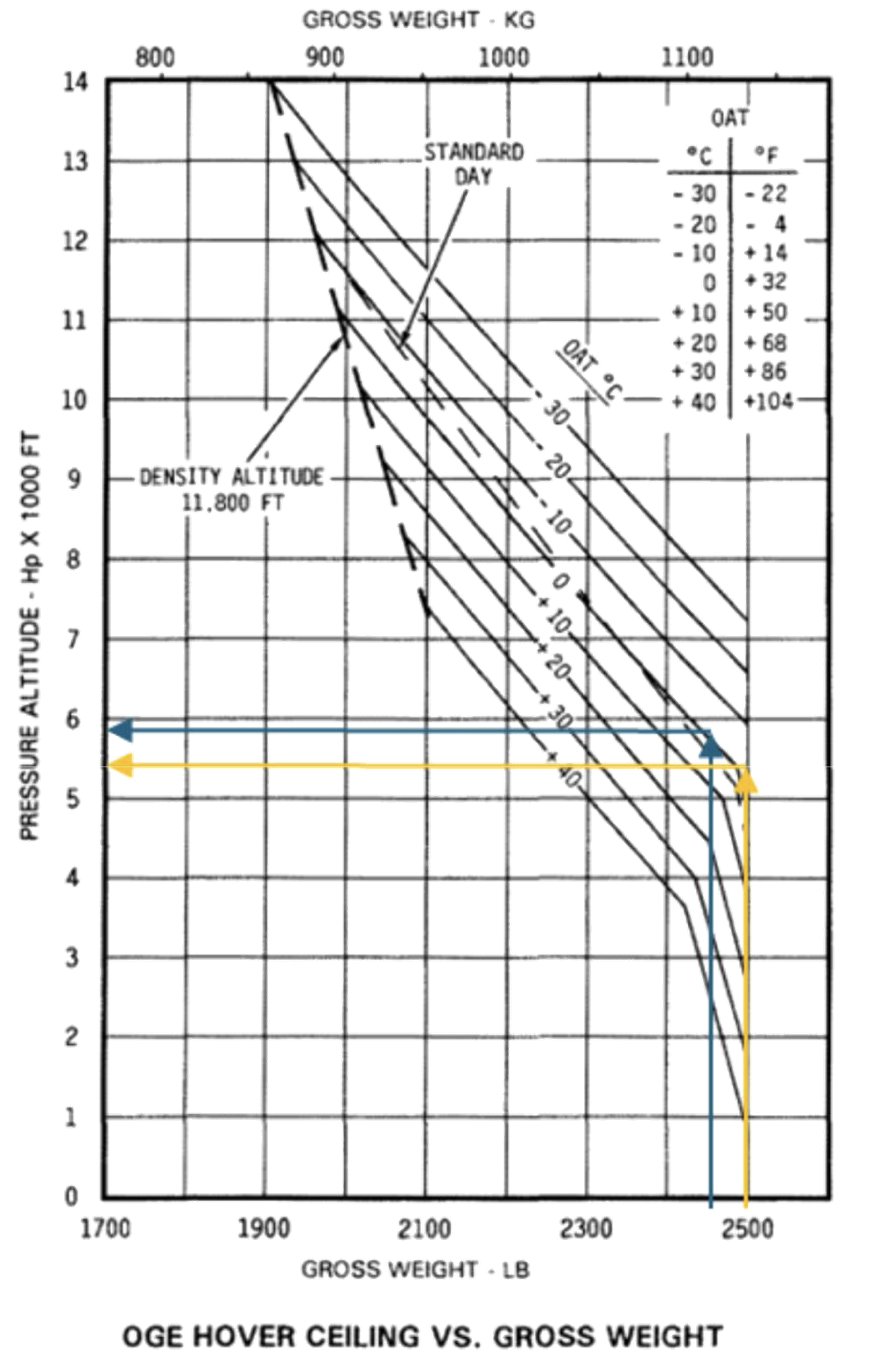
Figure 1. Out of ground effect hover chart for the R44 II helicopter, showing OGE hover capability for 2,450 pounds (blue arrows) and 2,500 pounds (orange arrows).
According to the Federal Aviation Administration’s Helicopter Flying Handbook (FAA-H-8083-21B), an OGE hover is defined as “Hovering a distance greater than one disk diameter above the surface. Because induced drag is greater while hovering out of ground effect, it takes more power to achieve a hover out of ground effect.”
According to the R44 II Pilot’s Operating Handbook, the main rotor diameter is 33 ft.
Pilot Information
|
Certificate:
|
Commercial
|
Age:
|
40,Male
|
|
Airplane Rating(s):
|
Single-engine land
|
Seat Occupied:
|
Right
|
|
Other Aircraft Rating(s):
|
Helicopter
|
Restraint Used:
|
4-point
|
|
Instrument Rating(s):
|
Airplane; Helicopter
|
Second Pilot Present:
|
|
|
Instructor Rating(s):
|
None
|
Toxicology Performed:
|
|
|
Medical Certification:
|
Class 2 Without
|
Last FAA Medical Exam:
|
October 3, 2024
|
|
|
waivers/limitations
|
|
|
|
Occupational Pilot:
|
Yes
|
Last Flight Review or Equivalent:
|
October 9, 2024
|
|
Flight Time:
|
2870 hours (Total, all aircraft), 43 hours (Total, this make and model), 2800 hours (Pilot In
|
|
|
Command, all aircraft), 84 hours (Last 90 days, all aircraft), 34 hours (Last 30 days, all aircraft)
|
Aircraft and Owner/Operator Information
|
Aircraft Make:
|
ROBINSON HELICOPTER
|
Registration:
|
N4361R
|
|
|
COMPANY
|
|
|
|
Model/Series:
|
R44 II
|
Aircraft Category:
|
Helicopter
|
|
Year of Manufacture:
|
2009
|
Amateur Built:
|
|
|
Airworthiness Certificate:
|
Normal; Utility
|
Serial Number:
|
12816
|
|
Landing Gear Type:
|
Skid
|
Seats:
|
4
|
|
Date/Type of Last
|
October 21, 2024 100 hour
|
Certified Max Gross Wt.:
|
2500 lbs
|
|
Inspection:
|
|
|
|
|
Time Since Last Inspection:
|
|
Engines:
|
1 Reciprocating
|
|
Airframe Total Time:
|
3491 Hrs as of last inspection
|
Engine Manufacturer:
|
Lycoming
|
|
ELT:
|
C126 installed, not activated
|
Engine Model/Series:
|
IO-540-AE1A5
|
|
Registered Owner:
|
ELKHORN AVIATION INC
|
Rated Power:
|
260 Horsepower
|
|
Operator:
|
ELKHORN AVIATION INC
|
Operating Certificate(s)
|
Rotorcraft external load
|
|
|
|
Held:
|
(133), Commuter air carrier
|
|
|
|
|
(135), Agricultural aircraft
|
|
|
|
|
(137)
|
|
Operator Does Business As:
|
Baker Aircraft
|
Operator Designator Code:
|
|
Meteorological Information and Flight Plan
|
Conditions at Accident Site:
|
Visual (VMC)
|
Condition of Light:
|
Day
|
|
Observation Facility, Elevation:
|
KBKE,3363 ft msl
|
Distance from Accident Site:
|
23 Nautical Miles
|
|
Observation Time:
|
08:53 Local
|
Direction from Accident Site:
|
298°
|
|
Lowest Cloud Condition:
|
Clear
|
Visibility
|
10 miles
|
|
Lowest Ceiling:
|
None
|
Visibility (RVR):
|
|
|
Wind Speed/Gusts:
|
/
|
Turbulence Type
|
None / None
|
|
|
|
Forecast/Actual:
|
|
|
Wind Direction:
|
|
Turbulence Severity
|
N/A / N/A
|
|
|
|
Forecast/Actual:
|
|
|
Altimeter Setting:
|
30.39 inches Hg
|
Temperature/Dew Point:
|
1°C / -4°C
|
|
Precipitation and Obscuration:
|
No Obscuration; No Precipitation
|
|
|
Departure Point:
|
Baker City, OR (BKE)
|
Type of Flight Plan Filed:
|
Company VFR
|
|
Destination:
|
Durkee, OR
|
Type of Clearance:
|
None
|
|
Departure Time:
|
07:50 Local
|
Type of Airspace:
|
Class G
|
Wreckage and Impact Information
|
Crew Injuries:
|
1 None
|
Aircraft Damage:
|
Substantial
|
|
Passenger
|
N/A
|
Aircraft Fire:
|
None
|
|
Injuries:
|
|
|
|
|
Ground Injuries:
|
|
Aircraft Explosion:
|
None
|
|
Total Injuries:
|
1 None
|
Latitude,
|
44.665687,-117.32766
|
|
|
|
Longitude:
|
|
Administrative Information
|
Investigator In Charge (IIC):
|
Salazar, Fabian
|
|
Additional Participating
|
Nathan Gale; Federal Aviation Administration; Portland, OR
|
|
Persons:
|
|
|
|
Original Publish Date:
|
December 10, 2025
|
|
Last Revision Date:
|
|
|
|
Investigation Class:
|
Class 3
|
|
Note:
|
The NTSB did not travel to the scene of this accident.
|
|
Investigation Docket:
|
https://data.ntsb.gov/Docket?ProjectID=195470
|
|
|
|
|
The National Transportation Safety Board (NTSB) is an independent federal agency charged by Congress with investigating every civil aviation accident in the United States and significant events in other modes of transportation— railroad, transit, highway, marine, pipeline, and commercial space. We determine the probable causes of the accidents and events we investigate, and issue safety recommendations aimed at preventing future occurrences. In addition, we conduct transportation safety research studies and offer information and other assistance to family members and survivors for each accident or event we investigate. We also serve as the appellate authority for enforcement actions involving aviation and mariner certificates issued by the Federal Aviation Administration (FAA) and US Coast Guard, and we adjudicate appeals of civil penalty actions taken by the FAA.
The NTSB does not assign fault or blame for an accident or incident; rather, as specified by NTSB regulation, “accident/incident investigations are fact-finding proceedings with no formal issues and no adverse parties … and are not conducted for the purpose of determining the rights or liabilities of any person” (Title 49 Code of Federal Regulations section 831.4). Assignment of fault or legal liability is not relevant to the NTSB’s statutory mission to improve transportation safety by investigating accidents and incidents and issuing safety recommendations. In addition, statutory language prohibits the admission into evidence or use of any part of an NTSB report related to an accident in a civil action for damages resulting from a matter mentioned in the report (Title 49 United States Code section 1154(b)). A factual report that may be admissible under 49 United States Code section 1154(b) is available here.
READ MORE ROTOR PRO: https://justhelicopters.com/Magazine
WATCH ROTOR PRO YOUTUBE CHANNEL: https://buff.ly/3Md0T3y
You can also find us on
Instagram - https://www.instagram.com/rotorpro1
Facebook - https://www.facebook.com/rotorpro1
Twitter - https://twitter.com/justhelicopters
LinkedIn - https://www.linkedin.com/company/rotorpro