|
Nov
16
2026
|
|
Posted 6 hours ago ago by Admin
|
|
VIEW VIDEO
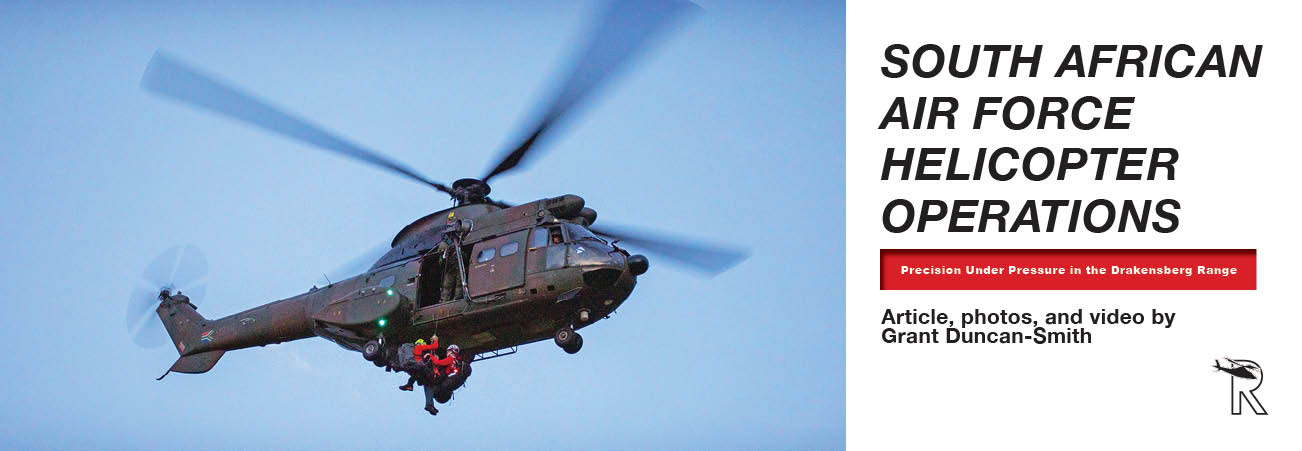
Resilience is woven into South Africa’s DNA. It’s a trait forged through decades of challenge—economic strain, operational constraints, and shifting national priorities. Nowhere is this more evident than within the South African air force (SAAF), where limited resources are stretched across peacekeeping commitments, domestic security, and life-saving rescue operations.
Yet within this pressure cooker, excellence persists. One such example is 15 Squadron, based in Durban, KwaZulu-Natal—a unit that continues to deliver precision helicopter operations in some of Africa's most demanding flying environments.
Squadron Forged in History
With roots dating back to 1939, 15 Squadron has evolved across multiple theaters of war and generations of aircraft. From maritime patrols with Junkers Ju-86s, to combat operations in East Africa and the Mediterranean during World War II, the squadron has continuously adapted to meet operational demands.
Re-established in 1967 as a helicopter unit, it transitioned through iconic platforms including the Super Frelon, Alouette III, and Puma, before settling into its modern role operating the Atlas Oryx and AgustaWestland AW109. The squadron also operates a 'C Flight' from AFS Port Elizabeth with the BK117. Its motto, “Aquila Petit Ardua” (The Eagle Seeks the Heights) is more than symbolic. It’s an operational reality.
Machines Behind the Mission
At the heart of 15 Squadron’s capability are these two versatile rotorcraft:
- Atlas Oryx
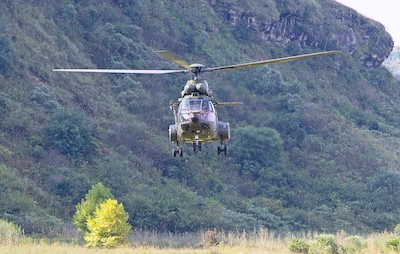
- Named after the Oryx antelope, the Atlas Oryx is a medium-sized utility helicopter developed and manufactured by the Atlas Aircraft Corporation (now Denel Aeronautics) of South Africa. The Oryx is based on the Super Puma, with the SAAF being the only operator.
- A rugged, medium-lift workhorse developed locally for African conditions, the Oryx excels in troop transport, casualty evacuation, and heavy-lift operations. With twin Turbomeca Makila engines and the ability to carry up to 20 troops, it remains the backbone of SAAF utility helicopter operations.
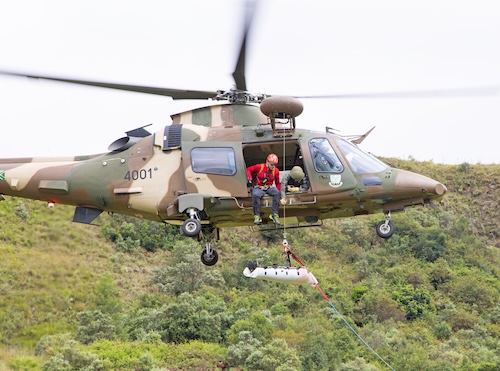
- Fast, agile, and highly adaptable, the AW109 fills the light utility role. Whether tasked with reconnaissance, training, or rapid-response missions, its twin-engine reliability and high cruise speed make it ideal for time-critical operations.
Together, these aircraft form a complementary pairing: one built for muscle, the other for precision.
Dragon’s Peak
Nestled in the rugged terrain of the KwaZulu-Natal Drakensberg lies Dragon’s Peak, a high-altitude training area that pushes both aircrew and aircraft to their limits.
Since 1985, this satellite base has been a cornerstone of SAAF helicopter training. Units such as 15 Squadron, 17 Squadron and 87 Helicopter Flying School deploy here multiple times a year to refine critical mountain-flying skills. This SAAF satellite base serves as a crucial mountain-flying training hub for the South African air force.
With peaks rising beyond 3,000 meters (9,843 feet), rapidly changing weather, and unforgiving terrain, the environment offers no margin for complacency.
Dragons Peak Historical & Operational Aspects:
- Purpose: Developed for specialized mountain-flying training, helicopter rescue, and pilot training in harsh, high-altitude terrain.
- Usage: Primarily used for SAAF training and Search and Rescue (SAR).
- Location: Situated at the Dragons Peak Mountain Resort in the KwaZulu-Natal Drakensberg
- Training Focus: Training includes specialized skills such as hoisting stretchers, individual and double-person hoisting, and hovering in mountainous environments.
- Key aspects of SAAF exercises at Dragon's Peak include:
- Mountain-Flying Training: Training student pilots in mountain navigation and handling.
- Mountain Rescue Simulation Training using Oryx helicopters, often in collaboration with the Mountain Club of South Africa (MCSA) for training in high-altitude pick-ups.
- Night-Vision Goggle (NVG) Training flying low-level in darkness with limited external references. Applicable for the pilots and engineers
Training for Search and Rescue
During a recent deployment to Dragon’s Peak, Rotor Pro joined training operations between the SAAF and the MCSA, a partnership that highlights the critical role helicopters play in mountain rescue.
The higher mountains of the Drakensberg range are vast, remote, and often inaccessible by ground. When lives are on the line, speed and vertical access are everything.
Here, helicopter crews train to:
- Insert rescue teams into near-vertical terrain
- Execute stretcher hoists in confined mountain environments
- Conduct extractions in rapidly deteriorating weather
- Operate seamlessly with civilian rescue teams
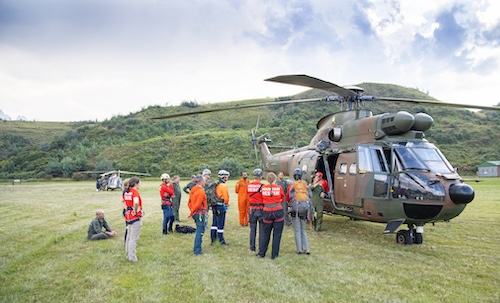
Each operation starts with a full briefing prior to the exercise with all pilots, engineers, and rescuers attending. The various helicopter types utilize different stretcher options and techniques to manage the patient around the helicopter. A screamer suit is a harness that is utilized for certain patients, depending on their injury. Sometimes a jockey -rescuer accompanies the patient on the hoist to the helicopter. Helicopter trooping techniques are also essential, where the helicopter transports rescuers into the mountains and then departs, leaving the rescue team to perform their mission.
Similar trooping occurs in Helitac firefighting operations, where crews are deployed rapidly via helicopter into areas that are difficult to access via road.
These missions demand absolute precision—and total trust—between pilot, crew, and ground teams.
Into the Night
If mountain flying is demanding by day, it becomes exponentially more complex at night.
Night Vision Goggles (NVG) operations form a critical component of SAAF training. Flying through narrow valleys with minimal visual references—often limited to scattered lights—requires intense focus and flawless crew coordination.
Landing on uneven, vegetation-covered slopes in darkness introduces additional risk. With the Oryx’s wheeled landing gear susceptible to instability, the role of the flight engineer becomes pivotal, as he, or she:
- Monitors power margins at altitude.
- Identifies obstacles such as power lines.
- Guides the aircraft into tight landing zones.
- Maintains situational awareness for emergency options.
It’s a high-stakes environment where small errors can have serious consequences, but it’s also where elite crews refine their edge.
Leadership
Behind every successful mission is experience—and strong leadership.
During the exercise, we flew with two highly respected figures in the SAAF.
- Brigadier General Kitley, director of helicopter systems, brings decades of experience since joining the air force in 1985, with over 6,600 flying hours across both fixed-wing and rotary platforms. He has flown various aircraft types from initial pilot training in the Harvard to the Impala and Bosbok. Helicopters he has flown include the Alouette III, Agusta A109, BK117 and the Oryx. His experience is complemented by fulfilling an instructor role on all types, including NVG instruction. Other SAAF leadership roles include, amongst others, serving as the Officer Commanding (OC) of 15 Squadron from 2008-2010 and as OC of Air Force College from 2017-2021. His calm authority and instructional expertise set the tone for operational excellence.
- Lt. Col. Darryl Sloan, was the A109 pilot for our operation. He joined the SAAF in 2001. After completing Basic Training, the Officers Forming Course, and Ground School at the military academy, he received his wings from Flight School at AFB Langebaanweg in July 2004. He trained at 87 Helicopter Flying School on an Alouette III and the Oryx. In October 2016, he completed his Instructors Course on the A109 at 87 Helicopter Flying School. Thereafter he transferred to 19 Squadron in Hoedspruit. His deployments include Madagascar, Democratic Republic of Congo and Burundi. In January 2007, he transferred to 15 Squadron in Durban and was promoted to OC of the Squadron in July 2022. Among Sloan’s notable achievements is leading a complex first A109 night rescue of an injured hiker, an operation that underscores the real-world impact of the training conducted in places like Dragon’s Peak. Sloan has 4,000 total flying hours, including 2,450 hours in the A109, and represents the next generation of SAAF leadership.
Capability Through Commitment
Despite ongoing constraints, the SAAF continues to produce highly capable helicopter crews, able to operate in some of the harshest environments imaginable.
At Dragon’s Peak, skill meets terrain, and training meets reality. It’s here—high above the valleys of the Drakensberg—that 15 Squadron lives up to its motto.
The Eagle doesn’t just seek the heights—it masters them.
VIEW VIDEO
READ MORE SEP/OCT ISSUE
READ MORE ROTOR PRO: https://justhelicopters.com/Magazine
WATCH ROTOR PRO YOUTUBE CHANNEL: https://buff.ly/3Md0T3y
You can also find us on
Instagram - https://www.instagram.com/rotorpro1
Facebook - https://www.facebook.com/rotorpro1
Twitter - https://twitter.com/justhelicopters
LinkedIn - https://www.linkedin.com/company/rotorpro1