|
Nov
09
2026
|
|
Posted 30 minutes ago ago by Admin
|
|
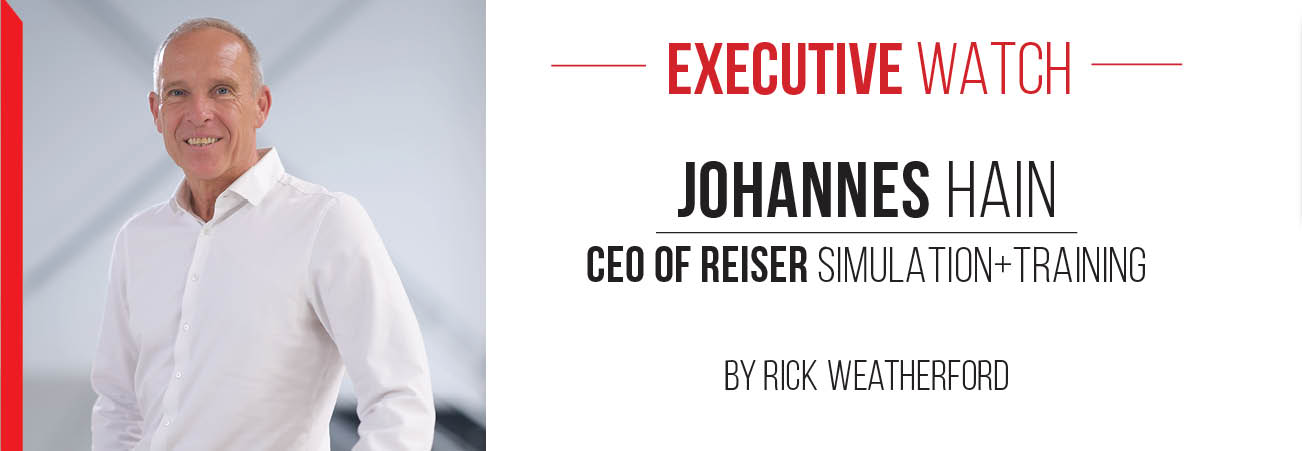
When we ask Johannes Hain, CEO of Reiser Simulation+Training in Berg, Germany, what he considers his greatest accomplishment, he fluently answers in English with his native Bavarian accent, “It’s not my personal accomplishment, but I’m still married after 34 years… I hope I’m right and my wife, Karin (a dedicated ICU nurse) doesn’t say we’ve been married 38 years!” The executive has been married, say approx. 34 years, has three grown children charting their own lives and careers … and he has a sense of humor.
Family Business
With the emphasis Hain puts on family, it’s no accident that he answered the call when Reiser came calling in 2023 to offer him leadership of their growing flight simulation company. (At the time Hain was in Lucerne, Switzerland, serving as executive VP for Rosen Group.) Hain said, “Reiser is a family owned business and there’s also a family feel to the rotorcraft industry that I’ve experienced. Since I made the move to this industry, I’ve never looked back.”
Reiser is family owned, but it’s not stuck in its traditions. That’s one reason that founder Wolfgang Reiser’s family pursued Hain to come to their company. “Reiser approached me because they’ve been growing up from a very small company to a medium-size company,” said Hain. “They were looking for somebody who could industrialize, for lack of a better word, their traditional workshop approach. You cannot throw standard industrial processes over a company like Reiser, but we’re marrying the old way with new technological processes to get the right balance.”
Right Niche
Hain and his team’s marriage of old and new appears to be working. In 2025, Reiser was ranked among the fastest-growing mid-sized companies in Germany, based on an analysis by Munich Strategy comparing 8,000 companies in the technology sector. Since its founding in 1988, the company has built on its passion for “realistic simulation and training solutions that protect people, the environment and resources, in aviation and beyond,” according to Reiser’s website. They engineer and manufacture products up to the highest EASA and FAA levels that include full flight simulators (FFS), flight training devices (FTD), mixed-reality (XR) simulation, aviation desktop trainers (ADT), and high-fidelity full-scale cockpits, plus they offer other flight training products and flight data software. They even manufacture a training console for trains, but all the company’s products and business revolve around the niche of training and simulation.
Being in a niche industry suits Hain; he’s worn that attire throughout his career. ““I’ve always worked in companies that are very technologically oriented and all were niche, specialty businesses. At Reiser, the technology is fascinating and the rotorcraft world is itself a niche of the larger aerospace industry,” he said.
That career began after an impressive academic education earning degrees in business administration and mechanical engineering from Technische Universität Darmstadt (near Frankfurt, Germany) where he also worked as a scientific assistant, which in 1995 culminated in an earned doctorate in mechanical engineering.
Taking His Schott
Upon graduation, Hain began his career as an in-house consultant at Schott Group, which manufactures specialty glass and ceramics found in many products. He said, “It’s one of those hidden companies that nobody knows of, but their products are in many everyday things, such as pharmaceuticals, eyeglasses, cameras, etc.” In his 14 years there, he rose up from a consultant to the executive level, and this corporate climb not only took him up, but overseas to manage Schott’s divisions in North America from 1999 - 2003, where he eventually rose to become president of Schott Corporation USA. (At one time during these years in America, the Hain family resided in Vincennest, Indiana, where their youngest son was born; he is appropriately named Vincent.)
Hain returned to Schott in Germany where he served at the executive-level of the multinational. In 2006, he was named chairman of the board of Schott Lithotec AG, where his career with Schott culminated in 2009.
Hain gives credit to CEO Udo Ungeheuer for mentoring him during these years. “He influenced me very much because at the beginning I did not have a specific direction for my long-term career. He specifically challenged me. He was really demanding on people (Ungeheuer translates into English as “monster.”), but he also gave a lot of opportunities. When he saw that somebody did a good job, he promoted them. He most influenced my professional life.”
Recreation
After stepping away from Schott, in 2010 Hain became executive VP of Rosen Group in Switzerland. The company tests, inspects, and certifies infrastructure, such as pipelines, for the global energy industry and he worked there until 2023 when he was named CEO of Reiser Simulation+Training, returning to beautiful Bavaria where he grew up. He almost provokes this writer’s envy when says, “I’m sitting here in one of our conference rooms on a beautiful, clear day and I can see the mountain range outside the window.” (Maybe he will break a leg on those majestic mountains when he engages in his hobbies of skiing and mountain biking! Forgive my schadenfreude.)
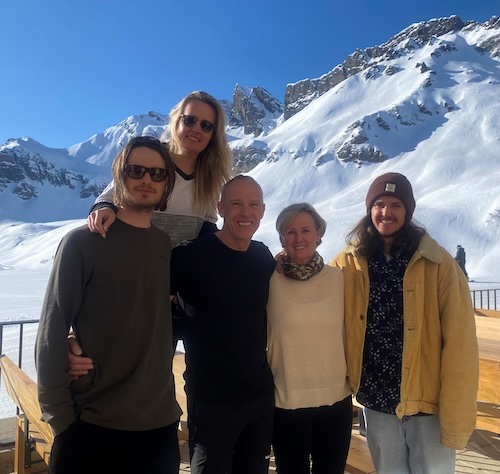
The chance of that injury happening, which for the record we don’t wish on an executive who gave us an hour of his time, is a slight risk because of limited exposure. Hain said, “I try to do something like [ski] once a week because my wife tells me I have to do something to stretch and not get stiff, but if I try to do it more than once a week, I don’t have the time.”
Hain does find time for less injury-prone pursuits, such as his current reading of a biography on Apple co-founder Steve Jobs, and he has a guilty pleasure that some of us relate to—watching Monty Python’s twisted comedy. “I’m not dead yet!” from their Holy Grail movie is a scene Hain fondly recalls.
Lesson Learned
Yet, he more somberly remembers a crisis as managing director of Schott Solar when their emerging industry could have been mistaken for dead. After 20 years, he well recalls the lesson learned from that event. Read and learn:
“The solar industry was just starting, but Germany was a big player. We were worried about government support and growing our customer base and focused on those issues, but what we really overlooked and missed, as an industry, was whether there was enough silicon in our supply line to manufacture our product. There wasn’t nearly enough when solar took off. It got to the point when silicon manufacturers offered to build a plant if we guaranteed to buy their production for the next five years—paid in advance!
“The industry got turned upside down because nobody thought to ask the basic question about our supply chain. We all just assumed there would be enough silicon because the solar industry was starting so small, but we outgrew our supply chain fast. We couldn’t grow our solar business because we overlooked a most basic question. I guess my only comfort is that it happened to all the companies because nobody asked. I learned that when you are responsible for a business you have to really look at everything around 360 degrees all at the same time.”
360-Degree View
These days, Hain’s head is on a 360-degree swivel, and the CEO sees opportunity and emerging technology issues for Reiser. “Our greatest opportunity is that the aviation industry is growing compared to other industries. Here in Germany the aerospace growth rate for last year was 7% to 8%. The more the industry grows, the more you need simulation and training for it,” he said.
Also, he sees another growth opportunity—if it is used appropriately: artificial intelligence. “We’ve tried to avoid putting AI over everything, just because we have it. There’s a German saying ‘when all you have is a hammer, everything looks like a nail.’ We’re using AI in software development to simplify coding. We can also use it in developing flight models, but you have to be very careful because in the end AI needs to tell you where it is getting its data from. It needs to follow valid flight physics.
“I think where AI is going to be most helpful is in monitoring the trainee in a simulation—to see where he or she is looking and focusing. Then, it can compile that information for the flight instructor to review. Another step further where AI may be useful is to adapt sessions tailored to a specific trainee. So, you wouldn’t have one-size-fits-all training. A trainee may have acquired certain skills and need more work on other ones. AI could be a tool to adapt that trainee’s sessions to work on his or her weaker skills to create more efficient training.”
While aviation training technology rapidly advances, just as technology is changing other industries, Hain has found something unique about the rotorcraft industry after his past in other industries. He said, “What’s unique is the longevity of the products. It’s unique to other industries how long some of the platforms, such as the Black Hawks and Skycranes, have been around.” Hain has been around the world in a long and varied career. Compared to other sectors, helicopters stand out—as do rotorcraft industry leaders.
READ MORE SEP/OCT ISSUE
READ MORE ROTOR PRO: https://justhelicopters.com/Magazine
WATCH ROTOR PRO YOUTUBE CHANNEL: https://buff.ly/3Md0T3y
You can also find us on
Instagram - https://www.instagram.com/rotorpro1
Facebook - https://www.facebook.com/rotorpro1
Twitter - https://twitter.com/justhelicopters
LinkedIn - https://www.linkedin.com/company/rotorpro1