|
Nov
02
2026
|
|
Posted 3 hours ago ago by Admin
|
|
VIEW VIDEO
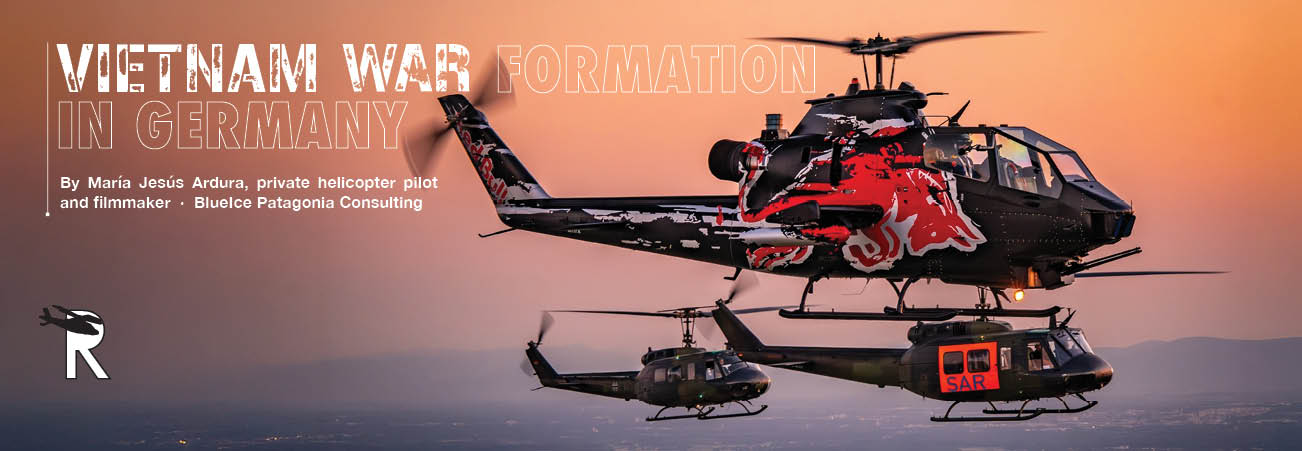
It was a perfect summer evening outside Stuttgart, Germany, around 9:00 PM at Baden-Airpark. The airfield had given us special authorization to takeoff at that hour. We were a small group — each classic helicopter with a pilot and co-pilot, and those of us with cameras in the doors-off BO-105 strapped in our harnesses with our equipment to capture the moment. There was a lot of focus and anticipation in the group. Everyone wanted this to go as well and professionally as possible.
I felt anxious, excited, and deeply grateful to see these iconic warbirds — the Huey and the Cobra — about to takeoff, and my gratitude was heightened even more to be alongside the Red Bull Flying Bulls pilots and to also be with Marcus Aulfinger and Stephan Konz — both EASA examiners with years of experience. Still, in the middle of it all, I had to keep my eyes on the camera. I’m sure that evening will stay with everyone who was there.
Huey Power
Before the turbine starts, a UH-1 ”Huey” already commands respect. The sheer size stops you in your tracks — the main rotor blades are enormous, remarkably wide, and the tail rotor is no different. Then, the turbine fires up and you start to understand why it’s a legend. The sound is unmistakable — powerful, distinctive — and the downwash from those blades means you’d better watch your face: any loose pebble or small object becomes a projectile. In the movies they look epic, but in person their size hits you first, and then that roar goes straight through your chest.
Nothing prepares you for that power.
The Huey, the Cobra, and the War
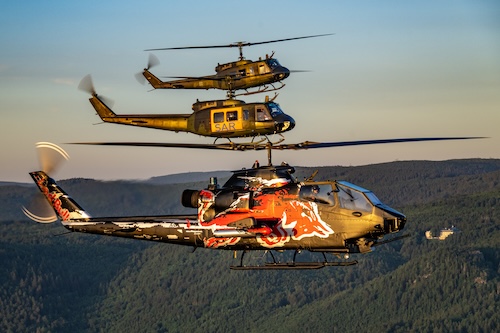
During the Vietnam War, the Huey was an icon on the battlefield. It carried troops, evacuated the wounded, and operated in combat zones where few aircraft dared to go. Yet, as it became the backbone of operations, it also became a target. It wasn’t fast or agile enough — Hueys were getting shot out of the sky, and something had to change.
The answer came from their manufacturer. Bell developed the AH-1 Cobra as an armed complement to the UH-1, sharing up to 80% of its components. The Cobras entered combat in 1968 and stayed in the fight through 1973, with more than 1,100 delivered during the war.
They are brothers. The Huey is the heavy-lift helicopter — the one that carried the troops and is slower and more vulnerable. The Cobra was built to protect — more agile, always armed, ready to defend its bigger brother. Together, they formed one of the most iconic teams in military aviation history.
Years in the Making
The idea had been living in Aulfinger’s head for years. Not only is he an EASA examiner, but he’s also a commercial helicopter pilot, an FAA Certified Flight Instructor, and co-founder of KSA, an educational platform for helicopter pilots. He is a Huey fanatic; on top of owning one, Aulfinger runs a social media account called “Huey Fun Flights” on both Facebook and Instagram with over 14,000 followers. He’s the one who pulled the helicopters together and pushed the project until it became real.
“The Huey is known as the helicopter of Vietnam,” Aulfinger explains. “It was one of the few helicopters ever built more than 10,000 times, and even though it was designed for a conflict, it’s still flying more than 50 years later. In Vietnam, they flew together constantly — the Cobra would clear the landing zones so the Huey could come in, drop soldiers or pull out the wounded.
“Hundreds of thousands of soldiers flew in Hueys around the world — in peacetime and in war. For them, the aircraft’s sound is unforgettable. This flight formation was a tribute to everyone who ever flew in one, or who served.”
VIEW VIDEO
How the Formation Came Together
Getting an AH-1 Cobra airborne in central Europe is no small feat. The Flying Bulls, based in Salzburg, Austria, operate one of the few still flying on the continent. “Mirko Flaim is the chief pilot of the Flying Bulls and a longtime friend,” Aulfinger says. “I always had this photo session in mind and we talked about it for years. Registration limitations meant we couldn’t fly to Austria, and the Bulls weren’t willing to make a two-hour flight each way to our area. The opportunity came when they were passing through southern Germany en route to an airshow in France and needed a fuel-stop near our base. We convinced Stephan [Konz], co-founder of KSA, to join us with another Huey. The weather was perfect.”
After several hours of briefing in the hangar, the plan was set to fly at sunset.
In the Air
Leading the flight formation was Flaim, who coordinated and led everything from the air at the controls of the Flying Bulls’ doorless BO-105.
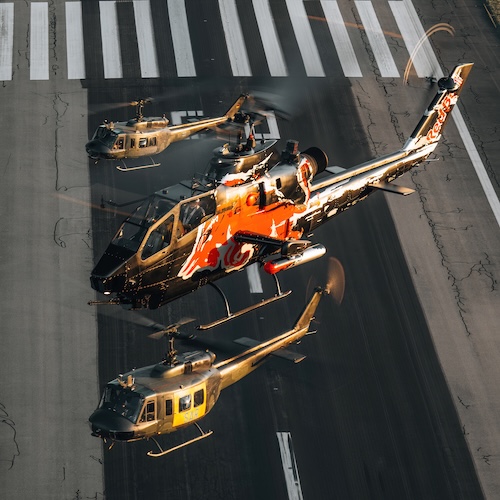
He said, “Before taking off, we wanted to pull off an ambitious shot: all three helicopters aligned on the runway, turning in unison at the same angle, captured in a single frame. It was simple in concept, but demanding in execution — the rotor wash from the aircraft above directly affected the stability of the one below, and holding the same heading and angle with precision was a real challenge. We worked at it for nearly 20 minutes. The result was worth every second.”
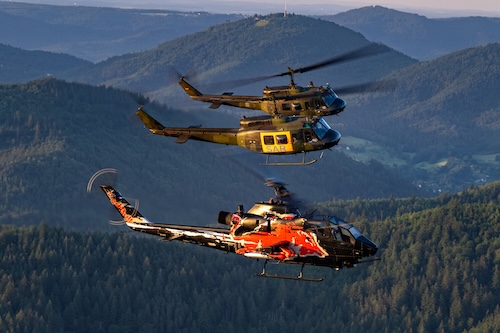
For Alex Schwarz, one of Europe’s most respected aviation photographers, this session was unlike any other. “Shooting a formation is always next-level,” he says. “I regularly photograph warbird airshow teams, so formations aren’t new to me, but a formation featuring these legendary helicopters is more than rare — it’s truly special.”
The biggest challenge wasn’t the day of the shoot — it was getting there. Schwarz adds, “Years passed between our first conversation and the actual shoot — that was the biggest hurdle. Once in the air, you have to stay fully focused and always be ready to capture that perfect shot, but when I saw everything going in the right direction, I thought, Wow, it was a perfect collaboration among everyone involved.”
Flaim says, “For me this flight was truly something special; formations like this are extremely rare in Europe — you almost never see a lineup like this flying together. Doing it under that sunset light was the cherry on top.”
Still, coordinating four aircraft with crews that don’t know each other well is always a challenge. Flaim explains, “Air-to-air shoots are demanding; a thorough briefing of every possible scenario and a solid contingency plan is non-negotiable. The more you work through on the ground, the better the result is in the air.”
Once in a Lifetime
Watching these three iconic warbirds from the Vietnam War flying in formation is something hard to put into words. I had the privilege of filming it from the inside — in the doorless BO-105, with my harness on and legs hanging out—and the formation just meters away.
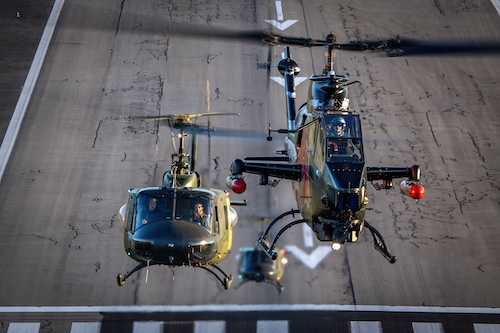
When we landed, adrenaline was still running through me. At that moment, with the sound of the turbines still ringing, I couldn’t help thinking about the soldiers who flew these same machines in actual combat. If it felt like this on a peaceful summer evening in Germany, I can’t imagine what it must have been like in an Asian war.
Behind the Scenes
Photography: Alex Schwarz — www.aviation-media.com
Video: María Jesús Ardura — www.blueicepatagonia.com
Project organized by KSA — www.ksa-heli.com
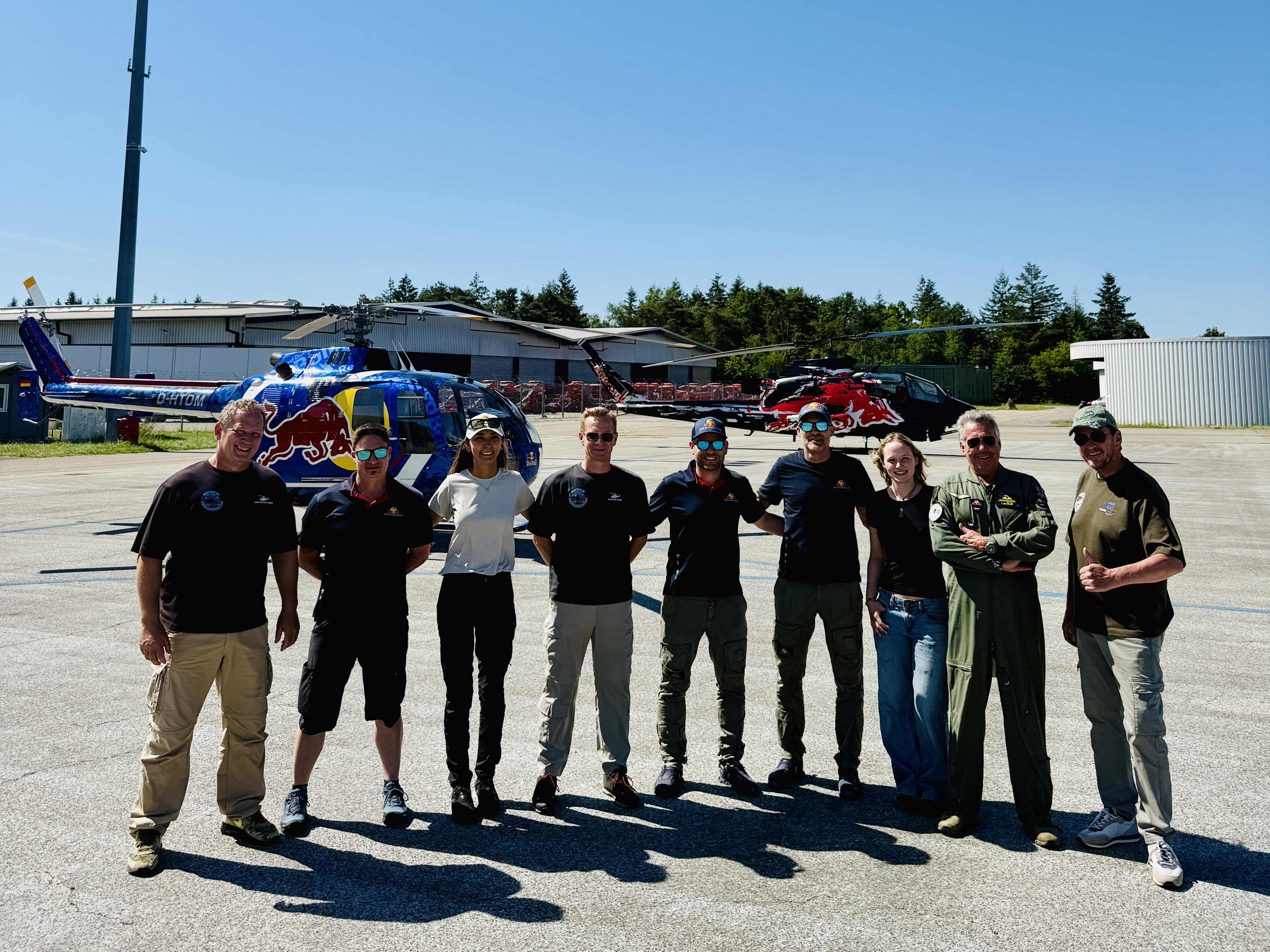
Pilots
- Marcus Aulfinger — UH-1D — www.ksa-heli.com
- Mirko Flaim — BO-105 — Flying Bulls / Red Bull Austria — www.flyingbulls.com
- Stephan Konz — UH-1D — www.ksa-heli.com
- Matthias Schwaighofer — AH-1G — Flying Bulls / Red Bull Austria — www.flyingbulls.com
Co-pilots
- Maja Aulfinger — UH-1D
- Robert Richter — UH-1D
Photography
Alex Schwarz — www.aviation-media.com
Video
María Jesús Ardura — www.blueicepatagonia.com BlueIce Patagonia Consulting
Rotor Pro Magazine
VIEW VIDEO
READ MORE SEP/OCT ISSUE
READ MORE ROTOR PRO: https://justhelicopters.com/Magazine
WATCH ROTOR PRO YOUTUBE CHANNEL: https://buff.ly/3Md0T3y
You can also find us on
Instagram - https://www.instagram.com/rotorpro1
Facebook - https://www.facebook.com/rotorpro1
Twitter - https://twitter.com/justhelicopters
LinkedIn - https://www.linkedin.com/company/rotorpro1