|
Sep
28
2026
|
|
Posted 21 days ago ago by Admin
|
|

Some pilots fly for work. Some fly for the love of it. And then there’s Sebastián Díaz — a Chilean aviator with over 9,000 total flight hours across helicopters, fixed-wing aircraft, and gliders.He flies to the most remote and unforgiving corners of the planet in conditions that can push any aircraft and crew to their limits.
Every year, between March and April, Sebastián organizes what has become one of the most extraordinary private helicopter expeditions in the world: a flight deep into Chilean Patagonia, pushing south until the continent simply runs out of land. This past season, a group of four Robinson helicopters — two R44s and two R66s — reached Cape Horn, the mystical southernmost tip of South America, where the Pacific and Atlantic Oceans collide in one of the most violent stretches of water on Earth.
It was his third time at the Horn. He has also reached the Diego Ramírez Islands — a remote Chilean archipelago 100 kilometers ( approx. 62 miles) southwest of Cape Horn, in the Drake Passage, just 790 kilometers (491 miles) from Antarctica’s South Shetland Islands — becoming the first Robinson pilot ever to land there. Antarctica, he says, is next.
ROBINSONS AT THE EDGE OF THE WORLD
Díaz organizes these expeditions out of a genuine love for helicopters and a passion for adventure. This is not a commercial operation — and that gives him something money can’t buy: the freedom to invite fellow pilots from around the world, particularly from Chile, where private Robinson helicopters are a familiar sight.
Before each expedition, Díaz gathers the group for a pre-departure briefing. The opening line never changes: “Never forget that we are going to fly to the most difficult place on the planet.”
.jpg?ver=Mz2Z1umIaag1oPg2jIXC4Q%3d%3d)
He means every word. Patagonia does not forgive mistakes. Winds regularly exceed 40 knots. Weather systems can build and collapse within the hour. The terrain is extreme — ice fields, glaciers, fjords, channels, open ocean crossings. Díaz chooses Robinson helicopters every time, precisely because they are the machines Chilean pilots know best — and because that deep familiarity is itself a form of safety. Flying the same model also brings a concrete operational advantage, such as similar cruise speeds and predictable fuel consumption across the group, which simplifies logistics enormously in the field.
That familiarity, however, is no substitute for preparation. Every briefing includes a thorough review of how to avoid inadvertent low-G flight — a situation that in two-bladed teetering rotor helicopters demands careful pilot attention. In Patagonia’s unpredictable turbulence, knowing and respecting the aircraft’s limits isn’t optional: it’s the foundation of a safe operation. Díaz also recommends that every aircraft install Robinson Helicopter Company’s new tail rotor stabilizer before departure — a component designed to add an extra layer of stability and safety in the most demanding conditions. On an expedition like this, every safety margin counts.
PLANNING IN PATAGONIA IS NOTHING LIKE PLANNING ANYWHERE ELSE
The expedition runs on a route that exists only in theory until the night before each leg. Weather is the real navigator.
Every helicopter carries two pilots — a non-negotiable rule. Fuel logistics are complex and expensive, particularly at remote staging points where a missed refueling stop isn’t just inconvenient: it can be deadly. Deep in Patagonia, there are no roads, no towns, no safety nets. Isolation isn’t a metaphor — it’s the operational reality of every single day. The route is planned and replanned according to the forecast, and the pace of the entire group is always set by the least experienced pilot on board. “I find it hard to put myself in the shoes of the least experienced pilot,” Díaz admits. “Someone can approach or exceed their limits without realizing it. They have to be the ones setting the pace — always.”
This past season, the group caught an unexpected break: a sustained 40-knot tailwind allowed them to push rapidly through Argentine territory, from Villa O’Higgins all the way to Cerro Guido — near Torres del Paine National Park — in a single day, arriving ahead of deteriorating weather closing in from the far south.
CAPE HORN: WHERE THE CONTINENT ENDS
Reaching Cape Horn by helicopter is not simply a feat of navigation. It’s a conversation with history. “It’s deeply moving to arrive at the tip of the continent and round the last island through the Drake Sea,” says Díaz. “You think about the sailors of the past — how brave they were, how they managed in that wild geography with so little compared to everything we have today.”
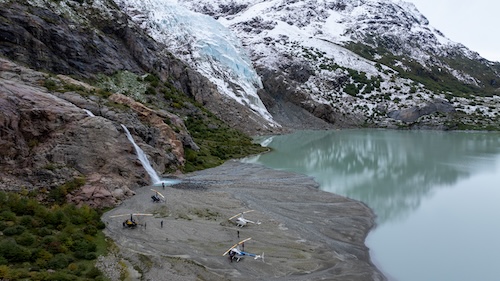
This expedition also brought an unexpected discovery: Isla Scott, a remote island between Punta Arenas and Puerto Natales, where a natural isthmus channels waves from opposite directions until they meet in the middle. Díaz landed without a second thought.
Another moment that will stay with the group: a rare weather gift at Isla Nueva in the Beagle Channel, where the sea was completely glassy — almost surreal. As Patagonia always reminds you who’s in charge, it lasted barely an hour before the wind and rain returned.
THE NUMBERS BEHIND THE LEGEND
Díaz has made this journey nine times. He’s reached Cape Horn on three occasions and the Diego Ramírez Islands once. In a previous expedition, the group grew to 13 helicopters — so many they had to split into two formations. His ideal number? Five. “Five fits almost everywhere,” he says, “and refueling doesn’t take forever.”
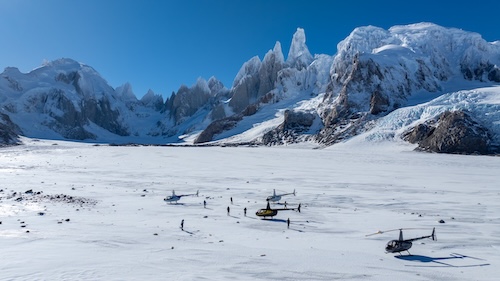
To join one of these expeditions, Díaz looks for one thing above all else: a genuine spirit of adventure. Technically, at least one pilot per aircraft should have more than 1,000 hours. Candidates need experience in the Andes — Chile’s central mountain range — and time flying in strong southerly winds, what Chileans call the surazo: gusts exceeding 35 knots along the coast. Night flying experience also helps. “Sometimes the tracks stretch longer than expected,” he says simply.
THE MAN BEHIND THE EXPEDITION
Díaz’s aviation career began in the 1980s with hang gliding and paragliding. By the 1990s he was crossing oceans in fixed-wing aircraft — ferrying planes between the U.S. and Europe, completing a transpolar circumnavigation in 2019 that earned him a FAI diploma, and more recently he recovered a single-engine piston aircraft stranded in Antarctica.
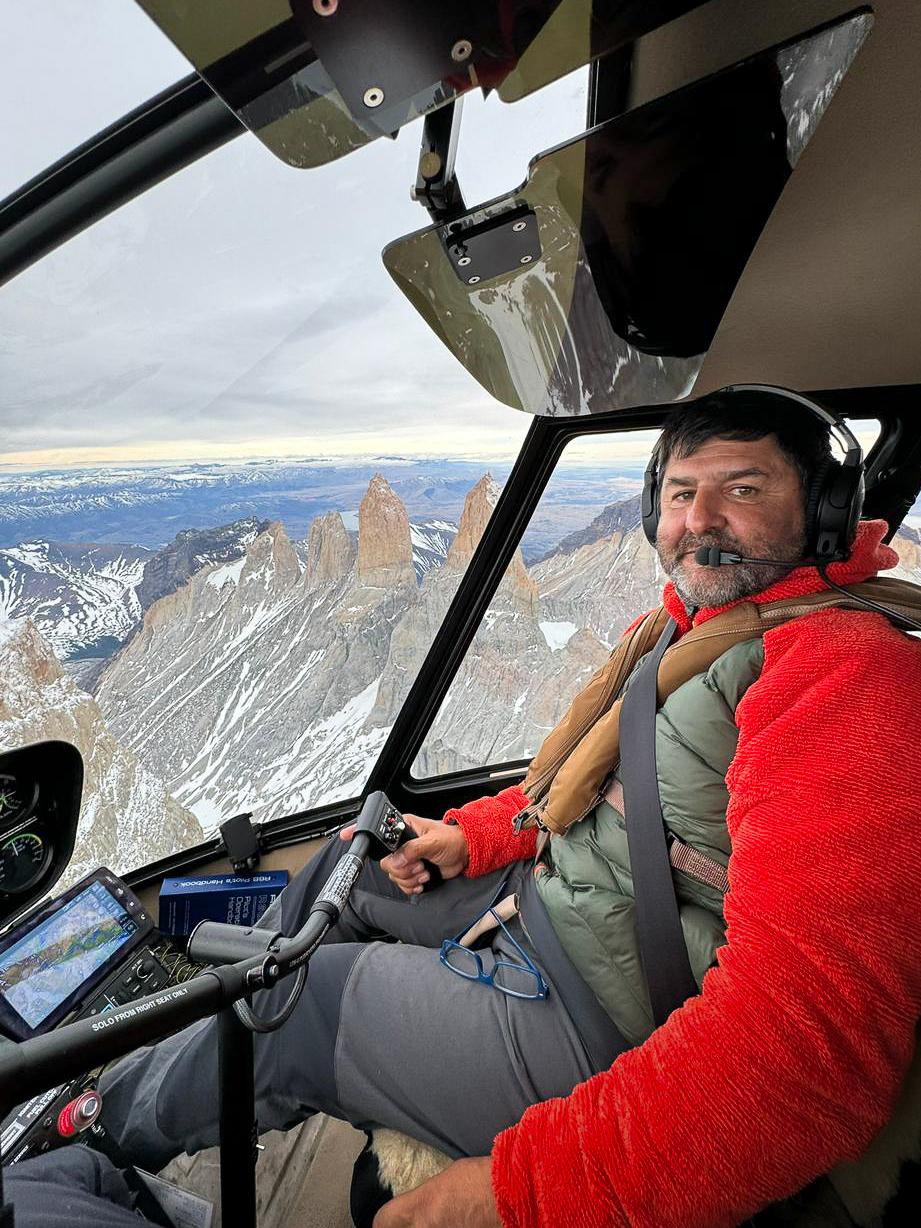
As a glider pilot, he has flown above 7,000 meters over Aconcagua and covered distances exceeding 600 kilometers (373 miles) in a single flight. As a helicopter pilot, he holds type ratings for the Robinson family, Bell, and Airbus, with extensive experience in agricultural operations, heli-biking, and heliskiing above 12,000 feet.
His next projects are every bit as ambitious: reaching the South Pole in a Robinson R66, and a round-the-world flight along the equatorial line heading east — this time alongside his father and his son, both pilots — for a second FAI diploma.
He is also the founder of Aerocondor Flight School in Santiago, Chile — one of the most respected helicopter training academies in South America, where the next generation of Chilean and international pilots takes their first steps in Robinson R22s and R44s.
AN EXPEDITION OF PURE PASSION
This is not a commercial venture. It’s an expedition born from a pure love of flight, organized among friends who share the same dream: pushing the limits of what’s possible in a helicopter. Groups are private, spots are limited, and the invitation comes entirely at Díaz’s discretion. “What matters is that they’ve flown in the mountains and in strong southerly winds — over 35 knots along the coast,” he says, “and that they can follow the leader and handle their aircraft in confined-area landings and on sloped terrain.”
Cape Horn is not a destination — it’s a threshold. Beyond it, the Diego Ramírez Islands lie 100 kilometers (62 miles) to the southwest in the Drake Passage — the closest land on Earth to Antarctica.
Sebastián Díaz has been there. And he’s already planning to go further.
Photo credits: Sebastián Díaz / María Jesús Ardura — BlueIce Patagonia Consulting
READ MORE JUL/AUG ISSUE
READ MORE ROTOR PRO: https://justhelicopters.com/Magazine
WATCH ROTOR PRO YOUTUBE CHANNEL: https://buff.ly/3Md0T3y
You can also find us on
Instagram - https://www.instagram.com/rotorpro1
Facebook - https://www.facebook.com/rotorpro1
Twitter - https://twitter.com/justhelicopters
LinkedIn - https://www.linkedin.com/company/rotorpro1