|
Sep
21
2026
|
|
Posted 20 days ago ago by Admin
|
|
VIEW VIDEO
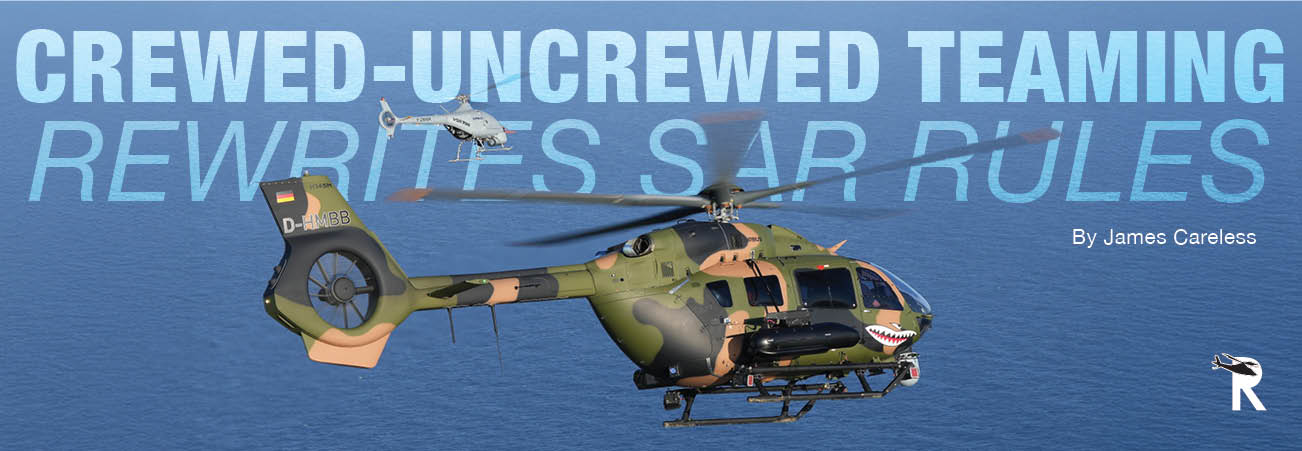
For helicopter and drone flight crews, the hardest part of any search and rescue (SAR) mission isn't the flying—it's the searching. Staring at grid lines while monitoring terrain and fighting fatigue can push human endurance to its limit. Now, the industry is fundamentally changing the equation by pairing crewed helicopters with uncrewed drones to share the workload.
Developed by the military, manned-unmanned teaming (MUM-T) is moving into civilian SAR and all-hazard emergency response.
By networking autonomous drones with crewed rotorcraft, manufacturers are tasking uncrewed systems with handling tedious search patterns and data gathering, freeing human crews in the helicopter to focus on physical rescues. Here is a look at how five major players are making “collaborative SAR” a reality.
Airbus Helicopters’ HTeaming Pushes the Boundaries
Airbus Helicopters is pushing the boundaries with its HTeaming MUM-T solution, which gives helicopter crews full control over drones in flight.
"Imagine a tablet in the cockpit with an incredibly intuitive HMI [human-machine interface]," said Victor Gerin-Roze, head of UAS business at Airbus Helicopters. "It allows the helicopter crew to literally take the reins of a drone, control its mission directly, and stream data in real-time."
"In a search and rescue scenario, the drone acts as the ultimate scout," he added. "It rushes ahead, scans the area, and pinpoints the victim. By the time the helicopter arrives on scene, the crew has the exact coordinates."
HTeaming allows the drone to be controlled from the cockpit or the rear cabin. This isn’t a time-intensive task: The drone uses an advanced, integrated autopilot that effectively flies it, while the crew selects waypoints or guides the thermal camera. The drone’s live video feeds are broadcast using a shared multicast stream, so that the aircrew and ground teams can view the exact same real-time footage.
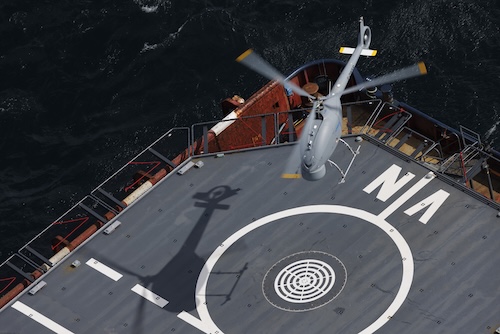
To ensure connectivity in deep canyons or remote environments, a drone will switch to a SATCOM network if the primary radio link can’t connect. "Beyond connectivity, we are specifically developing our UAS platforms to be highly resilient in harsh environments," said Gerin-Roze.
Despite its sophisticated MUM-T features, adding HTeaming to a helicopter doesn’t take much time. "The integration footprint is very low," Gerin-Roze told RotorPro. "Operators do not need to modify their existing cockpit layouts. The only physical retrofit required is mounting the external communication antennas." Crucially, this platform-agnostic MUM-T system works with drones from any manufacturer.
After successful operational trials with the Singapore air force (H225M), Spanish navy (H135), and French armed forces (NH90), Airbus expects HTeaming to be commercially available by the end of this year. Looking ahead, "future iterations will, for instance, allow a single helicopter crew to orchestrate a swarm of diverse drones simultaneously,” said Gerin-Roze. “For instance, one drone could handle electronic warfare, another could act as a kinetic effector, and a third could handle long-range reconnaissance."
Leonardo Pushes AI-Driven Teaming and Detection
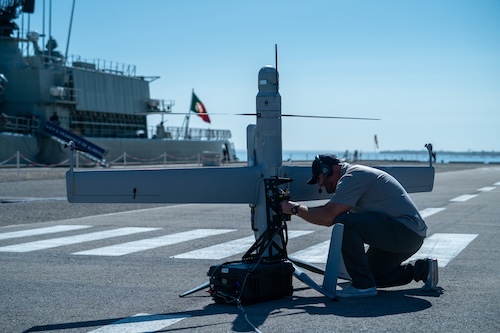
Leonardo Helicopters’ approach to MUM-T is all about teamwork, with AI-driven autonomous flight systems playing a key role. In fact, "Leonardo considers autonomy to be a mandatory component for enabling future uncrewed operations and teaming between crewed and uncrewed platforms," said Michael Bucari, the company’s senior marketing manager for the Americas. “Leonardo is developing integrated MUM-T solutions while advancing its 3-tonne-class Proteus demonstrator drone with full autonomous flight capabilities."
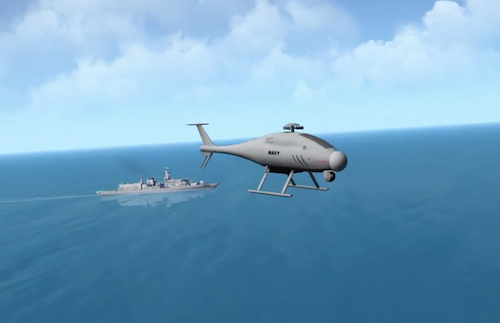
For wide-area SAR operations, Leonardo’s 200-kg.-class AWHERO drone is providing intelligence by scanning the landscape with its onboard suite of sensors.
"Utilizing the AWHERO for surveillance optimizes the use of manned helicopters, and it reduces the operational risks for aircrews in high-threat environments,” Bucari said. Crucially for MUM-T SAR, the AWHERO and its payloads have the potential to be directly controlled by other air platforms and can relay full motion video and data directly to the teamed manned platform.
Leonardo is offering a tiered uncrewed portfolio designed to “buddy up” with crewed aircraft. By fielding the lightweight AWHero alongside the 3-tonne Proteus demonstrator, the company allows rescue teams to scale autonomous support. This tiered approach allows SAR operators to deploy the right-sized drone for specific conditions, maximizing operational flexibility and minimizing fuel consumption during time-sensitive SAR missions.
VIEW VIDEO
To make the uncrewed search more effective for the partnered helicopter, Leonardo is deploying AI software upgrades to reduce the crew’s mental workloads.
"Leonardo has partnered with the Italian mountain rescue service to test an AI-driven object detection and tracking system called G4SAR," said Bucari. "G4SAR relies on a 4K camera augmented by AI software, which can be connected to uncrewed air systems (UAS) or integrated into the belly of a manned helicopter." As the drone or helicopter sweeps the search area, "AI can recognize human casualties on the ground, even if they are only partially visible, which dramatically reduces the time required to locate people in challenging environments like mountains,” he said.
Robinson Teams Automated Drones with Crewed Fleets
Robinson Helicopter Company (RHC) is well aware of the fatigue factors associated with airborne SAR. In response, RHC is rolling out a commercial MUM-T framework that shifts the search phase to automated drones while the helicopter serves as the airborne command and rescue hub.
“The MUM-T solution features a mix of our Spirit UAS with our manned R44 and R66 helicopters,” said David Smith, RHC's president and CEO. “The system uses cameras mounted on the helicopter and cameras mounted on the UAS to coordinate and pass information from zone-to-zone or aircraft-to-aircraft using Swarm AI software that self-organizes the flight path and coverage approaches. For a typical ‘find the missing hiker’ mission, this is invaluable as it allows for several air-deployed or ground-deployed drones to work collaboratively with the aircraft cameras to find the target.”
According to Smith, “It requires a very low workload to ‘paint’ the zone of interest” using this software. Once that has been done, the drones take care of the “entire pathing and distribution while the tactical flight officer manages communication with ground personnel and uses the larger camera on the helicopter to confirm what the UAS finds,” he said.
The best part: The helicopter crew does not need to manually fly the drones while trying to manage a rescue. "The UAS would fly themselves in our MUM-T application," said Smith. “It uses our sophisticated AI swarm software that keeps them separated from each other and the manned command helicopter." At the same time, Smith said, “All of the camera feeds are available to the TFO on their multifunctional controller, keeping the helicopter crew fully updated on the drone's search progress.”
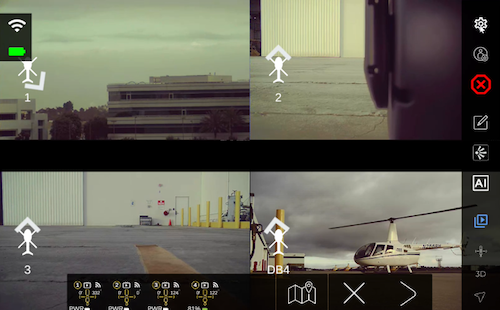
Looking ahead, he envisions a highly distributed SAR ecosystem where crewed and uncrewed assets deploy together. "We see a future where UAS are pre-positioned in secure boxes that can augment a search-in-progress and the manned helicopters will have onboard units to deploy if/when needed," Smith said. “Demonstration flights already prove this teaming concept works, as drone agility made for a significant increase in the speed of finding the target."
Schiebel’s CAMCOPTER Enables True Integration
For civilian pilots, MUM-T often sounds like a concept confined strictly to military test tracks. Schiebel is systematically dismantling that perception by proving that helicopters and drones can seamlessly share airspace for SAR operations in challenging maritime and coastal environments.
"Schiebel has been working on helicopter-drone teaming for many years, both through dedicated MUM-T demonstrations and through real-world search and rescue operations," said Neil Hunter, Schiebel’s head of global sales. “The CAMCOPTER S-100 has demonstrated MUM-T capabilities up to Level of Interoperability (LOI) Five, including integration with an Airbus H145 helicopter.
As the old saying goes, the proof is in the pudding. Schiebel has executed a number of successful MUM-T missions over the years and is increasing its capability to support them.
“A leading example is Bristow's operation on behalf of HM Coastguard in the United Kingdom,” Hunter told RotorPro. “Since 2020, the CAMCOPTER S-100 has supported search and rescue operations as a safety-overwatch asset across coastal, maritime and mountainous environments, including North Wales and the English Channel. The CAMCOPTER S-100 also supports EMSA maritime safety operations across Europe, including missions where search and rescue forms part of the operational tasking. Separately, the system supports the Spanish Maritime Search and Rescue Agency (SASEMAR) through the iSAR program, contributing to SAR, maritime surveillance and emergency response missions.”
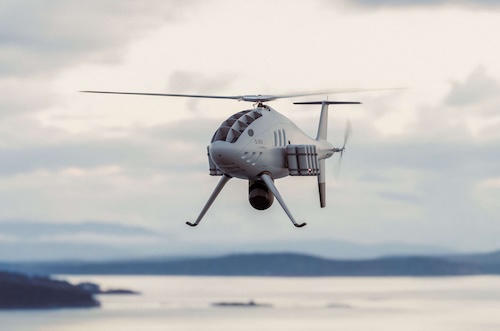
From Schiebel’s perspective, the division of labor in MUM-T SAR missions is clear: drones search, helicopters rescue. Hunter said, "What we consistently see is that unmanned systems can extend surveillance coverage, remain on station for long periods and provide continuous situational awareness while helicopters remain available for rescue and recovery tasks.” The data sharing is immediate, he said, "The CAMCOPTER provides real-time sensor data, including EO/IR and thermal imagery, to the Ground Control Station, from where it can be shared with command centers" and partnered aircraft.
Looking ahead, Hunter sees an increasing number of SAR missions adopting a MUM-T platform approach. “The future is clearly moving towards closer cooperation between manned and unmanned aircraft,” he said. “A good example is Project NYX in the U.K., where the CAMCOPTER S-300 has been selected for Stage One to explore future autonomous teaming concepts alongside Apache helicopters. At the same time, Schiebel continues to advance interoperability, autonomy, communications and sensor integration. The goal is simple: provide operators with better information, over larger areas, for longer periods of time, while allowing manned aircraft to focus on the mission itself.”
Sikorsky’s MATRIX Enables Crewed and Uncrewed Emergency Response
SAR operations often overlap with large-scale, all-hazard emergencies, like catastrophic wildfires, where finding trapped individuals and suppressing threats must happen simultaneously. To operate more safely in these zero-visibility, high-risk zones, Sikorsky is deploying advanced autonomy to allow crewed and uncrewed rotorcraft to work together more effectively.
Not surprisingly, Sikorsky views its S-70 Black Hawk as the anchor of such MUM-T SAR fleets. "With its 1,000-gallon (3,785-liter) water tank, retractable snorkel, twin turbine engine, and night vision capability, the S-70 Sikorsky FIREHAWK helicopter is designed to stop fires in their tracks," said Jenn Martone, the company’s Black Hawk sustainment and S-70 programs director. "Public safety agencies routinely rely on them night and day through dangerous and deteriorating conditions that force other aircraft to remain grounded."
In recent years, Sikorsky has worked hard to prove the viability of MUM-T missions. "Throughout 2025, Sikorsky conducted exercises in Southern California, showcasing the potential of autonomy to help crewed and uncrewed firefighting helicopters find and suppress early-stage wildfires," Martone said. "These efforts, which utilized Sikorsky's MATRIX-enabled Black Hawk helicopters, familiarized firefighters with the capabilities of autonomous systems in aerial firefighting. Sikorsky and CAL FIRE also announced a new initiative to expand the research, innovation, and operational capabilities of firefighting aviation resources, including the exploration of an autonomous FIREHAWK helicopter.”
In that same year, the Defense Advanced Research Projects Agency (DARPA) announced a partnership with Texas A&M University to develop capabilities for autonomous aerial firefighting, which involves Sikorsky’s MATRIX-enabled Black Hawk helicopters. To date, the MATRIX autonomous flight system has logged more than 1,000 flight hours, executed over 500 successful tests and demonstrations, trained over 100 operators from the defense and firefighting communities, and has been integrated into more than 20 different platforms.
Hybrid Horizon Merges Code and Crew
As Leonardo, Robinson, Schiebel, and Sikorsky are clearly demonstrating, the future of SAR rotorcraft response is hybrid. Drones and AI are no longer supplementary gadgets operating in isolated airspace. They are active, integrated wingmen who do the grunt work.
By offloading grid work and other tedious, precise tasks to autonomous swarms and AI-driven optics, human SAR crews are finally freed up to do what they do best: execute the complex, split-second maneuvers required to pull people out of harm's way. This is an effective division of labor that puts the best of both worlds into play, allowing SAR rotorcraft teams to do their jobs more safely and successfully than ever before.
The tradeoff: For the modern rotorcraft pilot, mastering the stick and rudder is now just the baseline. The next generation of lifesavers will be defined by their ability to manage a networked airspace, trust the code, and let the drones search the haystack for the needle so the human crew can focus entirely on the save.
READ MORE JUL/AUG ISSUE
READ MORE ROTOR PRO: https://justhelicopters.com/Magazine
WATCH ROTOR PRO YOUTUBE CHANNEL: https://buff.ly/3Md0T3y
You can also find us on
Instagram - https://www.instagram.com/rotorpro1
Facebook - https://www.facebook.com/rotorpro1
Twitter - https://twitter.com/justhelicopters
LinkedIn - https://www.linkedin.com/company/rotorpro1