|
Sep
14
2026
|
|
Posted 41 days ago ago by Admin
|
|
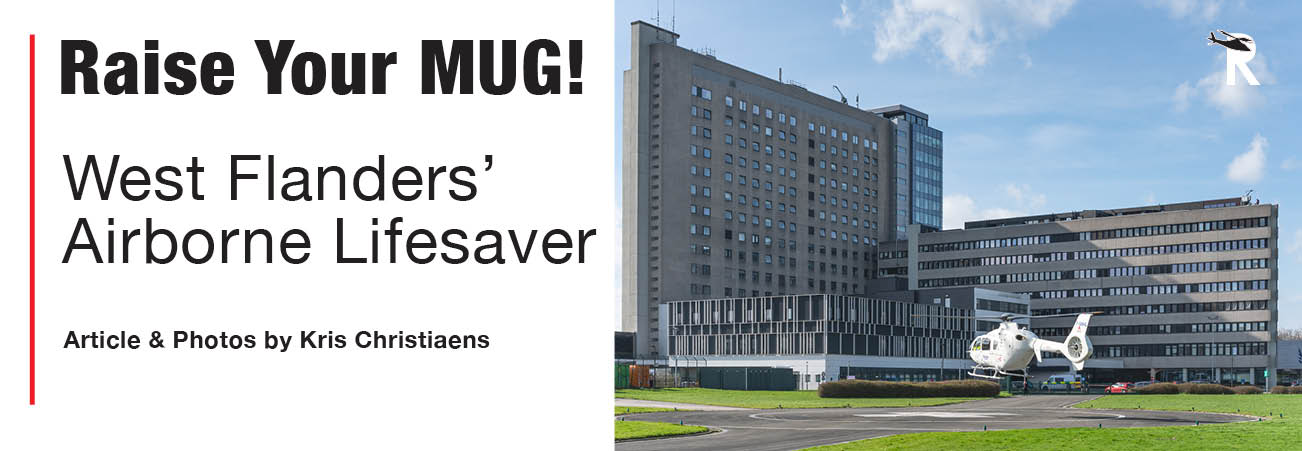
Some emergency services are defined by their equipment. Others are defined by the lives they save. The MUG-helicopter of West Flanders combines both. Operating out of the city of Bruges from a single helipad on the roof of AZ Sint-Jan hospital, this one aircraft functions as an airborne emergency medical unit for an entire Belgian province — and sometimes well beyond that border. In 2025, it crossed a milestone that had never been reached before in its nearly four decades of uninterrupted service: 1,000 medical interventions in a calendar year. That number, achieved on 6 December, is not merely a statistic. It represents 1,000 moments when a critically ill or injured person received advanced medical care faster than any road vehicle could have delivered it.
History of Persistence
Inspired by developments in the Netherlands, a government-backed experimental project called Helihulp launched in 1973. Under this initiative, a civil protection helicopter rotated between two bases: one at Beernem in West Flanders, supported by AZ Sint-Jan Bruges, and another at Crisnée in Wallonia. For over a decade, the project operated in this experimental form, but it was never given a permanent footing and was ultimately discontinued in 1986.
That same year, however, the IMDH — the Instituut voor Medische Dringende Hulpverlening — stepped in and took over the helicopter operation, establishing what has since become an uninterrupted service, making 1986 the true founding year of the MUG-helicopter as it exists today. A decisive turning point came in 1998, when the helicopter officially gained recognition as the only helicopter integrated into the 112 emergency medical system in Flanders, a distinction it still holds. Despite this formal status, it has never received structural federal government funding — a situation the IMDH has lobbied to change for decades without success.
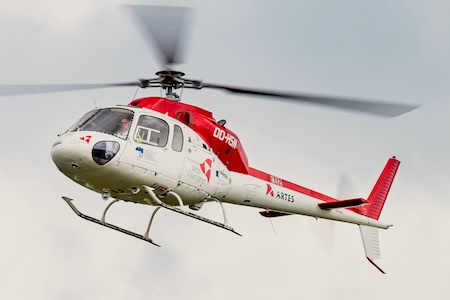
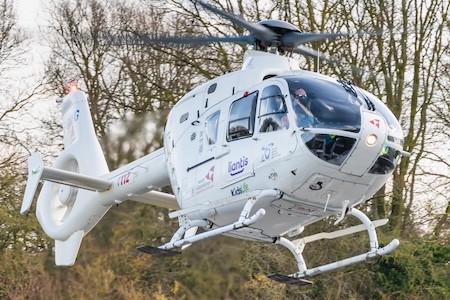
The fleet itself has evolved over the years. For a long time, the workhorse was an Aerospatiale AS355 Ecureuil twin-engine helicopter. In November 2008, the then-current aircraft — an AS355-F1 (registered OO-HSB) — was irreparably damaged in a crash near Bruges. Within months, a replacement was arranged: an AS355-F2 (registered OO-HSN) entered service in June 2009 and flew its final mission on Christmas Eve 2021. Since early 2022, the IMDH has operated an Airbus Helicopters EC135, flown under an operational partnership with the French helicopter operator Groupe SAF.
Covering a Province
The helicopter is permanently stationed at the helipad of AZ Sint-Jan hospital, the largest hospital in Bruges and a major regional medical center. From this central location within the province, the MUG-helicopter can reach any point in West Flanders within 15 minutes. Large portions of neighboring East Flanders and the adjacent Dutch province of Zeeland are also within an acceptable response window.
Speed is what makes the helicopter so valuable. After receiving a dispatch call from the 112 emergency center, the helicopter can be airborne in approximately five minutes. Once in the air, it covers roughly three kilometres per minute — equivalent to 180 km/h (112 mph). A ground-based MUG vehicle, by contrast, starts quicker (around two minutes) but averages only about one kilometre per minute (37 mph) on roads. The conclusion is clear: for any incident more than 10 kilometres away as the crow flies, the helicopter consistently arrives faster than any vehicle on the road. It operates every day of the year from sunrise to sunset, with an operational window extending from roughly 08:00 a.m. – 8:00 p.m. during long summer days. Night operations are not currently part of its mandate.
Organization Behind the Mission
The helicopter is operated and sustained by the Instituut voor Medische Dringende Hulpverlening (IMDH), a Belgian non-profit association founded in 1972 and based in Bruges. The IMDH's primary mission is to keep the MUG-helicopter operational, but its work extends further. It organizes first-aid training and medical education courses across both West and East Flanders, and provides medical teams at large public events to ensure rapid on-site response. It is, in short, an organization entirely devoted to closing the gap between the moment an emergency occurs and the moment qualified medical care arrives.
What MUG Means
MUG stands for Mobiele Urgentiegroep — Mobile Emergency Group. Its MUG-helicopter functions as a flying extension of AZ Sint-Jan's emergency department, dispatching a full medical team directly to the scene of life-threatening emergencies.
The helicopter is activated through Belgium’s (phone dial) 112 dispatch center, which assesses each incident and decides whether to deploy the air unit based on the nature and location of the emergency. It is particularly effective in rural areas that are harder to access by road; it is also deployed when the ground-based MUG unit for a given area is already occupied or when multiple simultaneous medical teams are needed. Every flight carries a crew of three: a professional pilot, a specialized emergency physician from AZ Sint-Jan's emergency department, and a specialized emergency nurse with qualifications in intensive care and emergency nursing. This is the legal minimum crew requirement for a MUG service in Belgium.
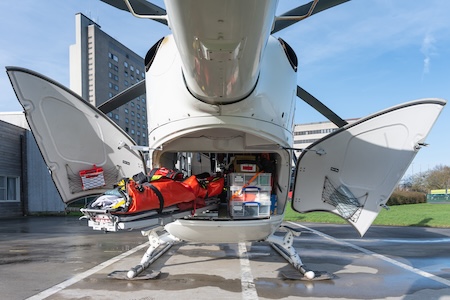
The medical equipment on board mirrors that of a ground-based MUG vehicles exactly: a defibrillator, a full resuscitation and intubation kit, a comprehensive range of emergency medications, monitoring equipment, and everything needed for hospital-level acute stabilization at the scene. In practical terms, the helicopter is a flying emergency department. Beyond emergency response, it also performs planned inter-hospital patient transports, participating in a broader network of pre-hospital and critical care logistics.
EC135 Advances Care
The transition to the Airbus Helicopters EC135 in early 2022 brought tangible improvements to the quality of in-flight medical care. The EC135 is a modern light twin-engine helicopter widely used for air ambulance operations across Europe, with its most immediately practical advantage being its cabin space. In the previous aircraft, only one medical crew member could sit alongside the patient during flight, with the other positioned beside the pilot — a limitation that constrained in-flight treatment. The EC135's larger cabin allows both the physician and the emergency nurse to sit with the patient throughout the flight, improving the standard of care that can be delivered en route.
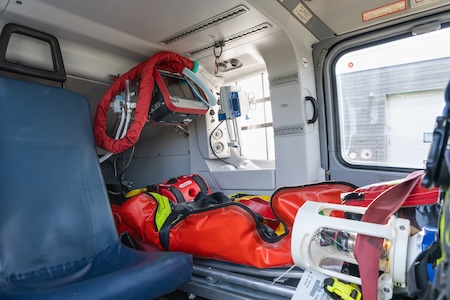
The aircraft is also significantly quieter than its predecessors, a detail that matters more than it might seem: emergency situations are already acutely stressful for patients and a quieter cabin reduces that burden. The improved layout has had a direct operational effect: more patients are now transported by air rather than being stabilized on-scene and handed over to a ground ambulance. The EC135 cruises at approximately 180 km/h (112 mph) and can carry one patient in a lying or a semi-seated position.
Numbers Tell the Story
The growth in annual interventions since 1986 illustrates how central the helicopter has become to West Flanders' emergency medical system. In 1987, its first full year under IMDH management, the helicopter completed approximately 200 interventions. By 2016, that figure had risen to 843. A dip to 611 occurred in 2021, probably attributable to the disruptions of the pandemic period, but the rebound was swift: by 2024, the service set a new record of 887 interventions — 501 in West Flanders, 381 in East Flanders, and 5 in the Dutch province of Zeeland.
Then came 2025. On 6 December, the helicopter surpassed 1,000 interventions in a single calendar year for the first time in its history. Along the way, it also set a single-day record of 10 interventions. The breakdown of 2025 call types reveals the scope of the work: cardiac and respiratory emergencies made up the largest share, while trauma cases — including traffic accidents, falls from height, and cycling accidents — accounted for roughly 200 interventions. More than 50 of those were full resuscitation calls. At least one intervention took place in France, reflecting the occasional cross-border reach of the service.
Not every dispatch results in a patient being transported. In 2024, more than 100 of the 887 dispatches were cancelled after the initial call; by the time the helicopter arrived or was en route, its intervention was no longer required. Of those that did proceed, just over 100 patients were transported by air; the remainder were treated on-scene and transferred to ground ambulances.
Statistically, the helicopter ranks as the fifth largest MUG service in a province served by approximately 10 ground-based MUG units. A single aircraft operating exclusively in daylight achieving that ranking is remarkable. The service is estimated to save approximately 40 lives per year that would otherwise have been lost if the fastest available response had been a road vehicle.
Community Funding
The annual operating cost of the MUG-helicopter is approximately 850,000 euros ($971,000). This covers the helicopter lease, maintenance, fuel, pilot and mechanic salaries, insurance, and all operational overheads. (The physician and nurse are employed by AZ Sint-Jan and their costs are not included in this figure.) Not a single euro comes from structural federal government funding. The IMDH has unsucessfully advocated over decades for this to change by emphasizing the helicopter's documented life-saving record. As of 2025, a formal recognition process within the Belgian emergency medical framework appears to be progressing; whether this will translate into financial support remains uncertain.
Funding comes instead from a patchwork of institutional and community sources. The Province of West Flanders is the primary institutional supporter, their funding is supplemented by contributions from cities and municipalities across both West and East Flanders, and from some Dutch municipalities near the border. Private companies provide additional sponsorship, and the IMDH also welcomes donations from the public via its website at https://www.imdh.eu/nl.
Powered by the People
The MUG-helicopter has long been appreciated by the people of West Flanders, but its profile rose nationally in the autumn of 2016 when the Belgian commercial television channel, VTM, began broadcasting a documentary series called Helden van Hier: In de Lucht — “Heroes of Here: In the Air.” Camera crews accompanied the IMDH helicopter team during actual interventions, bringing viewers face to face with the reality of pre-hospital emergency medicine. The series drew approximately half a million viewers per episode and prompted a second season in 2017. It remains one of the most prominent documentary productions ever made about Belgian emergency services and it brought a broad audience into contact with the helicopter's mission for the first time.
The combination of that public affection, four decades of continuous operations, an annual record now surpassing 1,000 interventions, and an estimated 40 lives saved each year that would otherwise have been lost makes the MUG-helicopter of West Flanders something genuinely speciall: a community-funded, publicly beloved, rigorously professional emergency service that, despite operating without federal structural support, has become an indispensable part of the medical infrastructure of an entire province.
READ MORE JUL/AUG ISSUE
READ MORE ROTOR PRO: https://justhelicopters.com/Magazine
WATCH ROTOR PRO YOUTUBE CHANNEL: https://buff.ly/3Md0T3y
You can also find us on
Instagram - https://www.instagram.com/rotorpro1
Facebook - https://www.facebook.com/rotorpro1
Twitter - https://twitter.com/justhelicopters
LinkedIn - https://www.linkedin.com/company/rotorpro1