|
Aug
24
2026
|
|
Posted 63 days ago ago by Admin
|
|
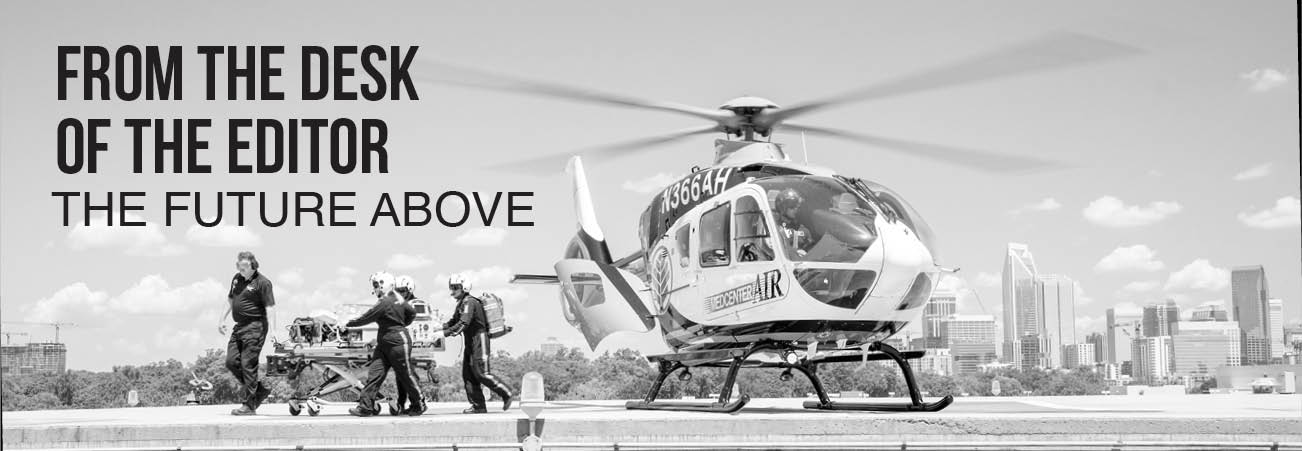
Twenty-six years ago, I remember being in the cockpit of my S76C+ HEMS helicopter and marveling at the technology I had at my fingertips: twin FADEC engines, glass cockpit, and a four-axis autopilot. The helicopter could literally fly itself better than me. We still didn’t have NVGs, TAWS, HUMS, CVR, and all the other acronyms that would equate to aviation advancement like nothing our industry has ever seen.
Even though terms like uncrewed, drone, and UAS were not part of our vernacular back then, I remember having philosophical conversations with crewmembers around the lunch table pontificating on how someday, there would be computerized, unmanned aircraft that would be able to do our work, and most often, those conversations ended with, “That’ll never happen.”
It’s Happening and Here’s Why
Now don’t get me wrong, HAA/HEMS pilots aren’t going anywhere anytime soon, but as Bob Dylan sang, “The times, they are a changing.” Broader air-ambulance services are projected to grow from roughly $13.4 billion to $14.6 billion in the mid-2020s toward more than $23 billion by the early 2030s, with rotary-wing platforms contributing meaningfully to that expansion. North America continues to account for the largest share, while the Asia-Pacific region shows the fastest growth as their healthcare systems modernize.
Yet, helicopter medical services face persistent structural pressures: high capital and high operating costs, pilot and clinical workforce shortages, weather-related limitations, variable night and instrument-flight capabilities, and uneven infrastructure (such as helipads and coordination systems) constrain reliability. These realities mean that even mature systems cannot reach every patient who might benefit.
Is There a Place for UAS?
Uncrewed aircraft systems (UAS), such as drones, offer a complementary—but not replacement—pathway. Already, real-world programs are demonstrating their value. In Sweden and at several U.S. sites, drones deliver automated external defibrillators to out-of-hospital cardiac arrest scenes faster than traditional responders, enabling bystanders to intervene in time-sensitive minutes.
Looking further ahead, larger uncrewed or hybrid electric vertical takeoff and landing (e-VTOL) aircraft may eventually transport stable patients or specialized equipment over short-to-medium distances, reducing crew exposure in high-risk environments and expanding coverage in underserved regions. Regulatory progress, particularly frameworks enabling routine beyond-visual-line-of-sight operations, will be decisive, as will integration with existing emergency dispatch, cold-chain logistics, and clinical protocols. The challenges of weather resilience, payload capacity, airspace management, cybersecurity, and public acceptance remain real and must be addressed through rigorous testing and evidence-based policies.
So, What’s the Bottom Line?
HAA will continue to form the backbone of advanced aeromedical response for the foreseeable future. However, unmanned aircraft can close critical gaps by delivering equipment and supplies —and perhaps eventually patients—more rapidly, safely, and affordably in select missions. The opportunity is to build hybrid networks that combine the proven strengths of crewed HEMS with the agility of uncrewed aviation, ultimately saving more lives with greater efficiency and equity. The sector’s next chapter depends on thoughtful collaboration among operators, regulators, clinicians, and technologists to make that integration a reality. Instead of saying, “That’ll never happen,” let’s realize that it’s just beginning to happen--now.
READ MORE JUL/AUG ISSUE
READ MORE ROTOR PRO: https://justhelicopters.com/Magazine
WATCH ROTOR PRO YOUTUBE CHANNEL: https://buff.ly/3Md0T3y
You can also find us on
Instagram - https://www.instagram.com/rotorpro1
Facebook - https://www.facebook.com/rotorpro1
Twitter - https://twitter.com/justhelicopters
LinkedIn - https://www.linkedin.com/company/rotorpro1