|
Aug
24
2026
|
|
Posted 42 days ago ago by Admin
|
|
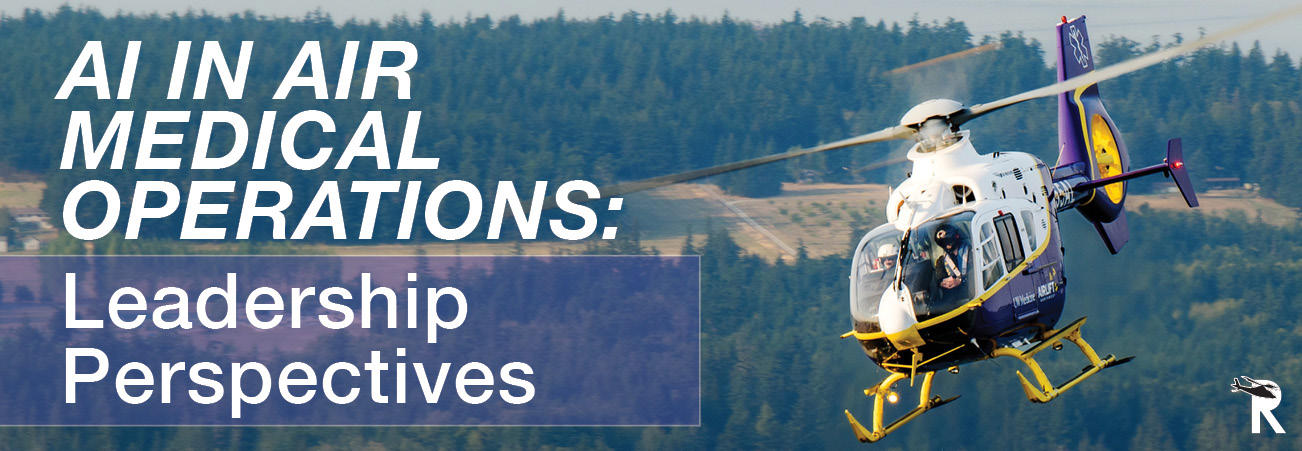
Across several industry meetings this past year, I’ve been struck by how few air medical executives have a clear roadmap for artificial intelligence in their organizations, but this isn’t surprising given the rapid pace of AI development.
Leaders’ questions consistently focus on where to begin and how to balance compliance and costs with the promise of improved safety, clinical quality, and operations. The challenge is that AI features are appearing in the operations, clinical, and quality applications we already use, faster than our organizations can absorb them. There’s also a growing body of research using AI for clinical decision support, accident analysis, pilot and clinical training performance, and dispatch optimization, among other areas.
Kolby Kolbet, chief innovation officer at Life Link III, and Angela Atwood, clinical development specialist at GMR, are two colleagues working through these questions in their own programs. Vendors are racing to integrate AI features, and as Kolbet has put it, “everyone’s trying to do something just to be first.” While the features may arrive quickly, the downstream costs surface later in implementations that weren’t well built or clearly mapped across the organization.

What follows are five leadership approaches with a set of AI readiness questions at the end. These approaches are grounded in air medical operations but have clear parallels to firefighting, offshore, and public safety operations.
AI literacy
AI literacy is the work most programs are doing right now, and it is the right starting point. As Atwood has explained, “the issue is a lot of people don’t know what it’s capable of or where the capabilities currently exist.” AI is much broader than the chat assistants most people imagine. It includes a range of methods, such as large language models, computer vision, and predictive analytics, with use cases spanning from ambient AI in clinical documentation to dispatch decision support and demand forecasting.
Once teams see the full scope of the field, their thinking shifts. Atwood has seen this change firsthand: “People went from really not knowing anything besides ‘ChatGPT helps me with my email’ to exploring all kinds of use cases.” She’s been successful in treating AI literacy as another educational opportunity for staff at all levels.
Before choosing any tools, the team needs a shared understanding of what AI is and isn’t, and the leadership team must agree on the direction. Kolbet said, “The challenge right now is helping everybody see that vision.”
With literacy established and leadership aligned, the next step is to focus on a problem AI is well-equipped to solve.
Lead with the problem
Before choosing any AI tool, it’s important to clarify the problem we want to solve. Whether it’s improving dispatch reliability, monitoring clinical guideline adherence, or identifying new hotspots in patient demand, the best use cases come from clearly defined problems. As Atwood said, “It’s always helpful to define a problem to solve that most people can rally around.” A shared problem creates momentum.
Instead of beginning with the technology and asking where the team fits, start with the work the team already does and determine where AI fits within it.
Provide approved tools and acceptable use
There’s a concept called shadow AI that occurs when programs heavily restrict AI use, prompting staff to use unauthorized tools outside their official environment, often on personal devices. Concerns about compliance and risk increase when this happens. Kolbet observes, “If we block everything, they’re going to find a way to use it.” Conversely, as Atwood has seen, “If you put a tool out there that people know they can use safely, and it’s supported, it’s going to have everybody look for ways to solve problems differently.”

Start by creating an acceptable-use policy and providing some vetted tools or platforms. As leaders, we have the opportunity to make the safe choice the easy choice.
Map end-to-end impact
Kolbet said, “We are not trying to solve yesterday’s problems with AI. We are creating new solutions with tools that did not exist before.” This forward-looking perspective involves system requirements that most programs underestimate. AI rarely improves a process in isolation.
Take predictive analytics on patient demand, for example. An AI model can identify patterns in flight volume by hour, day, and season, which is useful for adjusting shift times or expanding coverage. While the operational plan seems logical on paper, in practice, it relies on hiring, training, and onboarding new pilots, clinicians, and dispatchers, processes that can take months.
Therefore, AI detects patterns faster than the operations team can respond. This also highlights why the teams using the tool need to be involved in its development.
Anticipate second-order effects
While AI can improve efficiency in our daily work, the supporting data infrastructure usually needs to scale up as well, and the costs increase accordingly. So, even if an automation project costing $180,000 is considered high-value for the organization, you might discover you need a vendor for data integration, leading to thousands of dollars in monthly support fees. “So, all of a sudden, you have data fees that you never had before,” Kolbet notes.
In another example, Kolbet’s team at Life Link III has been using ambient AI in the clinical setting to streamline documentation. The technology works for documentation, but the audio capture overlaps with what the FOQA system considers flight-quality data, raising a governance issue that spans both clinical and operational areas. Leaders should anticipate these types of second-order effects.
Assess AI readiness
Air medical leaders are guiding the direction and strategy of our programs. AI provides new inputs that, when used effectively, support the existing strategy. It also broadens what’s achievable for our patients and programs. These six questions help assess AI readiness and set teams up for success:
1. How do your leaders define the role of AI in the organization?
2. What does your team understand about AI, and where are the knowledge gaps?
3. What problem is your AI work aimed at solving?
4. What approved tools and guidelines for acceptable use does your team follow?
5. What are the staffing, cost, and governance implications of your top AI use case?
6. How are your frontline providers involved in developing AI tools?
Written by Kyle Danielson, RN, MPH, MN, CMTE
Director of Operations at Airlift Northwest, UW Medicine; Principal at Flightline Strategy LLC
In collaboration with:
Angela Atwood, MSN, CFRN, FP-C
Clinical Development Specialist at Global Medical Response
Kolby Kolbet, RN, MSN, CFRN
Chief Innovation Officer at Life Link III
READ MORE MAY/JUNE ISSUE
READ MORE ROTOR PRO: https://justhelicopters.com/Magazine
WATCH ROTOR PRO YOUTUBE CHANNEL: https://buff.ly/3Md0T3y
You can also find us on
Instagram - https://www.instagram.com/rotorpro1
Facebook - https://www.facebook.com/rotorpro1
Twitter - https://twitter.com/justhelicopters
LinkedIn - https://www.linkedin.com/company/rotorpro1