|
Aug
17
2026
|
|
Posted 63 days ago ago by Admin
|
|
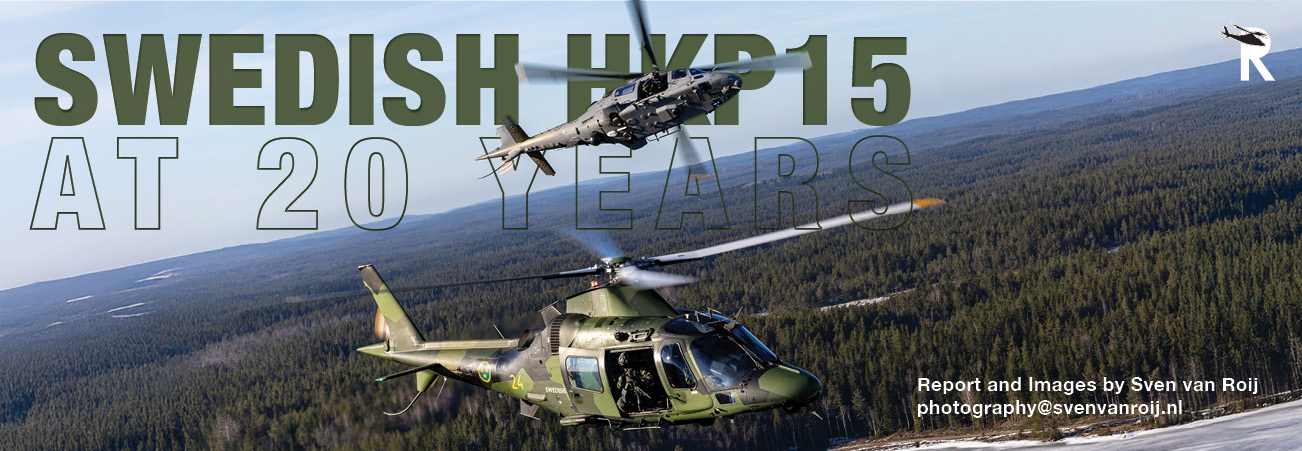
When the Swedish armed forces introduced the HKP15 in the mid-2000s, the aircraft was never intended to become one of the most versatile assets in their rotary-wing fleet. Originally acquired to serve as a cost-effective training platform, the HKP15 has since evolved into a true workhorse. Commander of the 22nd Helicopter Squadron, Major Anderas Pantesjö, informs our photojournalist correspondent, Sven van Roij, on the diversity of assignments of his squadron over the years.
The Swedish armed forces developed its own military naming system long before joining NATO. Sweden still uses ‘HKP’ (derived from the Swedish word ‘helikopter’) as its designation for helicopters. The HKP15, an AgustaWestland AW109 light utility helicopter, is closely tied to Sweden’s helicopter reforms in the early 2000s. Until then, the Swedish military operated separate helicopter units for their army aviation, search and rescue ops, maritime aviation, and air force. Major Pantesjö said, “During the times of budget cuts, the Swedish ministry of defense saw economic reasons to put those units together and create one Helicopter Wing.” Pantesjö, who has been flying with Sweden’s air force for over 20 years, continues, “The establishment of the Helicopter Wing also ensured helicopter operations became more standardized. At the time, we operated the HKP4, HKP9B, HKP10 and HKP11 (respectively the: SeaKnight, Bo105CBS, Super Puma, and AB 412) and the accident rate was higher. Creating a more uniform way of operating helicopters was a positive contribution to our flight safety. Since then, all military flying personnel and material in Sweden became part of the Flygvapnet, the Swedish air force.”
Twenty Airframes, Two Roles
A total of 12 land-based HKP15As and eight maritime HKP15Bs were ordered in June 2001. After several delays, the aircraft were delivered from February 2006 onwards. Pantesjö said, “The aircraft would initially serve as a training aircraft for our HKP14 (NHIndustries NH90) fleet, since the type was cheaper to operate. As delays and limitations affected the HKP14 program, the HKP15 filled our operational gaps. When the HKP15 arrived, we immediately saw its operational usages for our special forces and maritime operations.”
.jpg?ver=M40vKsGpqj3Iij5aF36V4g%3d%3d)
The pilots of the 22nd Helicopter Squadron use both the splinter-camouflaged HKP15A and the grey maritime HKP15B, as there are no major technical differences between the two variants. Pantesjö said, “The navy prefers to operate the HKP15B since they can be used on ships, but they can also operate the green helicopters if not being stationed aboard.”
Air Force Helicopter in a Raincoat
The minor differences are primarily related to additional capabilities for naval operations, such as mooring points for shipboard use and sensor systems including electro-optical forward-looking infrared (FLIR) equipment. The maritime helicopters are also equipped with air conditioning.
The unit assigned with maritime duties is 31 Stingray. Since the establishment of the Helicopter Wing, the HKP15B fleet has been part of the Swedish air force, pilots of the 31st are thus air force personnel. Pantesjö said, “The naval operations squadron is based in Ronneby and carries out a broad range of missions. The HKP15B is not a purpose-built anti-submarine warfare (ASW) aircraft due to the absence of a sonar. The unit thus has limited capability in ASW-related operations. There is the possibility to install a sonobuoy rack in the back. With its FLIR, and a size that suits landing on the relatively small Swedish naval vessels, the platform is perfect for sea traffic control and other naval warfare roles.
.jpg?ver=GfowN8ilAKfiPE9m7kIO8g%3d%3d)
With these capabilities, Sweden deployed a HKP15B in support of “Operation Atalanta” in Somalia several times. More recently, the type was deployed aboard the HSwMS Carlskrona patrol vessel for maritime surveillance in the Baltic Sea as part of the “Baltic Sentry” operation.
Initial Flight Training
Today, all Swedish military helicopter pilots begin their careers at the German International Helicopter Training Center in Bückeburg, regardless of their eventual specialization. After their training in Bückeburg, the trainees return to Sweden and continue their program at the Flygvapnet. At the 3rd Helicopter Squadron of the Flygskolan (Flight School) at Luftstridsskolan (LSS), the trainees will fly the HKP15 for the first time. Since the flight school does not operate its own helicopters, it relies on the helicopter wing’s fleet.
Flight school is followed by a year of Combat Readiness Training (CRT) with Major Pantesjös’ 22nd helicopter squadron or the 31st naval-oriented squadron. He said, “The 22nd is placed under the 2nd Helicopter Unit and part of the Helicopter Wing. During their CRT, my trainees refine their skills in realistic scenarios. After completing CRT, pilots may remain within the light helicopter unit or transition to the HKP14F/N (NH-90) or HKP16A (UH-60M), Swedish medium-lift platforms.”
From Transport to Fire Support
In addition to their primary CRT mission, Pantesjö’s unit carries out a wide range of other tasks, including personnel transport, reconnaissance, and general utility operations. In recent years, a new capability has been introduced: aerial sharpshooting and sniper support roles.
This represents a significant development in how the HKP15 is used at the unit. “These operations are something that we have never done at our squadron before. Since we fall under the command of the army in wartime, we have started taking responsibility to maintain these tasks on the light helicopter system in Sweden,” Pantesjös said. For this purpose, the HKP15 can be equipped with weapon systems such as the Ksp 58 (a Swedish variant of the Belgian FN MAG) and the Ak 4D (a license-built version of the Heckler & Koch G3 battle rifle).
.jpg?ver=-NdQdIxC4VGbB-jlgKDD_w%3d%3d)
For special operations, the helicopter is capable of fast-roping and rappelling using both internal and external attachment points. However, roping operations are not currently being carried out on the type. Pantesjö explained, “This is partly due to the fact that our special forces unit is no longer using this light helicopter. However, we still retain the equipment and several qualified instructors.”
Bridging the Talent Gap
Staffing has proven challenging for armed forces and operators all around the world. Pantesjö said, “It’s a problem overall in Sweden, and I guess in other countries as well. We simply do not have enough people. At the moment, I am training just four new pilots but a wave of retirements is approaching fast. This does mean more people will leave service then enter the unit. I think we will notice this problem in 2028. It has to do with the different pension ages in Sweden. For pilots, normally they can go at the age of 55 after a certain year of service. In two years from now, a lot of people can go. I am extremely happy a couple of guys have decided to prolong their service and are choosing to stay beyond their official retirement age.”
Born in 1983, the major finds himself in an unusual position: being among the oldest active pilots in his unit, yet still part of what should be his mid-career. He said, “That’s not desirable, there should be people who are two, three, or five years older than me in that middle layer to transfer their knowledge to the younger generation.”
Availability and Maintenance
Since 2012, Saab has had an exclusive agreement with the Försvarets Materielverk, Sweden’s defense material administration, to ensure the operational availability of the HKP15 fleet.
A significant portion of scheduled missions and training sorties are successfully completed, suggesting the fleet is performing well and the unit maintains a respectable level of operational output. “Since we have 20 aircraft, quite a few of them are available every day. If you look at how many of the planned missions we can actually fly, it’s quite a lot,” Pantesjö noted.
.jpg?ver=J-r_yAsaqOJAEpXnOR7UEQ%3d%3d)
However, the reality on the flightline tells a different story. Pantesjö said, “Aircraft that are technically part of the available fleet may not always be immediately ready. Maintenance cycles, inspections, and logistical considerations mean some helicopters are kept in a planned rotation or held back until another becomes ready. This way, availability is more of a managed process than a simple number. For example, we are now in a training week at the Villingsberg shooting range with four of our aircraft. All four are working, but it is not always like that.”
Future of Fleet
Over the years, the fleet has maintained a strong safety record. Pantesjö said, “Fortunately, we did not have any fatal incidents with the aircraft. We have had hard landings that took months to fix, but these have been resolved without long-term impact.”
However, after two decades of service, the HKP15 fleet faces increasing maintenance challenges. The squadron commander said, “While the aircraft have proven reliable overall, aging systems and limited availability of spare parts are beginning to affect operational readiness. Given the platform’s age and planned retirement timeline, major upgrades are not considered cost-effective. In addition, it is becoming increasingly difficult and expensive to obtain replacement parts. The future of the platform is closely tied to the upcoming defense budget decisions. We are hoping that we will get enough funding so that we can order new light helicopters.
“When the funding will be clear, I would prefer to acquire the same type that the International Helicopter Training Center at Bückeburg has started to operate. This will reduce the education time in Sweden by three to four months.” The commander does not wish to comment further on the specific type, but it is widely understood to be the Airbus H145M. A decision will have to be made soon, since the HKP15 should leave service around 2030.
READ MORE MAY/JUNE ISSUE
READ MORE ROTOR PRO: https://justhelicopters.com/Magazine
WATCH ROTOR PRO YOUTUBE CHANNEL: https://buff.ly/3Md0T3y
You can also find us on
Instagram - https://www.instagram.com/rotorpro1
Facebook - https://www.facebook.com/rotorpro1
Twitter - https://twitter.com/justhelicopters
LinkedIn - https://www.linkedin.com/company/rotorpro1