|
Aug
09
2026
|
|
Posted 67 days ago ago by Admin
|
|
VIEW VIDEO
Search-and-rescue dogs have been saving lives for decades; their extraordinary sense of smell and hearing make them one of the most powerful force-multipliers in emergency response. In South Africa, these four-legged specialists are increasingly pairing their skills with another vital tool, the helicopter.
From dense bush to rugged mountain terrain, helicopters allow K9 teams to reach areas that would otherwise take hours—or days—to access on foot. For a select group of highly trained dogs and handlers, rotary-wing operations have become a crucial part of modern search and rescue.
Front-Line Dogs
South Africa has a tradition of working dogs in conservation and law enforcement. South African National Parks (SANParks) rangers, private security units, and volunteer organizations all rely on K9s for tracking, detection, and apprehension. Their success record is undisputed, particularly in anti-poaching operations where speed and precision are critical.
Only a small number of these K9 teams are trained to operate with helicopters. Achieving this capability requires an exceptional bond between handler and dog, advanced training, and a deep understanding of aviation safety and procedures.
Enter K9 SARA
One of the organizations at the forefront of this specialized capability is the K9 Search and Rescue Association of South Africa (K9 SARA), a non-profit, volunteer organization dedicated to finding missing persons in wilderness, urban, and disaster environments.
Founded in 1998, K9 SARA consists entirely of civilian volunteers and their dogs. These are not government-owned animals, but highly trained companions whose handlers fund their own equipment, transport, and training. Units operate nationally with active teams in Gauteng, the Western Cape, and KwaZulu-Natal.
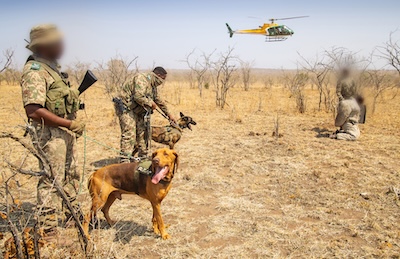
When people go missing in the mountains or buildings collapse, it is often K9 SARA dogs that help turn potential tragedies into successful rescues.
“Get to the Chopper”
Speed saves lives—and helicopters provide it.
Many K9 SARA missions require rapid deployment into remote or inaccessible terrain. Helicopters allow teams to: bypass obstacles, reduce response times dramatically, and insert dogs precisely where they are needed.
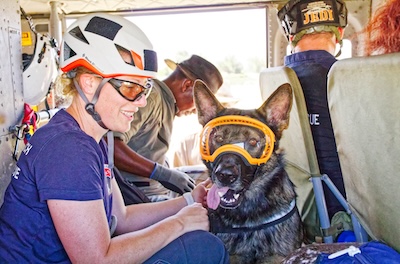
Of course, helicopters are not a natural environment for dogs. The noise, vibration, confined space, and rotor wash can overwhelm even confident animals. That’s why helicopter operations require specialized training for both dog and handler.
Recent helicopter training sessions conducted by K9 SARA were as serious as they were impressive. While there’s something undeniably endearing about a dog in a flight-ready harness, that appearance pales to their critical, potentially life-saving work.
Helicopter Training
Helicopter familiarization for K9 teams is carefully structured and progressive, focusing on safety, confidence, and operational readiness:
Desensitization
- Dogs are gradually introduced to the noise, vibration and movement of helicopters, ensuring the aircraft becomes a familiar working environment rather than a source of stress.
Aircraft Familiarization
- Handlers and dogs learn to safely operate around the helicopter, reducing the risk of startle responses during deployments.
Entry and Exit Procedures
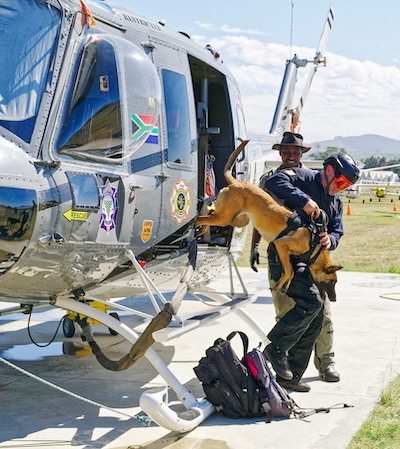
- Dogs are trained to board and disembark safely, including exposure to winch or hoist scenarios where aerial insertion may be required.
Mission Focus
- Even in an unfamiliar airborne environment, dogs must remain task-focused—tracking scent, responding to handler commands and working alongside aircrew.
Positive Association
- Training reinforces the helicopter as just another tool of the trade, building trust and confidence rather than fear.
The Right Sniff
K9 SARA trains both air-scenting dogs capable of detecting human scent carried on the wind across large areas, and scent-specific trailing dogs that follow individual tracks in urban and wilderness environments.
“These dogs can cover far greater distances than human searchers and locate people hidden in places we might never think to look,” the organization states. “They are trained to international standards, and handlers must be highly skilled in reading their dogs to ensure nothing is missed.”
Training takes approximately two years with teams evaluated every two years to maintain operational readiness. Standards are aligned with those of the American Rescue Dog Association (ARDA), U.S. agency FEMA, and the International Rescue Dog Organization (IRO), of which K9 SARA became a member in 2012.
On Call
K9 SARA teams are available 24/7, nationally, and can deploy internationally under the right circumstances. They operate at no cost, responding on instruction from park rangers, Metro EMS, Disaster Management, Wilderness SAR units and the Aeronautical Rescue Coordination Center (ARCC).
It’s a remarkable commitment from volunteers, handlers, and dogs alike.
K9 Criteria
Prospective K9 candidates must meet strict requirements: under one year old at entry, physically fit, medium-sized, toy-driven, non-aggressive, and without prior protection or attack training. Successful applicants begin a year-long probation before qualifying as operational teams.
For those who make the cut, the reward is not fame or fortune, but the chance to save lives.
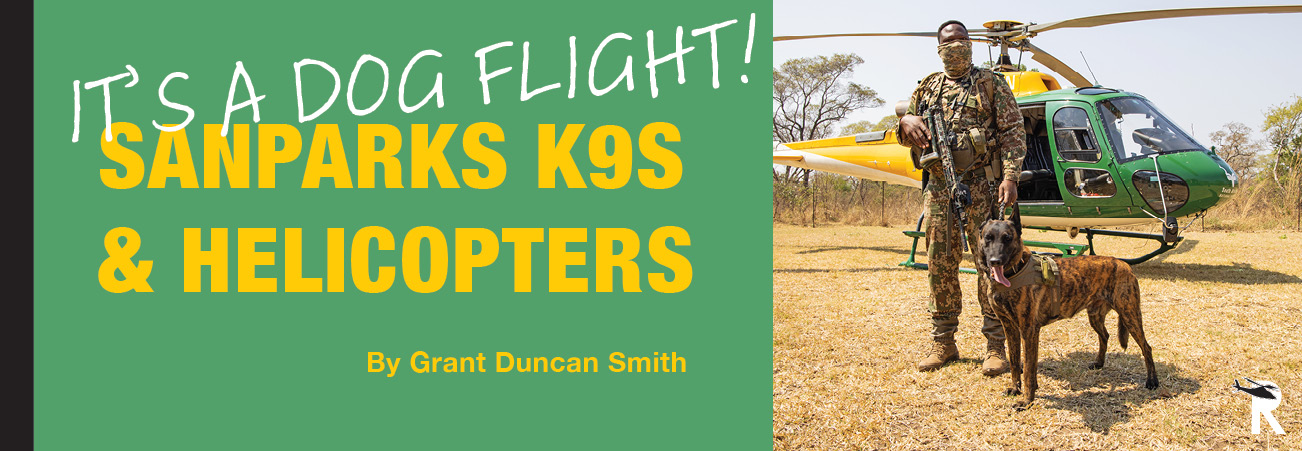
Deep in South Africa’s Kruger National Park, the fight against poaching and illegal incursions is waged by rangers, aircraft, and the canine class of the animal kingdom. SANParks currently deploy 52 highly trained working dogs across the park, each paired with a dedicated handler and integrated into specialized operational roles, many of them airborne. Sam Madalane, the K9 unit manager, provides insights on how the dogs and handlers are trained.
Within the Special Operations Unit, apprehension dogs are trained across multiple disciplines. These include aerial deployment, night operations, detection work, and long-range tracking— all are capabilities that dramatically extend the reach and effectiveness of helicopter-supported missions. Ranger dogs, by contrast, focus primarily on ground tracking, following human scent over vast and often hostile terrain.
At entry and exit points, gate dogs play a critical detection role. These dogs are trained to identify explosives, firearms, ammunition, and illegal wildlife products, providing an essential layer of security before threats ever reach the bush.
In high-risk areas, human-scent incursion detection dogs are deployed to hotspot zones, where they are able to detect and follow fresh human scent, which is often the first indication of an illegal crossing or poaching attempt.
Temperament Before Training
Before any dog ever approaches a helicopter, careful assessment is essential. Trainers evaluate each dog’s temperament and identify a favorite toy or reward item. This becomes the cornerstone of motivation. For the dog, the work must remain a game—positive, engaging, and rewarding. A relaxed, confident dog performs better, especially in the high-noise, high-stimulus aviation environment.
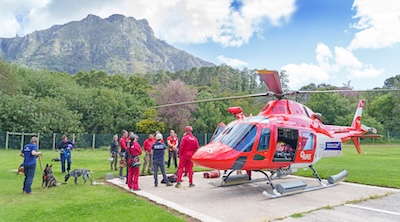
Introducing the Heli
Helicopter familiarization is conducted methodically, with the emphasis on calm exposure rather than force.
Training begins with loading the dog into the helicopter, with only the pilot on board. Once settled, the rest of the team is introduced. Everyone secures themselves while handlers ensure both dogs and humans are wearing appropriate hearing protection. Normal conversation is encouraged to reduce tension and reinforce calm behavior.
The engine is then started. At idle, the dog’s reactions are closely observed while the atmosphere remains relaxed. As power is increased to heavy idle, handlers continuously reward the dog with treats while team members gently touch and interact with it, making the aircraft feel like just another working environment.
Only after the dog is fully settled does the helicopter lift off. Behavior is monitored throughout the flight and again on landing. There is no rush to exit; observation continues until the dog remains calm and focused. Team members disembark last, reinforcing the idea that nothing about the helicopter experience is unusual or threatening.
As trainers describe it, the goal is simple: draw the picture you want the dog to see.
When done correctly, the result is an airborne K9 — a dog that is comfortably capable under spinning rotors in one of Africa’s most challenging operational environments. These teams prove one thing beyond doubt: aviation K9s increase capability.
VIEW VIDEO
READ MORE MAY/JUNE ISSUE
READ MORE ROTOR PRO: https://justhelicopters.com/Magazine
WATCH ROTOR PRO YOUTUBE CHANNEL: https://buff.ly/3Md0T3y
You can also find us on
Instagram - https://www.instagram.com/rotorpro1
Facebook - https://www.facebook.com/rotorpro1
Twitter - https://twitter.com/justhelicopters
LinkedIn - https://www.linkedin.com/company/rotorpro1