|
Aug
04
2026
|
|
Posted 84 days ago ago by Admin
|
|
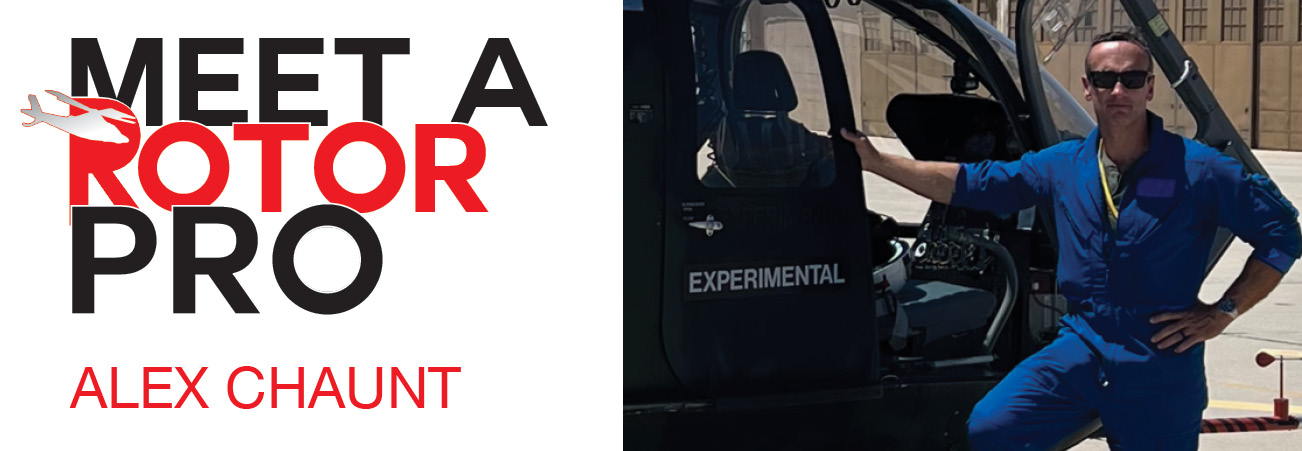
RPMN: What is your current position?
Founder and CEO of Anthelion Helicopters and I’m a helicopter experimental test pilot.
RPMN: Tell me about your first experience with helicopters?
It was while I was on my first ever cruise as a teenager in Alaska. We did a trip up to the glaciers to go dog sledding—or in our case, falling off, because we were terrible at controlling our sled! We took an AS350 AStar up there and back, and I remember thinking just how cool it,and the pilot, were and how complicated it seemed. From then on, I started reading some fiction novels with one of the key characters being a helicopter pilot, who naturally got all the girls, so I was hooked on beginning the journey!
RPMN: How did you get your start in the helicopter industry?
Following my desire to get started and emulate one of my heroes from the novels I was reading, I picked up the yellow pages, which in those days was about the size of a nuclear reactor, and turned through it to look for helicopter flight schools. The first one I found was called AlexAir; it was just a few miles away and I thought at that point it was fate. So, off I went to figure out how to get started.
RPMN: If you were not in the helicopter industry, what else would you see yourself doing?
Interesting question; I could go a number of ways. If I were to stay in aviation in general, getting into the test piloting world in the eVTOL DEP (distributed electric propulsion)/tiltrotor side has an appeal. They suffer from extremely complex and challenging aerodynamic and associated handling issues, which would be fun to tackle.
The space sector, being a general sci-fi geek, also has a huge appeal in many ways.
Out of left field, I’ve always wanted to start my own rock-climbing gym as climbing is a big passion of mine, although my body doesn’t thank me most of the time. I’d also like to have the time to finish my PhD someday before I'm 110 years old!
RPMN: What do you enjoy doing on your days off?
What’s a day off in the business-ownership world?? I enjoy being with my family: teaching my son how to build more complex LEGO sets (for which he has zero patience), climbing and working out with my wife. Managing the zoo we call a household (with two new cats: one crazy kitten and one large 4-year-old with paws the size of trash-can lids; they supplement our existing cat and dog) is an endeavor in itself! Besides that, growing my fruits and vegetables (with varying degrees of success), and reading more about life, the universe, and everything fill every waking moment.
RPMN: What is your greatest career accomplishment to date?
While I’m extremely proud to have accomplished a multitude of groundbreaking flying and industry firsts during my tenure as an experimental test pilot, I have to say that getting our company through the COVID pandemic was probably the greatest accomplishment. We were so close, many times, to shutting our doors permanently both during the pandemic and in the following years when we grappled with its after-effects of inflation and uncertain consumer sentiment. The mental toll it took was tremendous, and, at the time, forced me to take a second job. I refused to give up after so much blood, sweat and tears, and pivoted how the business ran in the belief that what we were doing was important.
RPMN: Have you ever had an ‘oh crap’ moment in helicopters? Can you summarize what happened?
I’ve had more than my fair share as an experimental test pilot, but that’s somewhat expected and inferred by the job description, I'll go back to early in my commercial career. One of the most memorable, for all the wrong reasons, was when I was conducting power-line survey work in Colorado many moons ago. I was flying in all the wrong ‘H’ conditions in an old beat-up B206 with the standard (terrible) tail rotor blades. I was High, over 8,000 feet, close to the mountains. It was hot, being summer, and I was as heavy as a bank vault, loaded up with LIDAR equipment…and pilot snacks.
As anyone knows from LIDAR power-line survey work, you’re flying low and slow, and making all directional changes predominantly with the tail rotor rather than the cyclic to keep the aircraft flat and the equipment in view of the lines. On one particular occasion, I let my concentration lapse after flying all day and made a slow, flat left-hand turn onto a line into a tailwind while going 30 knots at less than 300 feet. When I got onto the new line, the aircraft resolutely continued its left turn despite full opposite pedal as I entered an LTE condition. The only thing I could do was ‘dive’ the aircraft off the line (without getting low-G) to gain airspeed and stability. It gave me a real appreciation for LTE and to always be aware of wind direction.
RPMN: If you could give only one piece of advice to new pilots, mechanics, or support personnel, what would it be?
As Al Pacino said in The Devil's Advocate, “The worst vice is advice,” so I’ll say that my biggest suggestion and perspective is how important it is to critically LISTEN and LEARN when deciding to come into any area in the aviation sector, or indeed, to select a school for flight training. The importance of separating the hyperbole and misinformation from social media when you get bombarded from all directions by adverts, crazy videos glorifying questionable behavior, and “expert” opinion pieces is so important. There is a huge amount of opportunity in the future of our industry, and it's an amazing time to get involved with the emergence of so many new and exciting technologies, but be wary of getting sucked in under pretenses that may give you a very distorted view of reality.
RPMN: In your view, what is the greatest challenge for the helicopter industry at this moment in time?
I think right now, it’s the issue of emerging technologies and how to, or indeed how they should, integrate and interact with existing legacy platforms and infrastructure. This is from both a regulatory and integration (hardware and software) perspective. There can be no doubt that drones will continue to develop in both complexity, speed, size, and use cases. However, their successful integration into the National Airspace System, keeping them de-conflicted with other manned traffic, has not yet been resolved as far as I am aware. Likewise, the eVTOL DEP industry has an uncomfortable relationship, at best, with the existing helicopter industry, threatening, at least in principle, to take significant urban market share from traditional rotorcraft. However, the true reality of in-service timelines and exactly how they will integrate into large U.S. metropolitan environments is unclear. Lastly, the evolution of AI will undoubtedly create many challenges in how aircraft are piloted in the future.
We are currently largely deterministic in our software design for fly-by-wire and augmented systems for system behavior predictability. The lure of using AI to develop potentially more powerful non-deterministic control systems will create very challenging and convoluted flight-risk profiles for companies to manage safely.
READ MORE MAY/JUNE ISSUE
READ MORE ROTOR PRO: https://justhelicopters.com/Magazine
WATCH ROTOR PRO YOUTUBE CHANNEL: https://buff.ly/3Md0T3y
You can also find us on
Instagram - https://www.instagram.com/rotorpro1
Facebook - https://www.facebook.com/rotorpro1
Twitter - https://twitter.com/justhelicopters
LinkedIn - https://www.linkedin.com/company/rotorpro1