|
Jul
27
2026
|
|
Posted 87 days ago ago by Admin
|
|
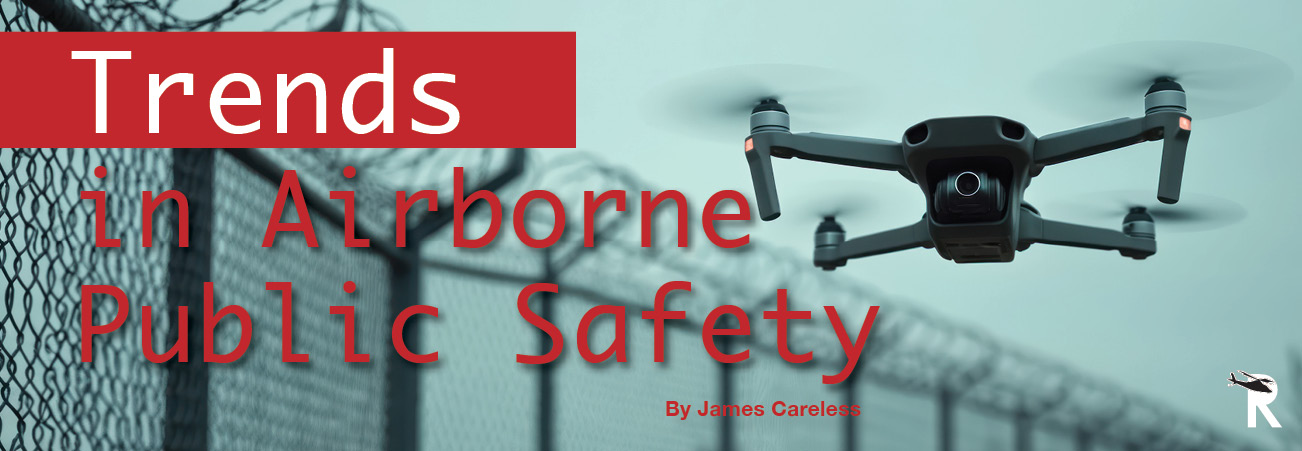
The days of helicopter-only police units are coming to a close as drones play an increasingly important role in aerial law enforcement. It’s not only the addition of drones that is transforming this sector. “Air units are becoming far more data-driven and integrated,” said Mike Bucari, Leonardo Helicopters’ head of marketing for the Americas He said, “Aircraft are no longer standalone assets—they’re an integral part in a much broader network that includes ground units, drones, real-time operating centers, and AI-assisted analytics.”
As a result of this trend, law enforcement helicopters “must incorporate capabilities such as live video downlink, LTE/5G connectivity or Starlink-type solutions, and cloud-based evidence systems, which are becoming standard expectations,” Bucari told Rotor Pro. “There’s also a major shift toward a manned–unmanned teaming model. Drones are handling more routine, lower-risk missions—perimeter searches, accident reconstruction, overwatch—freeing helicopters to focus on high-speed pursuits, tactical insertions, and extended overwatch.”
“As more public safety agencies across the U.S. adopt and expand their drone programs, departments can work more effectively and efficiently to save lives and keep their officers safe,” noted Wayne Baker, director of stakeholder engagement with the drone manufacturer DJI. “For example, drones enable officers to plan safer approaches for themselves and suspects in high-risk situations.”
Following are a few of the trends currently driving the evolution of airborne law enforcement.
Splitting the Workload
When it comes to missions, the integration of drones into aerial law enforcement is leading to a division of labor between the two. “Typically, our helicopters are deployed to car theft incidents and surveillance of expansive environments where criminal activity or the missing person can move across a county or city during the operation,” said David Smith, president and CEO of Robinson Helicopter Company. “Drones are often used in cases where there are barricaded individuals, breaking-and-entering cases, and other crimes that are less likely to cover a large area.”
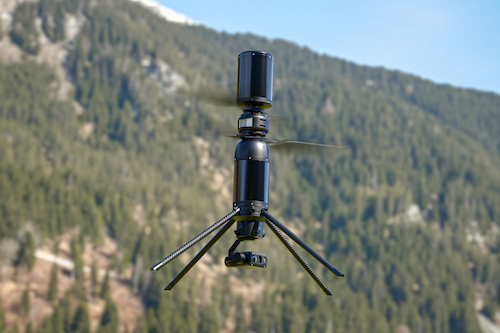
Roberto Sifuentes, sales manager of Airborne Solutions at Hensoldt—a major German multinational corporation specializing in defense and security electronics—noted, “There is a certain overlap in the distribution of tasks, but generally you can say helicopters are preferred in high-impact missions where flexibility and man-in-the-loop decisions are needed. Drones are typically operated in missions requiring persistence and stealthiness.”
According to Leonardo’s Bucari, the workload split between helicopters and drones is dictated by factors such as risk, cost, endurance, and mission complexity. As a result, municipalities are building a complementary model where both drones and rotorcraft are parts of a total law enforcement solution, rather than choosing one over the other.
“Helicopters remain the go-to for high-speed, dynamic, and high-risk missions,” said Bucari. “That includes vehicle pursuits where speed, range, and continuous tracking matter—something drones still struggle with due to battery life and airspace limits. Helicopters are also critical for tactical operations: inserting or extracting SWAT teams, supporting K9 deployments over large areas, and providing overwatch during active incidents.”
At the same time, drones are being enhanced to carry heavier payloads while staying aloft longer. Add in ever-tougher drones with improved imaging capabilities, and these uncrewed platforms are “increasingly being used for every imaginable task,” Baker said. “Additionally, when helicopters are unable to respond due to weather or terrain, drones can be used. For example, during Hurricane Helene, the DJI FlyCart 30, which can carry up to 88 pounds, was used to deliver water and medicine to people trapped as the roads were destroyed. In that mountainous terrain, it was not as easy to fly a helicopter to do this task.”
Growing Teamwork
There was a time when the teaming of helicopters and drones on shared missions seemed to be the stuff of science fiction. That’s no longer true. “Helicopter-drone teaming is already happening and becoming standard in bigger municipalities that have the money for both,” said Bucari. “It’s still evolving. Right now, it’s best described as coordinated cooperation, not fully unified operations.”
This state of coordinated cooperation is due to the current limitations of drones, which do not have the range or speed to work with helicopters as equal partners. “This is why, from a Leonardo Helicopters perspective, the larger metropolitan departments that have the funding for both helicopters and drones are working together in a semi-integrated model,” Bucari said. “The drone provides close-in, low-altitude detail to the team of both aviation and ground personnel. The helicopter maintains a wide-area overwatch, tracking movement, coordinating ground units, and managing the bigger picture.”
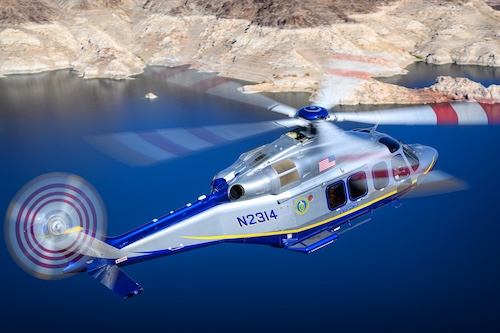
Sometimes this teaming can be used in unexpected ways to deliver substantial results. A case in point: “In Torrance, California, we saw an instance where a search for a suspect of a home invasion was tracked by both a helicopter and a drone,” said Smith. “The helicopter was used to distract the suspect, who was moving from one backyard to another. At the same time, the drone was able to track the suspect until they were in a position of vulnerability, at which point they peacefully surrendered.”
For more conventional teaming arrangements during disasters, Baker said, “We have seen drones used to quickly locate trapped individuals, allowing helicopters to rescue them with their hoist systems. This was done during the flooding events in Texas in July 2025, where drones located victims and guided helicopters or rescuers to save them.”
Adding AI to Mission
Artificial intelligence (AI) seems to be everywhere these days, and for good reason. “AI can speed up air-based law enforcement and reduce costs,” said Sifuentes. “For example, AI does a tremendous job in face/car identification and classification.”
So, how far has AI made its way into airborne law enforcement? On this point, opinions differ.
“We have not seen a significant contribution at this point,” Smith said. “However, part of Robinson’s manned/unmanned system uses artificial intelligence to assist in target identification and the management of small drone swarms after they are deployed from a helicopter.
Over at Leonardo Helicopters, the company is using AI to support practical, pilot-centric automation.” It’s not flashy autonomy, but systems that reduce workload, improve safety, and make single-pilot operations more manageable,” said Bucari. “For law enforcement crews, that translates directly into better mission effectiveness and lower risk in high-tempo environments. The automation on the flight side complements this by freeing up cognitive bandwidth. The pilot isn’t fighting the aircraft while simultaneously trying to support a complex mission.”
Of course, pilots need to be properly trained to use automation to its full potential. “Such training is essential to avoid introducing new safety risks, such as over-reliance on automated functions, which can lead to distraction, underestimation, and other unintended behaviors during flight,” Bucari said.
AI is also finding its way into law enforcement drones. “Many new DJI drones feature intelligent capabilities that ensure the safety of the aircraft, pilot, and surrounding environment by providing enhanced situational awareness of terrain obstacles and warnings of approaching crewed aircraft, to name a few,” said Baker. “Likewise, our drones can be programmed for automated missions. However, they do not fly autonomously as a pilot is still required to manage the flight routes and can take control of the aircraft instantly to avoid incidents.”
What’s Next
The capabilities of today’s airborne law enforcement technology are undeniably impressive. So, what does the future hold?
Smith said, “We believe that, in the era of both, our Robinson Manned/Unmanned collaborative teaming capability will amplify human pilots and tactical flight officers (TFOs) with an increased number of sensors, an increased pace of search, and a massively reduced workload. Our goal is to allow the helicopter TFO to be a conductor of the orchestra of differently equipped drones. This will allow them to deploy some drones to observe, some to inform and communicate with loud hailers, some to illuminate, and some to intervene with tasers and car immobilization technologies.”
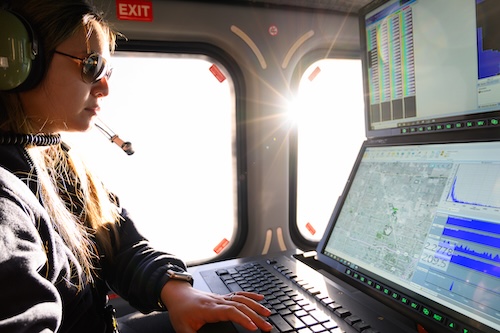
What’s Leonardo’s take on the future of airborne law enforcement? “We believe it will be a convergence of connectivity, autonomy-lite systems, and smarter mission integration,” said Bucari. “Airborne law enforcement is moving toward a model where information flows faster than the aircraft itself. It is evolving into a networked multi-platform ecosystem where drones handle immediacy and volume, helicopters provide capability and command presence, and connectivity ties it all together. The agencies that adapt fastest will be the ones that treat air assets as part of a real-time information system, not just a flying platform.”
Where Humans Fit
When one talks about the future of airborne law enforcement—especially given the growing capabilities of AI and autonomous flight—the inevitable question comes up: Will there always be a place for human pilots in airborne law enforcement?
Smith says yes. “We believe there will always be a need for human skills in the management of the airborne law enforcement mission set. The public will demand it and it will ensure that drone algorithms are being guided and trained by knowledgeable human pilots and TFOs.”
Bucari agrees with Smith, at least for now. “As of today, the answer is yes,” he said. “While it is impossible to predict what technologies may emerge over the next five, 10, or 15 years that could fundamentally reshape aviation, the need for pilot involvement remains clear. The ability to make sound judgments under pressure, maintain real-time situational awareness, and adapt quickly to evolving conditions will continue to be essential to successful operations, whether in airborne law enforcement, emergency medical services, or offshore transport.”
Sifuentes is also positive that people have a place in airborne law enforcement. “For the foreseeable future, human pilots will be employed in all missions that entail ad hoc decisions, volatile conditions and serious consequences,” he said.
So agrees Baker. “Yes, of course,” he said. “Drone pilots will always have a place in airborne law enforcement. DJI drones are designed to be piloted by a human operator as outlined by the FAA’s Beyond Visual Line of Sight (BVLOS) regulations. While some of our drones can be programmed for automated missions with an FAA waiver, a human operator can always take control and fly the drone as the situation dictates.”
The bottom line: Although technology is changing the very nature of airborne law enforcement, these experts believe that humans will remain central to its operations.
READ MORE MAY/JUNE ISSUE
READ MORE ROTOR PRO: https://justhelicopters.com/Magazine
WATCH ROTOR PRO YOUTUBE CHANNEL: https://buff.ly/3Md0T3y
You can also find us on
Instagram - https://www.instagram.com/rotorpro1
Facebook - https://www.facebook.com/rotorpro1
Twitter - https://twitter.com/justhelicopters
LinkedIn - https://www.linkedin.com/company/rotorpro1