|
Jul
06
2026
|
|
Posted 108 days ago ago by Admin
|
|
WATCH VIDEO
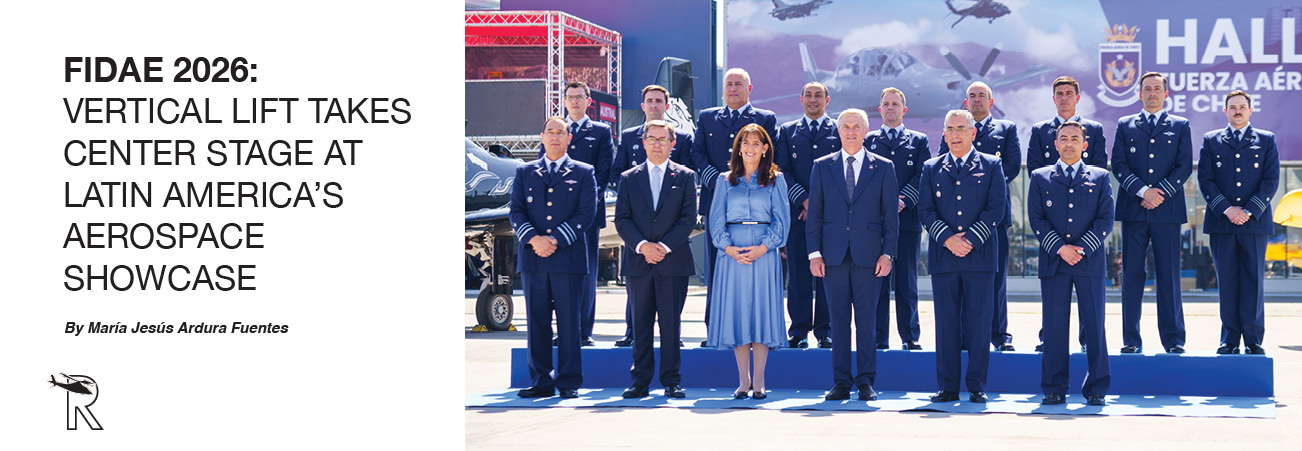
Santiago, Chile, was once again the epicenter of global aviation. The 24th edition of the International Air and Space Fair, FIDAE 2026, was officially inaugurated by President José Antonio Kast, accompanied by First Lady María Pía Adriasola, Minister of Defense Fernando Barros, and the Commander-in-Chief of the Chilean Air Force, General Hugo Rodríguez González. The event ran from April 7–12 at Pudahuel Air Base, bringing together 35 exhibiting countries, more than 440 companies, 112 official delegations, and over 100 aircraft on static and dynamic display. With more than 150,000 visitors expected between industry professionals and the general public, the fair reaffirmed its standing as the region's premier aerospace platform.
With 46 years of history, FIDAE stands as Latin America's most prominent Aerospace, Defense and Security exhibition. The first four days — Tuesday through Friday — were reserved exclusively for industry: high-level meetings, commercial agreements, technical presentations, and a networking ecosystem few fairs in the world can match. Over the weekend, the gates opened to the general public with aerial shows that left audiences speechless. FIDAE's reach also extended beyond its own program: several international aerospace fairs used the event as a platform to promote their upcoming editions, a testament to the fair's standing as a hub for the global industry calendar. Among them was FAMEX — Feria Aeroespacial México, whose next full edition is scheduled for April 20–24, 2027, organized by the Mexican Air Force under the slogan "Connecting the Future."
Vertical Lift: The Undisputed Star
For those working in the helicopter and advanced air mobility industry, this edition of FIDAE marked a turning point. For the first time in its history, the fair incorporated programming dedicated exclusively to vertical flight, with four panel sessions focused on the future of the sector, held on Wednesday, April 9. The participation of Vertical Aviation International (VAI) as a panelist confirmed what many had already sensed: vertical lift has moved from a secondary segment at major aerospace forums to a central conversation about the future of transportation and defense.
Bell and Robinson: Ninety Years of Leadership, Front and Center
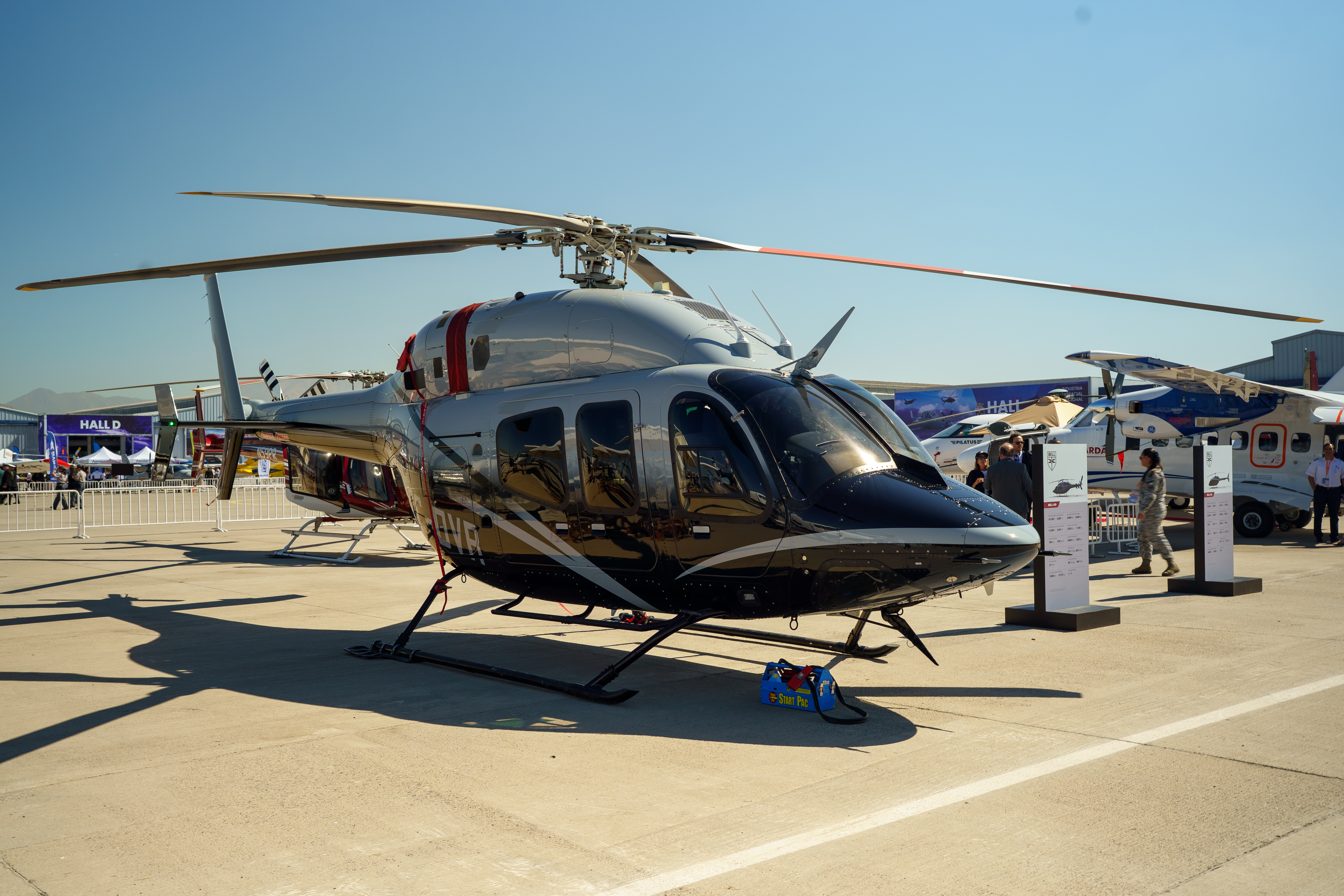
One of the most significant presences in the vertical lift segment was Bell Textron — arriving at FIDAE 2026 celebrating its 90th anniversary. A milestone the company made sure to honor. With nearly 2,000 military and commercial operators throughout Latin America, Bell showcased a complete lineup of vertical lift solutions at its dedicated chalet, including the Bell 505, Bell 407GXi, and Bell 429.
The most resonant announcement came on opening day: Bell Textron revealed that the Bell 505 recorded its highest number of orders in Latin America during 2025, cementing its position as the dominant platform in the light single-engine turbine segment across the region. The Southern Cone — particularly Argentina and Chile — holds the highest density of Bell 505s in all of Latin America, which has driven the expansion of authorized maintenance centers and technical support networks in the area. Globally, the Bell 505 fleet now exceeds 600 aircraft operating in more than 66 countries across six continents, having accumulated over 300,000 total fleet flight hours.
Also drawing considerable attention at the Bell chalet was the Bell 429 — a light twin-engine helicopter that has earned a strong reputation across Latin America for its versatility and mission readiness. With capacity for up to seven occupants, advanced BasixPro avionics optimized for IFR operations, a cargo hook rated at 1,361 kg, and two Pratt & Whitney Canada PW-207D engines delivering a cruise speed of up to 287 km/h and a range of 761 km, the 429 is designed for the most demanding missions — from search and rescue in remote terrain to medical evacuations and corporate transport. The platform is already in active service with military and government operators across the region.
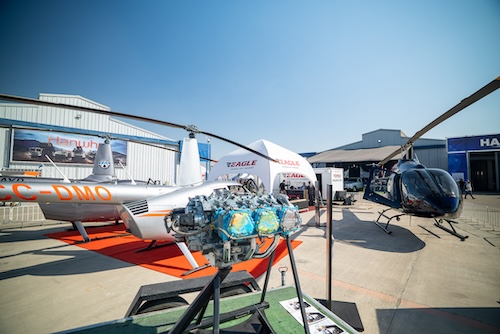
Robinson Helicopter Company was represented through its official dealer in Chile, Eagle Copters South America — also an authorized maintenance center for both brands. Eagle Copters showcased the Robinson R66, a single-engine helicopter with seating for five and an independent cargo compartment, alongside the Robinson R44 — a cornerstone of the training, patrol, and private transport segment, recognized for its low operating costs and accessible maintenance. The stand was rounded out by a flight simulator for both Bell and Robinson helicopters, delivering a complete proposition that spans acquisition, training, and technical support under one roof.
Airbus: Cutting-Edge Technology on Display
The Airbus stand was one of the most visited at the fair. On the rotary side, the company displayed its H125, H135, and the modern H160 — aircraft actively operating across Latin America in missions ranging from offshore work to medical emergencies in high-altitude mountain terrain.
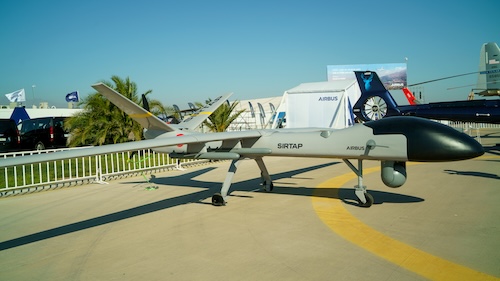
The standout moment was the live demonstration of the Flexrotor, Airbus Defence & Space's VTOL unmanned aerial system: it takes off vertically and transitions mid-air to fixed-wing horizontal flight for long-endurance surveillance missions, with endurance exceeding 12 hours and a cruise speed of 140 km/h. Its applications range from maritime surveillance to wildfire prevention — a growing priority across the region. Also on display were the Aliaca, a new electric VTOL for tactical reconnaissance, and the SIRTAP, a high-performance UAS built for all-weather surveillance.
Loft Dynamics: The Future of Flight Simulation, in Chile for the First Time
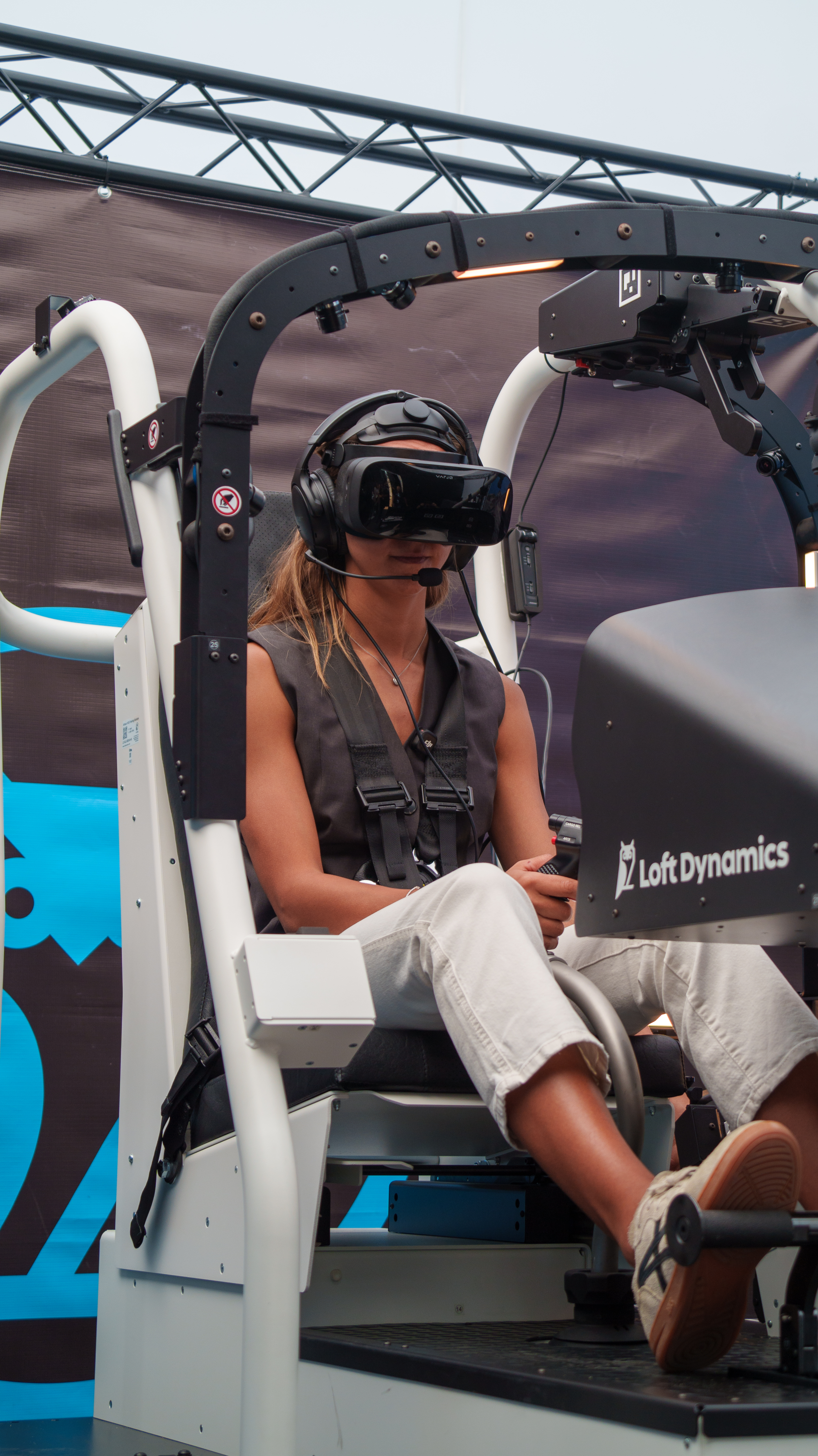
One of the most talked-about experiences of this edition was the arrival of the Loft Dynamics virtual reality flight simulator — making its Chile debut. Loft Dynamics simulators combine VR technology with a full-scale cockpit replica and a six-degrees-of-freedom motion platform, faithfully reproducing control loading forces and supporting training in emergency procedures across environments anywhere in the world.
Access was by invitation only, reserved for selected pilots. Those who flew it were unanimous: the platform allows users to simulate in-flight emergencies, change weather conditions, and fly in environments as varied as the Swiss Alps or New York City airspace — all with a fidelity that blurs the line between simulation and actual flight. For the helicopter pilot community in Chile and Latin America, its arrival at FIDAE did not go unnoticed.
The Helicopter Industry Gathers in Santiago
Beyond the major manufacturers, the vertical lift services ecosystem showed exceptional strength. Aerocardal, Platinum Helicopters, Explorair, Helisul-Ecocopter, and the Chilean Pilots' Association, among others, demonstrated that the local industry has genuine depth. Leonardo and MD Helicopters rounded out the international manufacturer lineup.
Air Shows: When the Santiago Sky Becomes a Stage
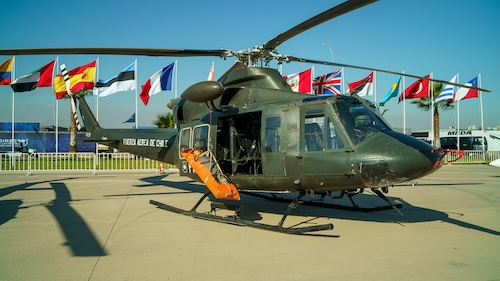
Every day of FIDAE 2026 was marked by aerial exhibitions combining spectacle, precision, and frontier technology. The U.S. Air Force F-35A Demo Team flew every single day. The FACH F-16 B50s demonstrated Chile's military aviation readiness, while the A-29B Super Tucano and the DHC-6 Twin Otter of the Boinas Azules Parachute Squadron completed the close air support and special operations program.
On the rotary side, the MH-60M Black Hawk from FACH's Aviation Group No. 9 delivered one of the most impactful demonstrations of the event — a joint Close Air Support and Combat Search and Rescue operation alongside two A-29 Super Tucanos that showcased, before delegations from over 35 countries, the tactical coordination and training level of Chile's crews.
The Halcones de Chile aerobatic team drew one of the loudest ovations of the fair. Chilean athlete Sebastián "Ardilla" Álvarez, of the Red Bull Aerobatic Team and former FACH F-16 combat pilot, added a radically different dimension with his wingsuit jump — the most extreme discipline in modern parachuting, reaching speeds above 200 km/h through a suit with membranes between arms and legs.
The Voice of FIDAE: A Conversation with General Miguel Stange Muñoz
WATCH VIDEO
To understand the true scope of what happens every two years at Pudahuel Air Base, Rotor Pro Magazine sat down with Aviation General Miguel Stange Muñoz, President of FIDAE 2026.
Asked what it means for the Chilean Air Force to host the region's most important aerospace event, General Stange is direct: "It represents a great responsibility and, at the same time, a source of institutional pride, because it reflects the pioneering role that Chile has played in the aeronautical and space development of the region." For him, FIDAE is far more than an exhibition. "The FACH doesn't just organize a fair — it leads a strategic platform that connects innovation, international cooperation, and technology transfer," he notes, pointing to the participation of more than 450 exhibitors from 35 countries and over 110 delegations as evidence that FIDAE has become "the gateway to the Aerospace, Defense, and Security industry market in Latin America."
On why Chile — and not another country in the region — managed to claim this position of leadership, the General offers a clear strategic reading: "Since its founding in 1980, FIDAE has evolved at the pace of global change, incorporating new areas such as space, cybersecurity, technological innovation, and human talent development." What sets FIDAE apart, he adds, is having transcended the traditional exhibition format to become "a comprehensive platform for business, knowledge, and international cooperation."
The message Chile wants to project to the world is equally ambitious. "The future of aerospace development is built on collaboration, innovation, and the generation of knowledge," General Stange states. Chile presents itself not merely as a host but as a genuine actor: "a country capable of leading international gathering spaces where industry, academia, defense, and technology converge to address global challenges."
FIDAE 2026: A Platform with Purpose
For the global vertical lift community, what Santiago demonstrated in April 2026 is no longer an aspiration — it is a concrete reality. In a region where geography imposes extreme distances, inaccessible mountains, and endless coastlines, helicopters, eVTOLs, and VTOL systems are not niche technologies. They are critical infrastructure.
FIDAE 2026 understood that. And with this edition, it made sure the world did too.
María Jesús Ardura Fuentes is a private helicopter pilot and founder of BlueIce Patagonia Consulting, a strategic marketing consultancy specializing in the aviation industry. She covers South America for Rotor Pro Magazine.
READ MORE MAY/JUNE ISSUE
READ MORE ROTOR PRO: https://justhelicopters.com/Magazine
WATCH ROTOR PRO YOUTUBE CHANNEL: https://buff.ly/3Md0T3y
You can also find us on
Instagram - https://www.instagram.com/rotorpro1
Facebook - https://www.facebook.com/rotorpro1
Twitter - https://twitter.com/justhelicopters
LinkedIn - https://www.linkedin.com/company/rotorpro1