|
Jun
15
2026
|
|
Posted 129 days ago ago by Admin
|
|
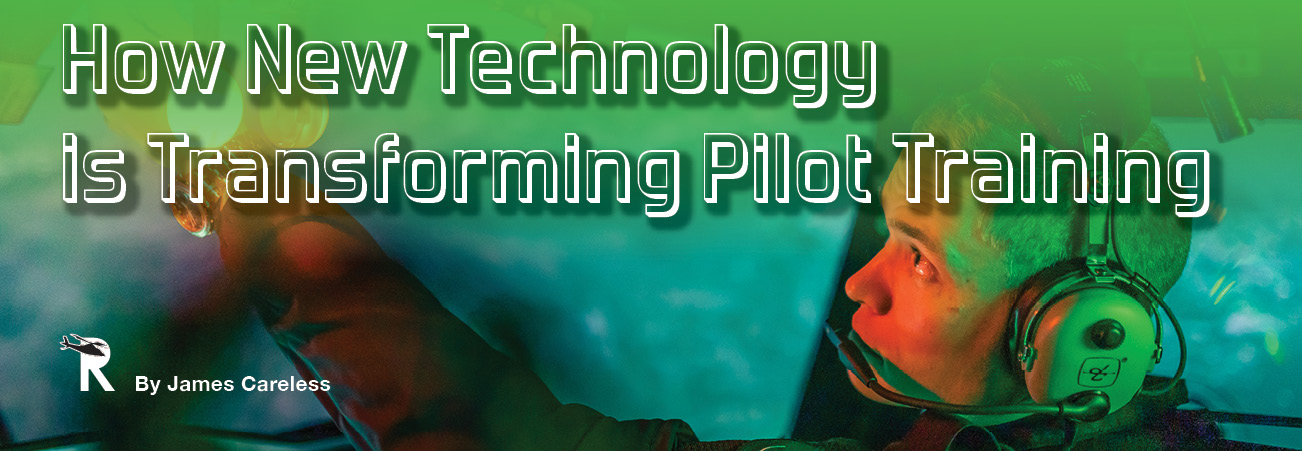
The very nature of helicopter pilot training is undergoing a rapid, technology-driven transformation. Although ground school classes and in-helicopter flight training remain, fixed-screen simulators are being replaced by virtual reality (VR), augmented reality (AR), and mixed reality (MR) flight simulation headsets. Meanwhile, artificial intelligence (AI) is being used to analyze student pilot reactions – and even postures – during these simulations, to track student progress and tailor teaching to their needs on the fly.
Impact of Extended Reality
Collectively, VR, AR, and MR are known as “extended reality” (XR). Individually, they are quite different. VR creates a fully digital, simulated environment that a pilot can see within their headset that moves with them as they turn their head.
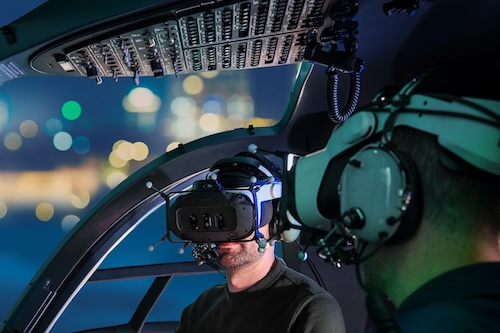
"With a head-mounted display in VR, you get a correct stereoscopic visual system," said Fabi Riesen, founder and CTO of Loft Dynamics, a developer of virtual-reality flight simulation technology. "When you move your head, the environment moves exactly as it would in the helicopter."
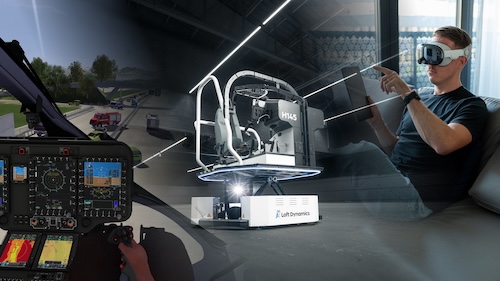
Pilot simulation training in the Loft Dynamics H145. Photo: LoftDynamics
AR goes one step further by overlaying digital graphics on a real-world view through the headset’s visor. MR goes a step beyond that, by allowing virtual and physical objects to co-exist and interact in real-time.
A case in point: "We’ve developed an XR helicopter simulator that merges a physical cockpit with virtual scenery, enabling pilots to train in a fully immersive, yet highly realistic environment," said Jonas Goercke, business line manager of flight training at Reiser Simulation and Training GmbH, a manufacturer of high-fidelity simulators for civil and military operators.
In such a system, the experience for the XR trainee is entirely realistic: They can see and move actual controls in the cockpit to “fly” the helicopter in a convincing synthetic world. Because these visuals adapt to the pilot's physical movements, they open up new training capabilities. "Since XR/VR headsets provide a 360-degree field of view, and accurate depth perception, they are fit for the purpose of training tasks, such as filling the bucket in firefighting or allowing tactical flight officers (TFOs) to scan the ground during police operations," said Nacho Navacerrada, sales director at Entrol, a manufacturer of certified flight simulators.

H145 FTD 3 with LED visual system. Photo: Entrol
"Augmented and virtual reality are already playing a meaningful role in modern pilot training by expanding access to immersive, scenario-based learning," said Jerry Messaris, vice president and general manager of TRU Simulation, a builder of scalable full flight simulators and VR training solutions. "Virtual and augmented reality are particularly useful for procedural practice and cockpit familiarization," said Lorenzo Napoli, lead AW139 TRI at Coptersafety, a training center operating high-fidelity simulators for professional helicopter crews.
AI’s Supporting Role
In contrast to XR’s upfront work in the simulator cockpit, AI is playing a major role in supporting training’s backend—it’s processing the massive amounts of data generated by digital simulator sessions quickly and effectively.
"On the AI side, the main impact is enabling a truly data-driven approach that helps tailor training to the pilot’s competencies and experience," Riesen said. This is because modern training simulators can track a student’s eye movements, body posture, control inputs, and reaction timing. “AI helps process all of that," he noted. The results can then be used to adjust the training regimen to address and improve the student’s weak points.
AI’s analytical power is easing the burden on human educators. "Moreover, it is taking over many recurring instructor tasks, allowing them to focus more on the actual education during a training session," said Goercke. This is why training-equipment manufacturers are incorporating AI into their next-generation devices. “AI doesn’t replace instructors,” Riesen said. “It gives them better tools."
While the impetus to use XR and AI technologies in helicopter pilot training is strong, industry veterans warn that it is not a magic bullet. "If applied properly, they can have the ability to make training more efficient, particularly in training systems where self-paced learning can be implemented," said Randy Gawenda, business development manager at Frasca, a manufacturer of turnkey flight simulation solutions ranging from desktop to full-flight devices. “If not, you can end up trying to stick the proverbial square peg in a round hole just because it’s trendy.”
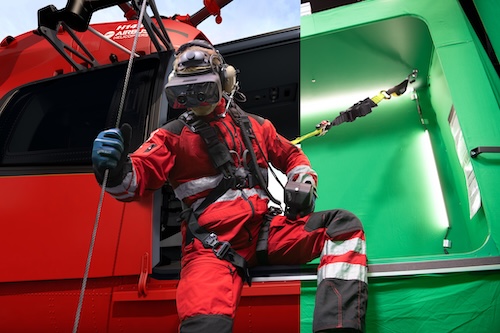
hoistAR® Helicopter Hoist Simulator. Photo: Reiser
Learning With Drones
As drones become an increasingly common factor in helicopters’ airspace, training programs are being adapted to teach pilots how to play nice with them while staying safe.
"Instructors can now populate simulation scenarios with entities like drones," Navacerrada said. This allows pilots to practice flying in congested airspace, which can be a critical skill during large-scale operations like wildland firefighting.
On the military and tactical front, helicopter pilots are increasingly being expected to coordinate directly with drones to fulfill their missions. "Training is increasingly emphasizing situational awareness and airspace integration, ensuring that helicopter pilots understand how unmanned aircraft operate and how both systems can safely share the same operational environment," Napoli said.
Navigating safely in this new shared airspace dynamic requires a deep understanding of modern aircraft systems as well as enhanced situational awareness. "Helicopter pilots are going to need to learn both of these areas to be more effective and to communicate better in these types of operations," said Gawenda.
Government regulations are also evolving to support these combined operations. "Coordinating helicopter operations with drone activity is not always simple, but the strong commitment of aviation authorities is making a difference," said Massimo Baldassari, lead AW169 TRI at Coptersafety.
Can In-Flight Training Be Safely Reduced?
There are those who fantasize about simulation-based training superseding the need for student pilots to fly an actual helicopter before graduation. However, this is not the purpose of XR and AI-enabled training systems. Instead, their goal is to enhance student safety while reducing instruction costs by minimizing how much time has to be spent in the air.
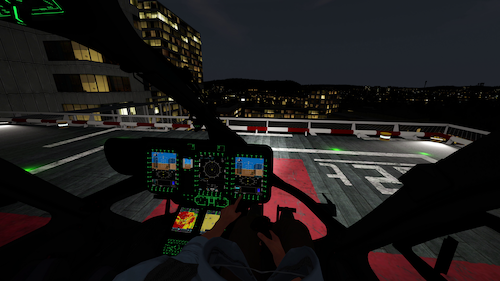
Pilot simulation training with H145 at night. Photo: LoftDynamics
"From e-learning and computer-based training that allows you study from anywhere on any device, to FTDs that fit into a small room, to full flight simulators that replicate every detail of an aircraft, pilots are well prepared for when they take an aircraft into flight for the first time," said Matt Presnal, chief theoretical knowledge instructor at Coptersafety. “This is a much better option than putting a newbie into an actual helicopter sooner than necessary.”
By shifting basic training tasks to simulators equipped with modern motion-cueing systems, educators are seeing their students perform better, sooner, when they do go aloft. “In many cases we’ve heard students getting into the aircraft for the first time and hovering unassisted in about 30 minutes," Gawenda said. He noted that this can reduce approximately four to six hours of in-aircraft training for this fundamental task alone.
In fact, this front-loading of skills in XR/AI-enabled simulators transforms the training curriculum as a whole. "The aircraft time then becomes focused time," said Riesen. "Instead of learning basic coordination, you focus on judgment, environment, real-world variables, and operational decision-making."
Likewise, XR-enabled simulators are a safe way to let students experience and master in-flight emergencies while still on the ground. “This level of realism has resulted in a reduction in required aircraft hours for certain qualifications," said Messaris, thanks to students’ ability to practice complex flight dynamics and degraded visual environments entirely in simulation.
So, how much can in-flight training hours be safely reduced through the use of these advanced training systems? "Simulators today reproduce flight behavior with such fidelity that the few hours flown in the real helicopter during a type-rating probably do not make a significant difference," Napoli said. This doesn’t mean that we’re at the point of not training helicopter pilots in-flight at all—that will likely never happen for safety reasons—but we may be getting close.
"I think we are still a long way from a Matrix-style neural download to learn how to fly a helicopter," Gawenda observed. Emphasizing the psychological difference between a simulator and a real aircraft, he added, "I think the basic human tenet of death may be imminent still outdrives non-aircraft training, regardless of how good the simulation may be."
What’s Next?
As impressive as today’s XR and AI-enabled training systems are, the manufacturers we spoke with are constantly looking to do more.
Reiser H145 D3 XR Simulator. Photo: Reiser
So, what is coming next? "In the near term, a major focus is on completing certification of Reiser’s XR H145 D3 simulator and getting it into service with customers," said Goercke. He added that expanding their XR portfolio to other platforms, as well as advancing capabilities for night-vision flying and hoisting, is on the company roadmap.
Also, the ability to run on various simulation hardware at many locations is a big focus for manufacturers, especially those wanting to support operators with varying budgets. "This is why Entrol is developing new FTD models of different rotorcraft, increasing the training capabilities," Navacerrada said.
Software flexibility is becoming a core requirement for many training organizations, as they strive to make the most of their existing equipment. "We are also advancing modular and configurable training architectures that give customers flexibility to tailor training solutions to specific mission profiles, aircraft types and operational environments," said TRU Simulation’s Messaris.
For Loft Dynamics, the future is all about smoothing the transition from simulators to actual cockpits. "Technically, it’s already possible to complete a very large portion of the training path in the simulator before stepping into the aircraft," Riesen said. "What we’re working on now is refining that progression, making the transition even smoother and making the simulator time even more targeted and effective."
At Frasca, their future products are being driven by operator feedback. "Our focus on continuous improvement, and working closely with our customers always helps to make sure we stay ahead of training needs and tasks that our customers need and want our simulators to perform," Gawenda said.
Coptersafety is also advancing. "One of the areas where training is evolving most quickly is the possibility of tailoring it more precisely to the real missions that operators perform," said Napoli. “Terrain databases, weather modeling, and oerational scenarios are becoming increasingly detailed, allowing us to recreate situations that are very close to what pilots experience in real life.”
Bottom Line
Ultimately, the use of XR and AI in helicopter pilot training represents a fundamental shift in how aviators are being built. The good news is that this shift is making it possible to train pilots better, quicker, and more safely than ever before.
READ MORE MAR/APR ISSUE: https://bit.ly/RotorProMag_MarApr2026
READ MORE ROTOR PRO: https://justhelicopters.com/Magazine
WATCH ROTOR PRO YOUTUBE CHANNEL: https://buff.ly/3Md0T3y
You can also find us on
Instagram - https://www.instagram.com/rotorpro1
Facebook - https://www.facebook.com/rotorpro1
Twitter - https://twitter.com/justhelicopters
LinkedIn - https://www.linkedin.com/company/rotorpro1