|
May
25
2026
|
|
Posted 148 days ago ago by Admin
|
|
WATCH VIDEO
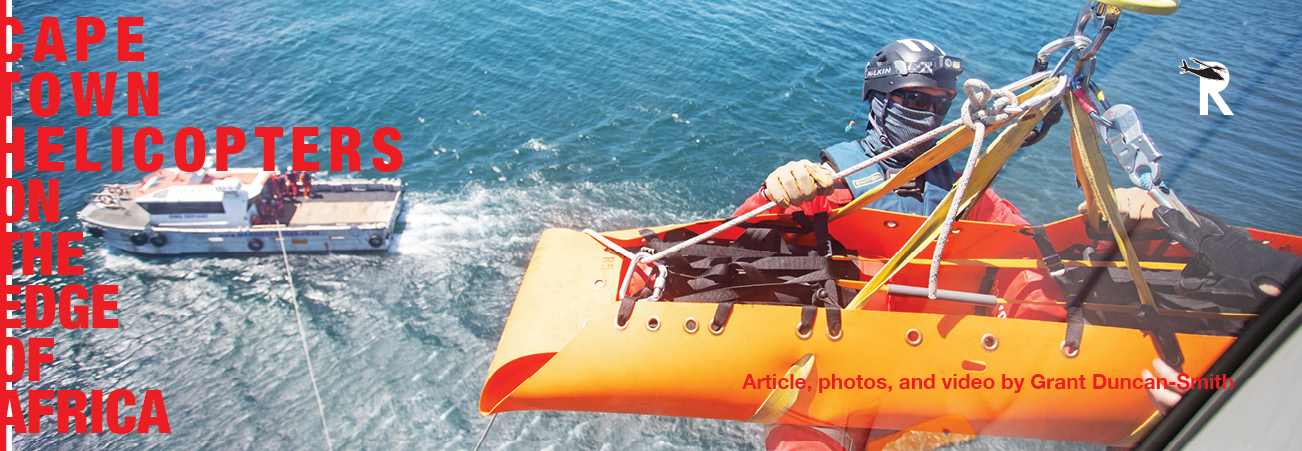
Few helicopter missions test crews and machines like offshore flying: long legs over cold water, tight timelines, and no margin for indecision. Every departure is a deliberate commitment to precision, discipline, and trust—in the aircraft, the crew, and the systems that keep everything working when the nearest runway is a horizon away.
From its dual bases at Cape Town International Airport and the V&A Waterfront, Cape Town Helicopters (CTH) has quietly built a reputation for exactly this kind of flying. Decades of experience in multi-disciplinary, twin-engine operations have positioned the company at the forefront of high-end, dual-crew helicopter work in one of the most demanding operating environments.
Scenic Flights to Serious Work
The addition of an Airbus AS365 represents a major step forward in their continuous drive to expand, modernize, and diversify their fleet. Cape Town Helicopters is best known to many for its bustling tourism operation in one of the busiest helicopter sightseeing markets anywhere in the world. From Robinson R44s to Airbus H120, H125, and H130 helicopters, as well as a King Air fixed-wing aircraft, the fleet carries thousands of passengers each year along one of aviation’s most spectacular coastlines and across South Africa, but offshore operations were a natural evolution.
Their Airbus H130 and H135 have already supported diamond vessels off the coasts of South Africa and Namibia for many years. With shipping traffic around the Cape of Good Hope surging, the next step was inevitable: expanding offshore capability into the Cape Town market.
Growing, Changing Mission
Since late 2023, the Red Sea shipping crisis has forced major commercial vessels to abandon the Suez Canal and reroute around Africa’s southern tip. The result: voyages extending by up to two weeks, rising costs, stretched crews—and ships arriving off the Cape in urgent need of resupply, technical support, or medical assistance.
This is where helicopters matter.
For MEDEVACs, time is everything. When a vessel is already days behind schedule, the speed and reach of a helicopter can mean the difference between escalation and resolution. Cape Town Helicopters’ offshore team delivers rapid access where boats simply don’t.
.jpg?ver=6K7awNcYv78oy5rdn1c2Iw%3d%3d)
To strengthen this capability, CTH has partnered with Global Medical Safety and Risk Solutions (GMSRS)—a leading provider of medical, rescue, and risk-management services across Africa. Together, they offer fully integrated offshore medical response, combining aviation expertise with world-class emergency care in some of the most remote and unforgiving environments.
Aircraft that Changes the Game
At the heart of this offshore expansion is a proven classic: the Airbus AS365 Dauphin.
First flown in the 1970s and refined over more than four decades, the Dauphin remains one of the most respected medium twin-engine helicopters ever built. Long-legged, fast, and remarkably quiet, it was designed from the outset for maritime operations—and it shows.
Powered by twin Turbomeca Arriel engines and equipped with FADEC, the AS365 offers automated start sequences, workload reduction, and robust redundancy. Its Starflex main rotor and Fenestron tail rotor deliver low vibration and noise levels that remain among the best in class—well below ICAO standards.
Category A performance allows the aircraft to depart at maximum weight from sea level; that’s a critical consideration for offshore operations. Composite rotor blades, corrosion protection, reinforced structures for hoisting or slinging, and multiple radar options make the Dauphin equally at home over open ocean or rugged coastline.
Inside, flexibility is the defining feature. The cabin can be rapidly reconfigured for passenger transport, VIP charter, EMS, or SAR. Large sliding doors, built-in steps, and space for up to 12 passengers—or fewer in high-comfort layouts—make it a genuinely multi-role platform.
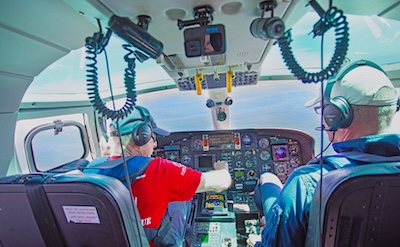
The cockpit reflects the same philosophy. While designed for two-pilot operations, the Dauphin can be flown single-pilot under IFR, supported by a sophisticated four-axis automatic flight control system. Modern avionics, weather radar, TCAS, HUMS, and comprehensive flight-data recording reduce workload and enhance situational awareness when conditions deteriorate.
People Make It Work
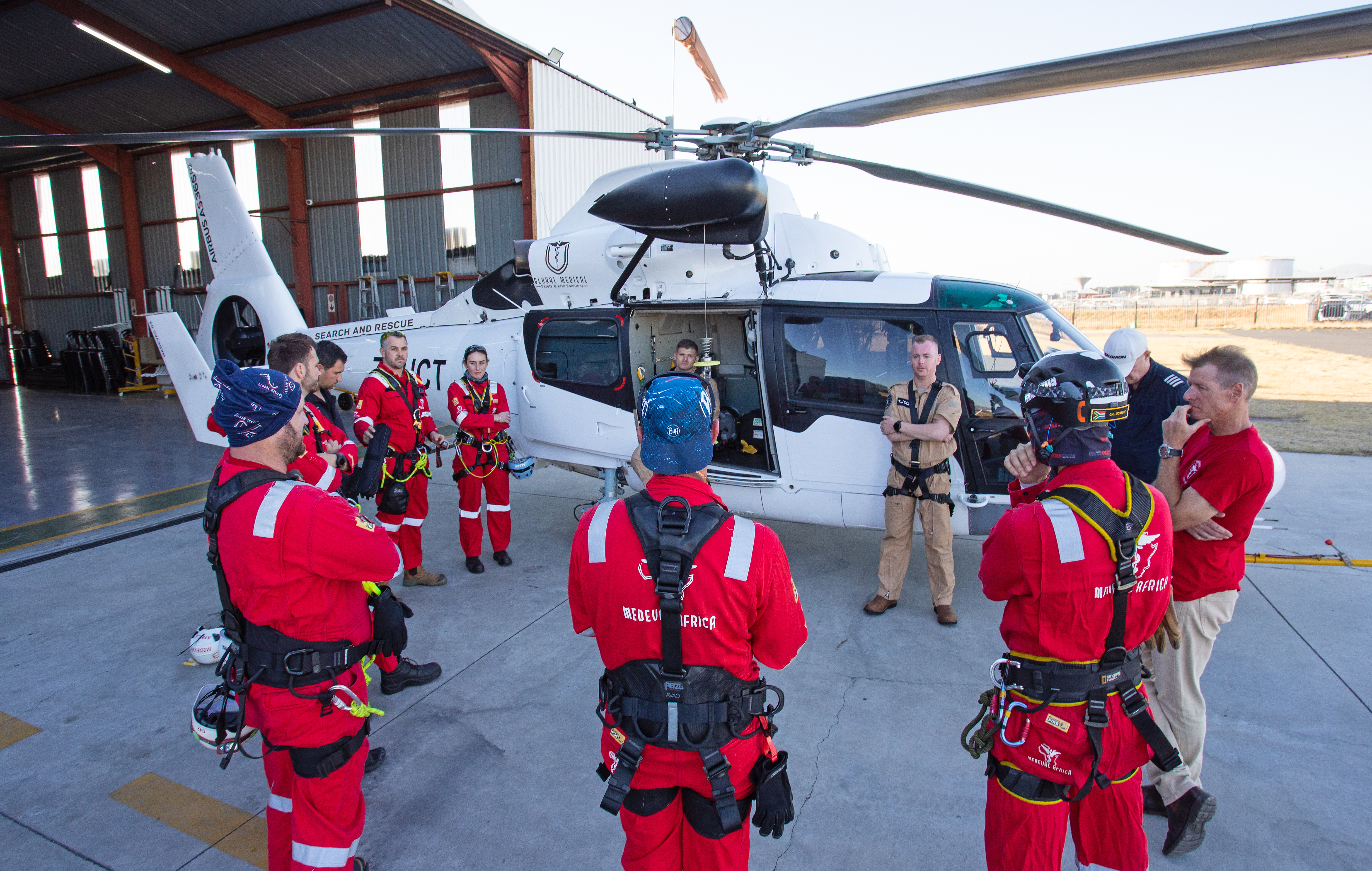
Aircraft matter, but offshore flying is ultimately about crews. Leading the charge are pilots Donovan Kohl and Chris Bohnenn, whose flying backgrounds span offshore, tourism, aerial photography, and search and rescue operations. Calm, methodical, and deeply experienced, they set the tone for an operation where professionalism is non-negotiable and preparation is everything.
Behind them stands a broader team trained not only in flight operations, but also in winching, slinging, and technical rescue— the skills that transform a helicopter from a transport platform into a true offshore lifeline.
More Than a New Helicopter
I asked Donovan to delve deeper into the AS365 N2 Dauphin and explain why it’s so special. It’s a 1991 model, so it has been around for a while. There are newer, more viable options, such as the Airbus H145, so why does the AS365 hold a special place in his heart? He answers that the aircraft’s versatile configurations (including search & rescue), its fuel endurance and redundant fuel systems, plus its engine all impress him.
For a helicopter that punches above its weight, it has a small profile. Classified in the light-to-medium twin category, it’s not as large as the Leonardo 139, 189 or Puma. This form-factor is critical where space is a challenge, such as offshore deck landing.
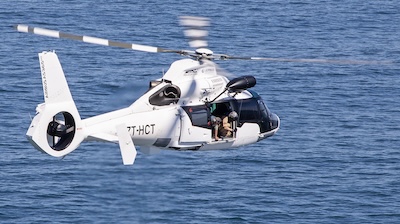
Donovan mentions the AS365 is surprisingly nimble and stable for its size and a pleasure to fly. You can move it to where you want without much restriction as long as power, weight, and balance are within limits.
Another great feature that impresses him is that the collective has a minus-two-degree pitch when fully down, providing the ability to suck itself down onto the deck; that’s especially valuable on an unstable landing surface.
Auto hovering with the autopilot system and Doppler radar adds to the helicopter's operational strength. The upgraded AS365 N3 has FADEC (full authority digital engine control) and other digital enhancements.
The cabin is spacious and able to handle the team, their gear, and the patient. This allows efficient treatment.
Their operational outer limit is 100 nm offshore, roughly an hour out, 45 minutes overhead the vessel, and a return to the point of departure.
Donovan concludes, “She’s our old girl, she is reliable, and we love her – what more can you want from a helicopter?”
U.S. Coast Guard
The U.S. Coast Guard has been heavily upgrading its AS365 Dauphin helicopters, transitioning them from the MH-65D to the advanced MH-65E configuration, featuring a modern glass cockpit, improved autopilot, new sensors for better search & rescue, and enhanced navigation for complex air traffic. This modernization, part of a Service Life Extension Program (SLEP), extends their service life by thousands of hours, ensuring readiness for critical maritime safety and national security missions.
Key Upgrades to the MH-65E Dolphin:
- Cockpit & Avionics: Installation of a "glass cockpit" with modern displays for improved pilot situational awareness.
- Search & Rescue Tech: Advanced technology for locating people in distress, enhancing rescue capabilities.
- Navigation: Improved autopilot and weather radar for safer operations in challenging environments.
- Structural Enhancements: Replacement of key components (like the canopy, floorboards, and structural frames) to add 10,000 flight hours.
Future Plans
For Cape Town Helicopters, the AS365 is not simply a fleet addition; it is a statement of intent.
Yes, it elevates VIP charter and premium tourism flying, offers twin-engine reassurance and refined comfort along one of the world’s most dramatic coastlines. Yet more importantly, it anchors a growing offshore capability designed to support maritime operations, emergency response and critical missions where reliability is paramount.
Plans include expanding the fleet further and establishing Cape Town Helicopters as the premier offshore helicopter operator at Africa’s southern gateway.
At the edge of two oceans, where shipping lanes converge and conditions can change in minutes, the mission is clear: fly further, respond faster, and operate without compromise.
Offshore, there is no room for anything less.
WATCH VIDEO
READ MORE MAR/APR ISSUE: https://bit.ly/RotorProMag_MarApr2026
READ MORE ROTOR PRO: https://justhelicopters.com/Magazine
WATCH ROTOR PRO YOUTUBE CHANNEL: https://buff.ly/3Md0T3y
You can also find us on
Instagram - https://www.instagram.com/rotorpro1
Facebook - https://www.facebook.com/rotorpro1
Twitter - https://twitter.com/justhelicopters
LinkedIn - https://www.linkedin.com/company/rotorpro1