|
May
11
2026
|
|
Posted 148 days ago ago by Admin
|
|
WATCH FEATURE VIDEO
Far out in the Indian Ocean, northeast of Madagascar, the Seychelles form one of the world’s most remarkable archipelagos. The country is made up of 115 islands scattered across turquoise waters, where dramatic granite formations meet powder-white beaches and coral reefs teeming with life. While the Seychelles are widely associated with luxury travel, the islands also hide a number of fascinating natural wonders.
Among them is the extraordinary Coco de Mer, a palm that produces the largest seed in the plant kingdom and grows naturally only on a handful of islands. The archipelago is also home to the ancient Aldabra giant tortoise and the pristine Aldabra Atoll, one of the world’s largest coral atolls and a Unesco World Heritage Site.
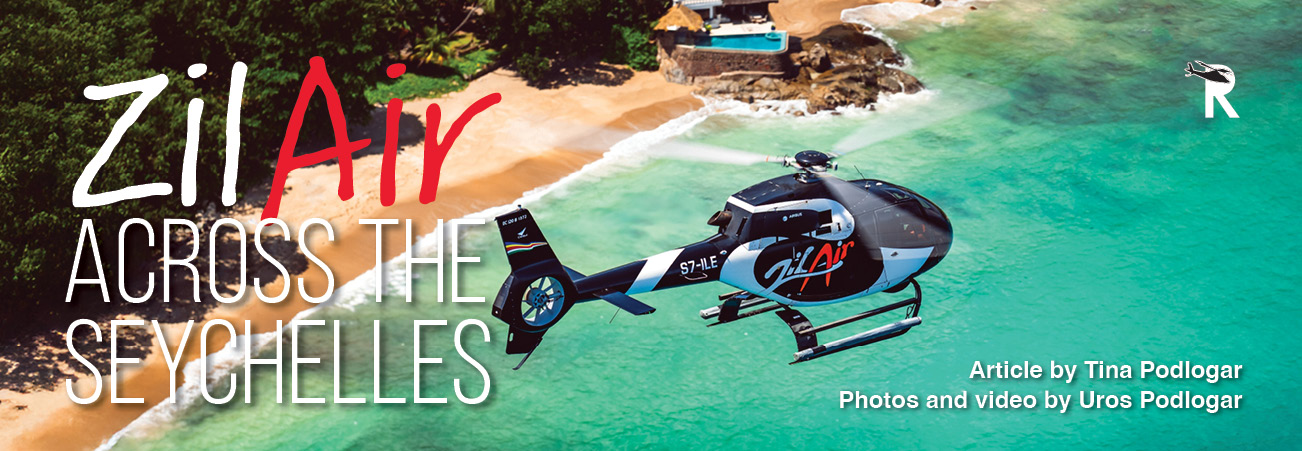
With islands often separated by dozens of nautical miles, the sky is as important as the sea when it comes to traveling across the Seychelles. This is where Zil Air plays a vital role, connecting remote islands, luxury resorts and hidden beaches by helicopter while offering visitors a spectacular aerial perspective of this unique island nation.
Fittingly, the name says it all – “Zil” means island in Creole, the local language of Seychelles, perfectly capturing the operator’s core purpose.
Connecting Paradise
Almost two decades ago in 2007, Zil Air was founded by Mr. Francis Savy, executive director, whose professional background spans tourism, property development, destination marketing, and more recently aviation, which seems natural considering Savy's father was among the very first Seychellois pilots in the 1970s.
At the time, Zil Air was not the only helicopter operator in the Seychelles, sharing the skies with the country’s first such company, Helicopter Seychelles Ltd. However, following the latter’s eventual cessation of operations, Zil Air remained as the sole operational helicopter company in the Seychelles.
Their operations began with a single Airbus H120 (EC120) helicopter. From these modest beginnings, the company has steadily grown into Seychelles’ leading premium helicopter operator, now operating a diversified fleet of eight aircraft, including five Airbus H120 helicopters and three fixed-wing aircraft.
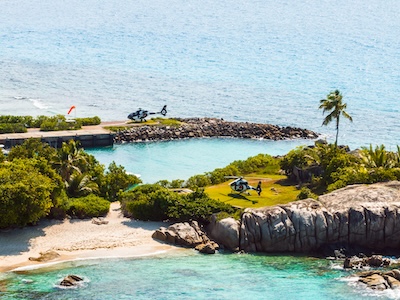
The majority of Zil Air's operations are centred around tourist-driven island transfers, which remain the company’s core activity, seamlessly linking remote resorts and far-flung islands. At the same time, Zil Air extends its capabilities beyond leisure travel, supporting ad-hoc medical evacuation flights, as well as utility and aerial work when required. Its offerings span also to private helicopter transfers, scenic flights, tailored VIP and corporate services, and fully customized, “à-la-carte” experiences, each designed to match the expectations of its high-end clientele.
As the sole helicopter operator in Seychelles, the company works in close coordination with local authorities, undertaking a wide range of specialized operations as they arise and providing essential support to the country’s needs. This evolution mirrors the unique geography and rhythm of Seychelles itself, where distances are measured not in kilometers, but in flight minutes. Many flights connect to and from islands such as Félicité, known for its secluded luxury retreat and unspoiled natural beauty.
With tourism forming the backbone of the nation’s economy and many of its most exclusive resorts located on private islands, seamless air connectivity is not merely a luxury, but a necessity. In this setting, Zil Air has become more than just an operator. It is an integral part of the travel experience, offering a perspective of Seychelles that is as breathtaking as it is essential.
For all its breathtaking beauty, flying across Seychelles comes with its own set of complexities. Rapidly changing tropical weather, strong coastal winds, and vast stretches of open ocean demand constant vigilance and precision. With these ever-changing conditions, thorough planning is essential, requiring the team to stay consistently on top of every detail.
With over 95% of flights conducted over water, operations are carefully routed along specially approved flight corridors, ensuring that safety remains at the very core of every mission. Operational risk is managed through rigorous pre-flight planning, continuous weather monitoring, conservative fuel policies, and strict adherence to approved operating procedures and training. A safety-first culture underpins every sortie.
Comfort, Capability, Reliability
The company’s first Airbus quickly proved to be more than just a smart acquisition; it was the precise aircraft they had been searching for. Operating predominantly over vast ocean expanses, their missions demanded a rare balance: the refinement of an aerial ‘limousine’ experience paired with the capability to perform more technical, precision-driven tasks. “Few helicopters can truly deliver on both fronts, but Airbus emerged as the clear answer to this multifaceted challenge,” explains Savy.
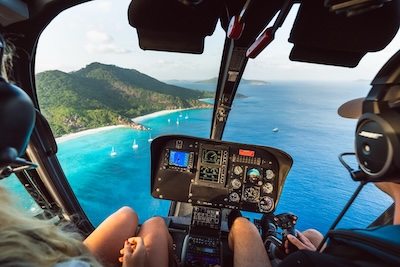
Their choice fell on the Airbus H120, a model renowned for its reliability and refined engineering. In an environment where safety, consistency, and passenger experience are non-negotiable, the H120 stood out. “Its exceptionally low noise footprint makes it ideal for both urban operations and sensitive natural environments, while its thoughtfully designed cabin ensures a high level of passenger comfort. Notably, its ability to carry luggage, often a limitation in this helicopter category, adds a layer of practicality that elevates it above many competitors,” notes Savy.
Beyond its technical credentials, the H120 embodies versatility. “It is a smooth, quiet performer with robust safety features and a reputation for straightforward maintenance, which is an essential factor for operators seeking efficiency without compromise. The helicopter’s panoramic cockpit and passenger layout further enhance the onboard experience, flooding the cabin with natural light and offering uninterrupted views,” Savy said.
In every sense, the Airbus H120 has become a cornerstone of the company’s operations, equally at home delivering luxurious scenic flights as it is tackling more demanding, technical assignments. For guests, it represents comfort and exclusivity, and for the operator, it is a dependable, all-around performer that continues to exceed expectations.
Operating a helicopter company in the middle of the ocean places reliability at the very core of the business. Here, having a safe and dependable aircraft is only part of the equation. Equally critical is the strength of the maintenance infrastructure behind it. In such a remote and demanding environment, there is little margin for error, making technical excellence and operational discipline absolutely essential.
Zil Air addresses this challenge through a fully integrated, in-house approach. “Our engineering, CAMO (Continuing Airworthiness Management Organization), and AMO (Approved Maintenance Organization) teams work seamlessly together, ensuring every aircraft is maintained to the highest possible standard. This level of control not only streamlines operations, but also allows for immediate response to any technical requirements, minimizing downtime and maximizing safety,” emphasizes Savy.
Operating in strict compliance with EASA standards, Zil Air’s maintenance philosophy goes beyond routine upkeep; it is a proactive commitment to airworthiness. The result is a fleet that is not only impeccably maintained, but also consistently ready to perform in one of the most logistically challenging environments in aviation.
Pace, Precision, Performance, and Pilots
Operating from dawn to dusk, seven days a week, 365 days a year, Zil Air runs at a pace that leaves little room for compromise. In an environment where demand is constant and expectations are high, maintaining a deep and capable pilot roster is a necessity.
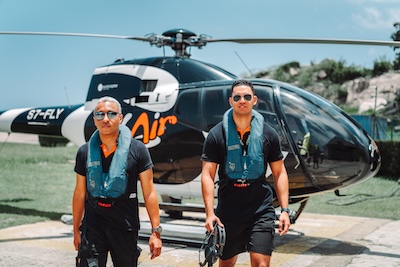
To meet this intensity, the company employs an average of 12 helicopter pilots alongside six fixed-wing pilots, creating a balanced and flexible flight crew capable of handling a wide spectrum of missions. “During peak periods, operations ramp up significantly, with numerous flight sectors taking place throughout the day. It’s a demanding tempo that highlights both the scale of the operation and the level of precision required to maintain it,” says Savy.
High utilization demands equally high standards. “At Zil Air, we place a strong emphasis on recurrent training with pilots undergoing evaluations every six months under the supervision of external instructors and examiners. This ensures that skills remain sharp and aligned with the latest operational and safety benchmarks,” Savy says. “For more advanced aircraft trainings, pilots are sent to FlightSafety International, one of the world’s leading aviation training institutions, where they receive type-specific instruction in highly controlled, simulator-based environments.”
This strong focus on continuous training and professional development is also what makes Zil Air particularly attractive from a pilot’s perspective. For Capt. Ryno Carstens, it was a key factor in his decision to join the company. “My decision to join Zil Air was driven by the unique nature of the operation and the opportunity to expand my experience as a pilot. Coming from Namibia, where flying is often over vast and remote landscapes, I was drawn to the contrast of island-based operations. Zil Air’s strong reputation for safety, professionalism, and premium service also played a big role. It offered the chance to be part of a highly skilled team while operating in one of the most visually stunning environments in the world,” he explains.
Beyond the training and high operational standards, it is the dynamic environment that truly defines the pilot experience at Zil Air. “The most rewarding aspect is the variety,” says Capt. Jude Zelime. “At Zil Air, no two days are ever the same. One moment I might be conducting inter-island transfers, and the next, supporting medevac missions, scenic flights, VIP transfers, or special operations. Flying in this environment keeps me constantly alert, adaptable, and fully engaged. What I find especially fulfilling, however, is interacting with guests experiencing my country and its islands from above for the very first time. Their excitement is a powerful reminder of just how unique this job truly is.”
What is also particularly unique about this job are the flight hours. “At the height of the season, Zil Air can operate up to 60 flight sectors per day, accumulating approximately 4,000 helicopter flight hours annually,” said Savy.
While they operate in what many would consider a paradise, the job still comes with its own set of challenges. Savy said, “The remoteness from source markets, tropical weather variability, marine environmental exposure, high logistics costs, and rising regulatory compliance costs are all factors that present challenges when flying through the skies of Seychelles.”
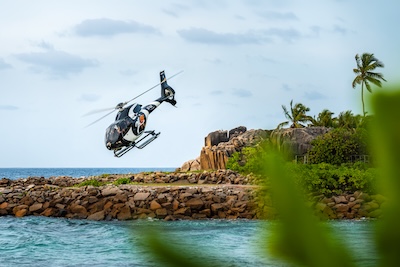
Against this backdrop, the pace at Zil Air requires pilots to remain consistently focused, adaptable, and efficient. ”With multiple flights each day and a wide range of operational demands, it sharpens your decision-making and time-management skills. You learn to maintain a high standard of performance while working within a structured and safety driven environment. The intensity ensures that you are always thinking ahead, managing risks and refining your skills. Overall, it has made me a more precise pilot that’s capable of handling a wide range of operational scenarios,” said Carstens.
Looking Ahead
Throughout its evolution, the company has remained focused on delivering an experience that is “more than just a flight” while supporting Seychelles’ tourism industry through efficient, safe, and exclusive inter-island connectivity. In a destination where turquoise lagoons meet lush granite islands, every journey becomes part of the experience itself, offering a perspective of Seychelles that few ever forget.
Aviation for this part of the world is not just a service, but a lifeline. It plays a fundamental role in the country’s economy and tourism sector: connecting islands, enabling luxury travel, and supporting essential logistics. Without reliable and cost-effective aviation, much of what makes Seychelles so unique would remain out of reach.
Looking ahead, Zil Air continues to explore sustainable growth opportunities while actively advocating for renewed investment in the small helicopter category. Despite significant technological progress across the aviation industry, development in light helicopters has remained limited. Their message to industry leaders is clear—the demand is here, now it is time to deliver the right solutions to support the future of island aviation.
The Seychelles are, without question, a truly spectacular destination where emerald islands rise from endless stretches of crystal-clear water, and every horizon feels like a postcard. Flying above this breathtaking landscape is more than just transportation. It is an experience that stays with you long after the journey ends. The kind of moment that earns a place on many bucket lists, offering a rare perspective on one of the world’s most extraordinary island nations and coming as a fitting reminder of just how special aviation can be in connecting people to places.
READ MORE MAR/APR ISSUE: https://bit.ly/RotorProMag_MarApr2026
READ MORE ROTOR PRO: https://justhelicopters.com/Magazine
WATCH ROTOR PRO YOUTUBE CHANNEL: https://buff.ly/3Md0T3y
You can also find us on
Instagram - https://www.instagram.com/rotorpro1
Facebook - https://www.facebook.com/rotorpro1
Twitter - https://twitter.com/justhelicopters
LinkedIn - https://www.linkedin.com/company/rotorpro1