|
Mar
22
2026
|
|
Posted 212 days ago ago by Admin
|
|
VIEW VIDEO
RPMN: What is your current position?
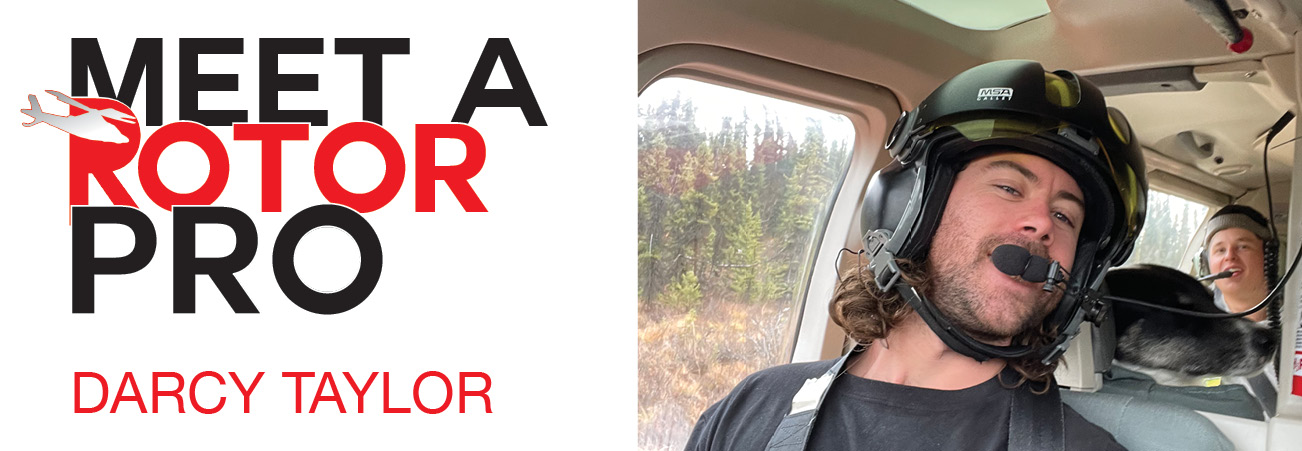
I am a contracting pilot. I have been working seasonally between my homeland of Australia and Canada for the last eight years with most of my recent experience being in firefighting and mineral exploration in the Bell 212 and 407. I’ve recently started posting some of my work adventures on social media under the name “Bushpiloting” to share my experiences with others while having fun!
RPMN: Tell me about your first experience with helicopters.
I was 16 on a family holiday in New Zealand. Dad had us booked in for a white-water rafting tour that day with one deviation; for an extra $50 you could skip the 45 minute winding bus ride through the mountains and instead take a five-minute helicopter trip to the starting point. The pilot threw that machine around in a way that made those five minutes of airtime dictate the rest of my life.
RPMN: How did you get your start in the helicopter industry?
At 17, I initially tried to take the military route. However, the Air Force said "no thanks mate.” So, I did it the expensive way. I left the farm not long after finishing high school to enroll in a theory class and later started my flight training 2,000 kilometers (approx. 1,242 miles) from home. A year later, I had my CPL(H) in hand, but that only gave me the right to work, I still had to find a job and work my way into a seat.
RPMN: When and how did you choose the helicopter industry? Or did it choose you?
The aviation industry chose me. I remember being in awe of the airliners flying over at 30,000 feet when I was a little guy. It was I who chose helicopters in the end after realizing that planes were kind of lame.
RPMN: Where did you get your start flying or maintaining professionally?
It was tough eating for the first year. I found a job mixing chemicals for an ag. company for a couple of months, but that wasn't it. I looked into going up North and getting into cattle mustering, but that wasn't it. I finally got a call back from a tour operator on a small island near Melbourne doing scenic flights. The boss liked that I was a farm boy and that I was constantly looking for things to do. After a month or two of sweeping floors and washing helicopters, he finally let me fly passengers around the six-minute lap of the island. That was 12 years ago. Ian, thanks for everything!
RPMN: If you were not in the helicopter industry, what else would you see yourself doing?
If i wasn't already dead in a gutter, I'd love to run my own fishing lodge in the wilderness somewhere. There would always be a spot to park a heli, though.
RPMN: What do you enjoy doing on your days off?
Mountain biking, snowboarding, camping or fishing. Generally, anything that's outdoors. The seasonal work is difficult to schedule and predict. Some tours can last over a month, and when you do get sent home, you're not too sure when you'll be going back. That’s just the nature of the beast. Enjoy the ride!
RPMN: What is your greatest career accomplishment to date?
Getting permanent residency in Canada during COVID. That doesn't seem like a career accomplishment, but if you're a foreigner trying to navigate the immigration system of another country all on your own, you'll understandt. Going from a Sponsored Employee Visa with no room to negotiate to achieving occupational freedom in 2021 was the last time I cried.
RPMN: Have you ever had an ‘oh, crap’ moment in helicopters? Can you summarize what happened?
The most recent one was after I was endorsed on the 212 last season. The wind was swirling around at our dip site close to the fire that the three of us were bucketing on. The other two pilots were 212 bucketing legends in Canada, I was new and I tried to keep up, I rushed myself into the dip site right as the wind had swung. As I pulled the collective and kept sinking, it did not feel good. My instincts told me to nose it over into clean air, which I did. Unfortunately, I had to pickle the 150-foot line and bucket off along the way as the combo wasn't going to be able to clear the trees ahead. Fortunately, the bucket and line landed three feet from the lake’s edge and was retrieved by the ground crew. After 20 minutes, I tested the gear and was up and running again. I usually have one good scare per season that reminds me where my limits are as a pilot.
RPMN: If you could give only one piece of advice to new pilots, mechanics, or support personnel, what would it be?
Learn from other people's mistakes; it's cheaper.
RPMN: In your view, what is the greatest challenge for the helicopter industry at this moment in time?
In my opinion, most of the valuable metrics are slowly improving. Over the last decade, I've seen pay increases, some ridiculous regulation implementations fail, along with a better safety culture and working conditions. Pilots tend to still complain about these topics, but complaining is just in our nature.
READ JAN/FEB ISSUE OF ROTOR PRO
READ MORE ROTOR PRO: https://justhelicopters.com/Magazine
WATCH ROTOR PRO YOUTUBE CHANNEL: https://buff.ly/3Md0T3y
You can also find us on
Instagram - https://www.instagram.com/rotorpro1
Facebook - https://www.facebook.com/rotorpro1
Twitter - https://twitter.com/justhelicopters
LinkedIn - https://www.linkedin.com/company/rotorpro1