|
Mar
16
2026
|
|
Posted 213 days ago ago by Admin
|
|
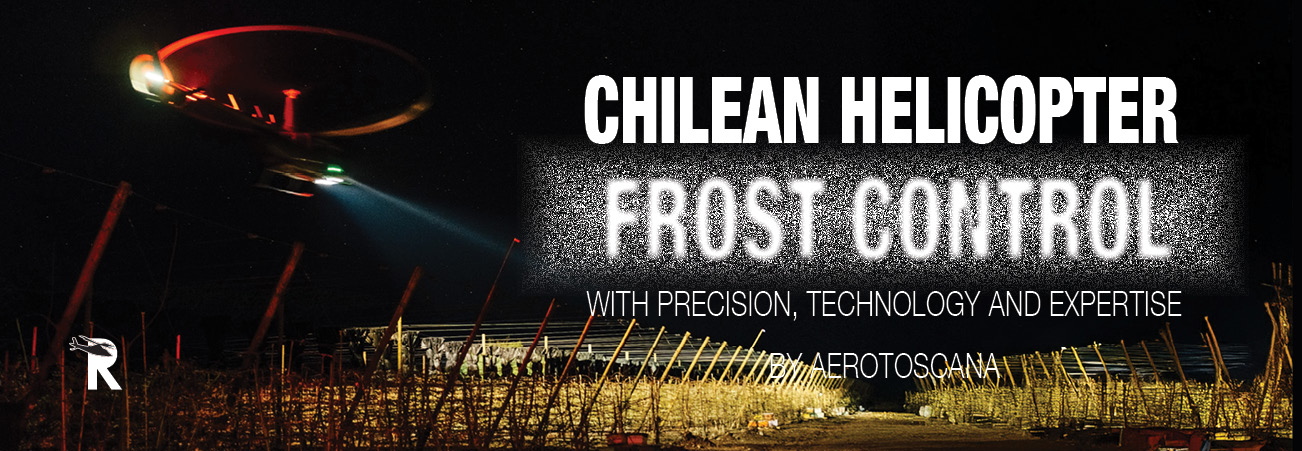
In the Southern Hemisphere when winter fades and early spring unfolds, fruit growers across Chile, Argentina and Peru deal with one of the most crucial periods of their growing season: frost events that occur during late winter and the beginning of spring. For cherry, plum and grape producers, a single cold night during this time can erase an entire year of investment. When temperatures drop a few degrees below critical thresholds, fragile blossoms are damaged by ice crystals and that can delete revenue up to $20,000 USD per hectare (approx 2.5 acres). To fight Jack Frost, helicopters have become one of the most reliable tools to protect crops and secure livelihoods.
Understanding the Enemy
From an agronomic standpoint, frost damage occurs when air temperature falls below the plant’s damage threshold, which depends on species and phenological stage. The damage comes not only from the cold itself, but from the formation of ice crystals inside the plant’s cells, which rupture their membranes and dehydrate blossoms.
There are two main frost types:
Radiative (white) frosts: These are the most common. They occur on clear, calm nights when the ground loses heat through radiation, creating a thermal inversion layer between 10–20 meters above the surface. These conditions are ideal for helicopter-based control.
Advective (black) frosts: Caused by large, dry polar air masses that displace local air. They are extensive, intense, and lack a strong inversion layer, which makes active control methods much less effective.
Why Helicopters Are Effective
Farmers use various methods to combat frost—wind machines, heaters, or overhead sprinklers—but none match the efficiency, speed, and flexibility of helicopters. The principle is simple, yet powerful: by flying at low altitude (15–20 meters), the helicopter rotor mixes the cold air trapped near the ground with the warmer inversion layer above, raising the temperature in the blossom zone by 4–6 °C in radiative, white frost events. That small difference can determine whether a season is saved or lost.
Helicopters act as both mobile fans and heaters, providing coverage where and when it’s most needed, something fixed systems can’t easily replicate.
Field Operations
Frost control flights take place at night or in the early morning—exactly when temperatures hit their lowest point. These are highly technical operations requiring meticulous preparation, reliable equipment, and seamless coordination between the pilot and ground crews.
Aerotoscana, a Chilean aerial services company based in Viña del Mar, has spent years refining their operational protocols for these missions. Some of their key elements include:
- Reflective marking of orchard boundaries, crop rows, and potential obstacles (wires, trees, buildings, poles) to ensure safe night operations.
- Daytime and nighttime reconnaissance flights to define safe flight routes and coverage patterns.
- Thermal monitoring with SmartLite sensors and thermometers placed at mid-canopy height to anticipate inversion behavior.
- Precise activation of flights typically begin when temperatures drop to 1°C (or 33.8℉) maintaining 7–10 knot speeds at 15–20 meters to continuously renew air over critical zones.
- Clear communication with farm managers to prioritize sensitive areas and adjust strategies in real time.
Safety is paramount. Designated loading zones are well-lit, emergency procedures are briefed in advance, and all ground crews are trained to support rapid, coordinated responses.
Thermal Technology and the Robinson R66
Technology has transformed frost control operations in recent years. Thermal visual aids, like SmartLite temperature-sensitive lights installed at strategic orchard points, change color according to temperature. This gives pilots real-time visual cues to fine-tune their flight patterns instantly. Combined with on-site weather stations and digital platforms such as Agviewer, operators can anticipate risk zones and optimize flight paths, increasing efficiency while reducing fuel burn.
For these missions, Aerotoscana relies on the Robinson R66 Turbine, an aircraft that has proven exceptionally well-suited to the task. Key advantages include:
- Compact size and excellent visibility that’s ideal for low-altitude precision flying.
- Reinforced air filters that are perfect for dusty agricultural environments.
- Efficient fuel consumption (approx. 88 liters per hour of Jet A-1) with over 650 m³/s.
- Simple, reliable maintenance that’s critical for intensive night operations.
- Altimeter and thermometer onboard to track thermal inversions in real time.
Another key advantage of the Robinson R66 is that its rotor downwash is powerful, yet controlled, allowing it to protect delicate fruit, such as cherries, without causing damage. Some cherry varieties are so fragile that slight bruising can disqualify them from meeting strict export standards. Aerotoscana has carefully defined specific flight altitudes for each cherry variety to prevent damage while maintaining thermal efficiency. This level of precision is often difficult—if not impossible—to achieve with larger helicopters, whose more aggressive rotor wash can inadvertently harm the crop.
The R66’s balance of power, maneuverability, and operating costs makes it an invaluable asset for frost control operations in South America’s fruit-growing regions.
Economic Impact
Ultimately, frost control is an economic strategy. The difference between a protected and unprotected orchard is often measured in hundreds of thousands of dollars:
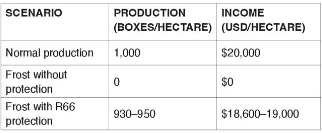
Just one unmanaged frost night can mean the difference between a profitable season and a total loss.
Chile Informs the Region
Chile has become a global leader in cherry exports, with regions such as O’Higgins, Maule, and Ñuble at the forefront. Neighboring areas in Argentina (Mendoza, Río Negro) and Peru (highlands) are also increasingly affected by late frosts. Chile’s accumulated expertise—combining local knowledge, reliable aircraft, and smart technology—has turned the country into a regional reference for aerial frost control.
Each season, Aerotoscana participates in operations across multiple valleys, supporting hundreds of growers in protecting their harvests with precision, commitment and innovation.
Looking Ahead
As the frost season ends, attention turns to the next aerial operation: post-rain cherry drying during the summer harvest. It’s another critical moment when helicopters—especially the R66—show their versatility and value.
Conclusion
Helicopter frost control is where atmospheric science, aerial precision, agricultural logistics, and economics intersect. Aerotoscana is constantly working to refine and professionalize the role of helicopters in frost control operations, ensuring reliable and efficient support for growers during critical moments of the season.
About Aerotoscana:
Aerotoscana is a Chilean aerial services company specializing in precision agricultural operations, Patagonia exploration, and boutique charter experiences using Robinson helicopters. Learn more at www.aerotoscana.com.
READ JAN/FEB ISSUE OF ROTOR PRO
READ MORE ROTOR PRO: https://justhelicopters.com/Magazine
WATCH ROTOR PRO YOUTUBE CHANNEL: https://buff.ly/3Md0T3y
You can also find us on
Instagram - https://www.instagram.com/rotorpro1
Facebook - https://www.facebook.com/rotorpro1
Twitter - https://twitter.com/justhelicopters
LinkedIn - https://www.linkedin.com/company/rotorpro1