|
Mar
08
2026
|
|
Posted 219 days ago ago by Admin
|
|
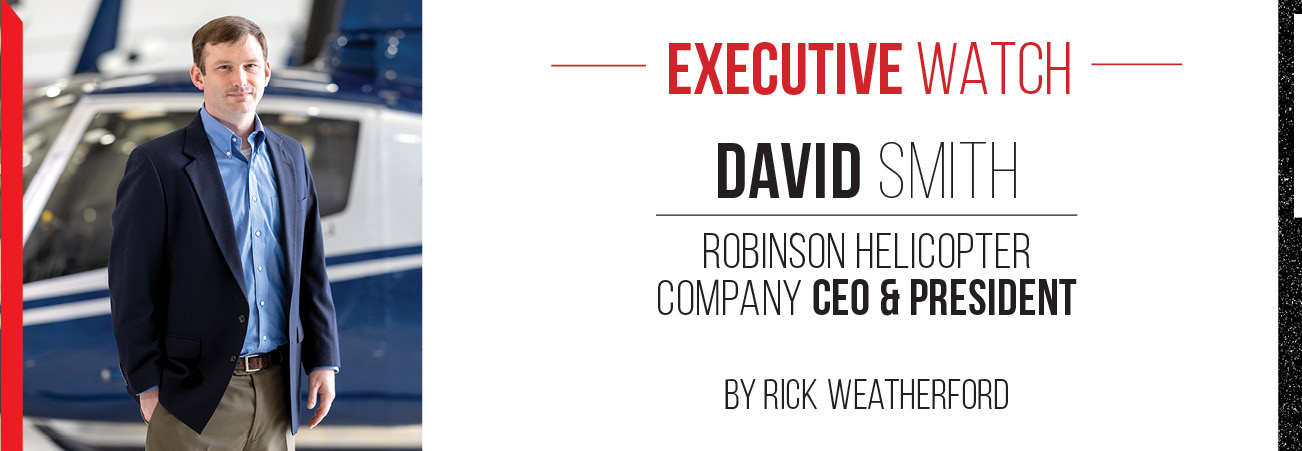
If there was a Mount Rushmore for the giants of helicopter history, the late Frank Robinson would be carved in granite. The rotorcraft pioneer’s driving vision was to put a sophisticatedly simple, affordable light helicopter in the sky. So, he left his position as a chief engineer at Hughes Aircraft to start Robinson Helicopter Company at the draft table in his Palos Verdes, California, living room where he began to will his vision into reality by founding Robinson Helicopter Company 53 years ago.
Robinson Helicopter Company’s current president and CEO, David Smith, is committed to extending Robinson’s legacy at least another half century. He said in our interview, “My goal is to make sure we’re in business for hundreds of years.” How does one do that? By playing the long game. “When they recruited me here, [Robinson’s] shareholders told me that they want to grow the business and they made it very clear we have a business-growth horizon of 20 or more years. With that, we can build a generational foundation like what Frank built originally, and we can build a hugely successful, diverse business from his foundation. We are thinking on a 50-year time horizon because we have to. I learned that from doing business in China over the years; they really think in epochs, not quarters. Why would we change something that’s already working? Because it wouldn’t have succeeded for [another] 50 years, with relatively few doing the heavy lifting. We are building a business with a sustainable future that will last at least another 50 years.”
Smith is the first person to lead Robinson Helicopter Company without the surname “Robinson,” having been preceded by Frank and his son, Kurt Robinson. Mr. Smith went to Torrance with his own idealistic vision for Robinson Helicopter Company, with which we’ll conclude this profile. However, let’s first get to know Robinson’s current pilot-in-command. Actually, that title is a bit of a misnomer on my part, for Smith is not a pilot for good reason.
During high school in his native home of Baton Rouge, Louisiana, Smith gravitated toward his father’s fondness for engineering. Dad, Lonnie, changed career horses midstream from being an electrical engineer to become a lawyer. He later told his son, “You can choose whatever career you want, but if you become a lawyer, I’ll disown you.”
Under Pressure
With that fatherly advice received, Smith worked toward being accepted by the Air Force Academy so that he might eventually become an aerospace engineer after an Air force career, but his epilepsy disqualified him from, he says, “fun” options, such as being an Air Force pilot. Smith then closed the cockpit door on that and took an alternate route by attending MIT with the goal to become a design engineer. He says MIT was “academically brutally hard, even painful.” How hard? One of his classmates was a Marine helicopter pilot who flew attack missions in Iraq and Afghanistan, an astronaut, and mother of twins. At a class reunion, she said her four years at MIT were by far the hardest thing she ever did in her life. “The whole class applauded in agreement,” Smith says. “I completely agree; when I graduated from MIT with an aeronautical engineering degree, the real world seemed easier and slower by comparison.”
Smith doesn’t seem to do anything slow. After he finished his rigorous college years in Boston, he immediately headed to Texas with his hard-earned engineering diploma to quick-start his career on the Bell Helicopter Xworx Experimental Design team. (While employed, Smith later earned an MBA from the University of Texas )
During his first 11 years at Bell Flight (he returned later to Bell in 2020 for three more years to build a factory in Wichita, Kansas, after five years at Tru Simulation. During his first tenure at Bell, Smith climbed his way up the engineering rungs of the Bell corporate ladder to become program director of the Bell 505 Jet Ranger X, where he was responsible for all activities associated with design, certification and delivery of Bell's new game-changing, single-engine helicopter. Smith considers leading that team a professional point of pride. “Anyone who was on that program would probably say it’s a career highlight for them too; I know that because we still stay in touch,” he says. “Working at Bell was a great and informative experience; it was hard to leave the people there. It taught me about the challenges that affect big business: I learned how material moves throughout a business, how data informs decisions—and often doesn’t, and how unions work and connect closely to productivity. I just learned at Bell a whole slew of useful things that I still benefit from today at Robinson Helicopter.”
Vice versa, Smith also benefitted at Bell from Robinson Helicopter when he took the lead of the 505 project. “One of the first things we did in that program was rent a Robinson 66, took it apart and de-engineered it. I could clearly see how Robinson built a great product,” he says. “We then sent a team to tour Robinson’s factory; at that time, they gave free tours. We studied the heck out of Robinson and realized they were going to be kind of hard to beat.”
Thus, a foundation of respect for Robinson Helicopter Company was laid before Smith first met President/CEO Kurt Robinson and Peter Riedl, Robinson’s head of engineering. At the time of that meeting, Smith was then at Tru Simulation + Training. Robinson and Riedl repeatedly asked Smith to join them at Robinson, but the timing wasn’t right. “I was then focused on sims for Tru,” Smith says. “Every six months or so, Pete would contact me to touch base. Then, I was later contacted by Kurt, Pete, and a head-hunting firm after Frank passed away and the family brought on additional investors. I had four opportunities [from others] at that time, including some overseas, but being VP of operations at Robinson was the best place for me and my family by far.”
Special Family
When he mentions his family, Smith becomes an enthusiastic fan-boy when he talks about him and his wife’s son. “He’s got a brain that’s wired like mine (that focuses obsessively on a subject) and he’s interested in the helicopter business. Over the holidays, I was in the office and he was with me, listening to conversations and walking the shop floor. He’s a Boy Scout and I try to stay active with him in that. I’m an Eagle Scout and he’s half-way there!”
Another thing the highly functioning 12-year-old has also accomplished half-way is de-engineering. “He likes to take things apart around the house and study how they work, so a big hobby of mine is going around behind him to put things back together he can’t fix and make sure he doesn’t burn the house down,” Smith says with no trace of annoyance. The boy’s hands-on education is furthered by his mom home-schooling him; Emily left her career as a speech therapist to do so.
Father and son also have a common affinity for disaster movies. “We just watched Greenland, which was good even though I had to edit some stuff out for him,” Smith said. Dad also likes watching sci-fi and, he says, “clever dramas.” His reading is “confined to all things aviation, including every accident report I can get my hands on.”
View from the Top
What was no accident, but rather a methodical plan, was Smith being promoted in-house from VP of operations to Robinson Helicopter Company president and CEO in 2024 when Kurt Robinson retired from those responsibilities. How have the past couple of years been going for Smith in his new roles? The CEO/president candidly answers, “I see success somedays, but we have so much more to do. My team is super successful and performing at a high level, but I don’t know if I will ever feel personally successful until one day 20 years from now when I retire and look back. Right now, I’m in the middle of playing whack-a-mole and reshuffling priorities.”
A main priority is eventually expanding Robinson Helicopter Company from its current core business of designing and building lightweight helicopters such as the R22, R44, R66, and recently announced eight-passenger R88.
Smith concludes with his compelling vision of what Robinson Helicopter Company will look like when he retires in the distant future: “In 25 years, if there’s another Hurricane Helene-type crisis, Robinson helicopters will still be the backbone of the response, but who will then supply the heavy-lift Chinooks, Black Hawks, etc.? They’ll be retired and the companies that made those products won’t make them anymore. We can build all sizes: small, medium, and big and I think that’s what we’re going to go after down the road, but we will stay connected to our current customer base as we expand.”
“I think Robinson Helicopter is in the best position to fulfill the future needs of the vertical-lift space. If it needs to hover, it will come from Torrance.”
READ JAN/FEB ISSUE OF ROTOR PRO
READ MORE ROTOR PRO: https://justhelicopters.com/Magazine
WATCH ROTOR PRO YOUTUBE CHANNEL: https://buff.ly/3Md0T3y
You can also find us on
Instagram - https://www.instagram.com/rotorpro1
Facebook - https://www.facebook.com/rotorpro1
Twitter - https://twitter.com/justhelicopters
LinkedIn - https://www.linkedin.com/company/rotorpro1