|
Jan
26
2026
|
|
Posted 253 days ago ago by Admin
|
|
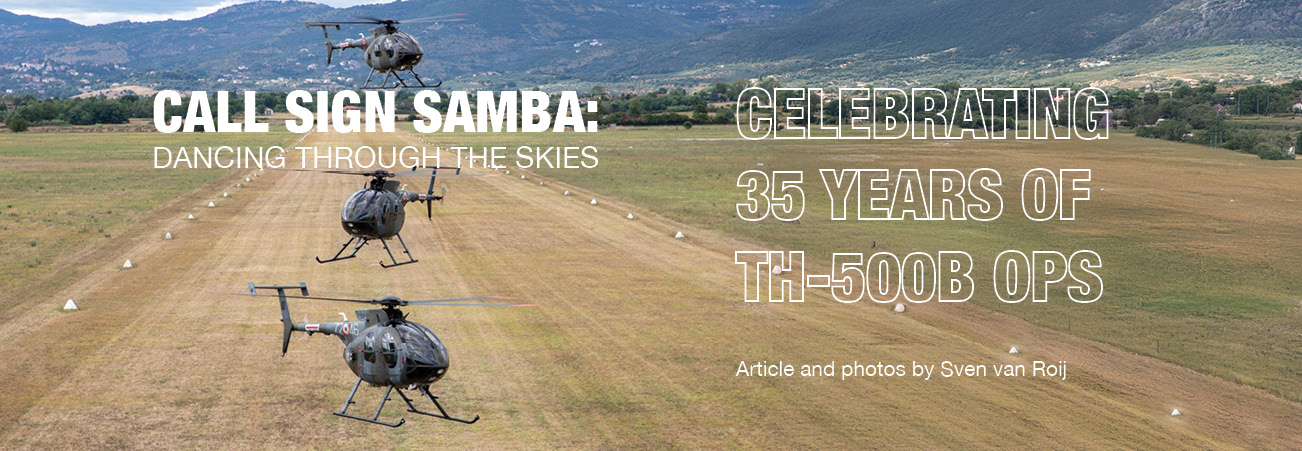
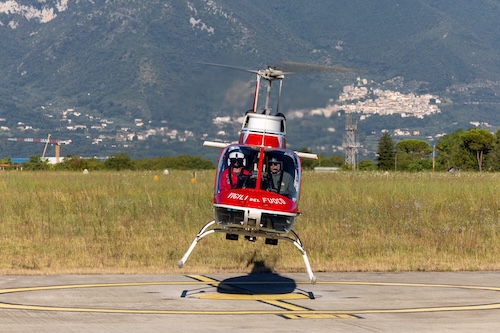
About an hour’s drive southeast of Rome lies Frosinone Air Base. At first glance, the base appears to be a small location in a valley with only a grass strip. However, it is the training ground for Italy's military helicopter pilots and home to the 72nd Stormo (72nd Wing). The unit operates the small, reliable, and rugged TH-500B. Unit Commander Colonel Alessandro Fiorini briefed us on a unique mission: performing the very first aerial dances with the newest helicopter pilots of the Italian armed forces.
Colonel Fiorini’s path to Frosinone is as varied as it is impressive. After joining the Italian air force academy in 1996, he graduated as a military pilot in 2002 at the Euro-NATO Joint Jet Pilot Training (ENJJPT) program at Sheppard AFB in Texas. Fiorini said, “After the lead-in fighter training course, I served as a Panavia Tornado pilot and as an instructor at the Operational Conversion Unit (OCU). My instructor position at the OCU was followed by a temporary assignment at the ENJJPT program as a T-38C flight instructor.”
Jets and Helicopters
His career continued with several key leadership roles at Lecce, responsibilities in flight safety investigation and a position as air task force commander with the Italian national contingent in Kuwait. Since July 2023, Fiorini has been in command of the 72nd Stormo, where he continues to instruct on the TH-500B and AW-139.
The colonel is honest on his transition from frontline fighters to training helicopters. He said, “For my personal ego, flying jets is all about the thrill – speed, G-Forces, high altitudes, and the feeling of being everywhere in the sky. Flying helicopters, though, is a completely different game. It takes a whole new mindset. At first, dealing with the aerodynamics and flight control feels really tough and demanding until you start getting the hang of it. I’ll never forget my very first flight in the TH-500B and thinking to myself: I’m never going to make it!”
His dual perspective from operating both jets and helicopters provides a unique lens. “For me, the helicopter generates different emotions, mainly visually based. This is due to the helicopter's operating area, proximity to the ground and its flexible usage. The flight envelope is truly different. With the helicopter, one is contained, while the envelope of a jet is wide and large. However, as a pilot and professional that is focused on his assigned role and mission task, both fighters and helicopters are equally attractive to me and must be respected for what they are meant to do.”
Much in Little
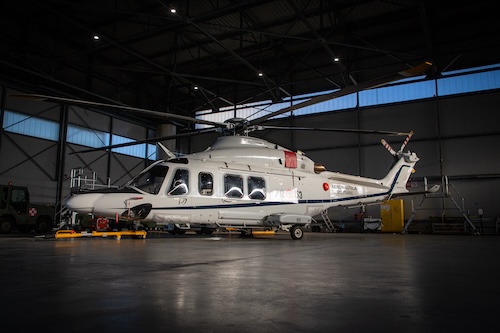
Over the past 35 years, some 2,000 pilots have been successfully trained on the type. The commanding officer said, “The main strength of the Wing is summarized in its motto, ‘Multum in Parvo’ (Much in Little). Although relatively small, the school is capable of independently meeting the training needs in the rotary-wing sector, not only for the Italian air force, but also for other armed forces and state corps.” These include trainees for the Italian army, the Carabinieri and the Guardia di Finanza. In addition, pilots are also trained for domestic security purposes, for example for the Polizia di Stato.
The colonel said, “This remarkable capability of our motto should not be mistaken for a weakness. As training demands continue to rise, both human and material resources are evolving to keep pace. Expectations remain high for those who have consistently achieved much with limited means. While the quality of instruction offered to students is still unmatched, the real challenge today lies in striking the right balance between managing available resources and responding swiftly to the growing demand for pilot training.”
The Wing is not just Italy’s training hub; it is an international training institute for many future pilots from foreign armed forces. “In recent years, the demand for collaboration from foreign countries has led to a significant internationalization process at our school, making it a benchmark for helicopter training not only nationally but also internationally. Pilots from Afghanistan, Djibouti, Lebanon, Zambia, Malta, Albania, Kuwait, and Saudi Arabia have earned their wings at Frosinone. Currently, there is a collaboration between Italy and Argentina aimed at having a pilot instructor from the South American country at the 72nd Wing. Finally, student pilots from an undisclosed country in the Middle East are currently undergoing training.” Fiorini said.
The Legacy of the Stormo
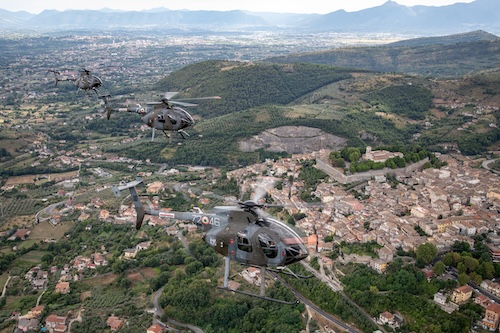
The 72nd Wing heritage stretches back far beyond its official founding in 1985. Rotary training at Frosinone began as early as in 1955. Back then, the unit was named Helicopter Center. Five years later, the Center evolved into the Helicopter Flight School.
Fiorini said, “The chief of staff of the Italian air force, General Oreste Gargioli, officially changed the name of the Helicopter Flight School to the 72nd Stormo on 1 November 1985. This change marked not only a name update, but also an official recognition of the operational excellence of the unit.”
Small Heli, Big Impact
No other aircraft symbolizes rotary training in Italy as strongly as the single-turbine engine, five-bladed training and liasion TH-500B. Derived from the Hughes NH-500, fifty airframes of the Italian-built Breda-Nardi version entered service from 1990 onwards. The type gradually replaced the ageing Agusta Bell AB47J and Agusta Bell AB-204B. In 2023, the fleet accumulated more than 200,000 flight hours. Currently, the entire fleet flies around 4,000 hours annually.
On a daily basis, instructors of the Wing take future pilots into the skies. Due to their inexperience, they dance through the air. Fiorini said, “Our call sign is ‘samba’ since a novice pilot’s maneuvers are characterized by quick and rapid movements similar to the dance.”
Despite all this ‘dancing,’ there have been relatively few major incidents involving the TH-500B fleet. One airframe was lost in Kosovo on 18 January 2001. Another crashed during a simulated crash landing near Arnara on 13 March 2008. The third aircraft lost was involved in a hard landing in Ripi on 14 November 2017. Looking back, one could say the overall record is one of safety and dependability. Fiorini emphasizes the helicopter type’s strengths: reliability, agility, and suitability for basic training. “Accidents were almost always linked to human factors, sometimes reinforced by environmental conditions. “The 500 has proven to be a highly reliable aircraft,” he said.
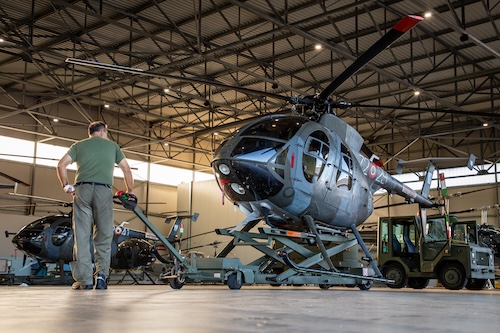
Operational availability of the TH-500B fleet remains high, with about 85% of the assigned helicopters ready for daily use. Maintenance is shared between air force personnel and industry partners, with major overhauls outsourced to companies such as Leonardo and, more recently, Mecaer Aviation Group.
Training the Trainee
An Italian air force’s pilot training begins with Phase I at the 70th Stormo in Latina. During this phase, cadets receive basic flight instruction on the SIAI-Marchetti. Phase II follows as the primary flight training stage that is conducted at the 61st Stormo in Galatina on the MB-339A. Phase II can also be conducted at partner bases abroad, such as at ENJJPT.
Students for the helicopter track then arrive at Frosinone air base, where they begin a training program that will lead to the achievement of the multi-pilot military pilot license. The CO said, “The process for the air force students is divided into two phases: Phase III/a and Phase III/b. In Phase III/a, approximately 100 flight hours are flown on the TH-500B, including visual and instrumental flights, low-altitude navigation over land or water, and basic and tactical two-aircraft formation flights.” For Phase III/b, students advance to the Leonardo UH-139 and end their training at Phase IV at an Operational Conversion Unit (OCU).
“Night and mountain flights are also conducted, in addition to instrumental approaches via the instrument landing system (ILS) and ground-controlled approach (GCA). Furthermore, simulator missions are performed to learn the correct way to manage emergencies and for instrument flight rules (IFR) training. We typically receive just over 50 candidates annually and usually about 90% of these candidates graduate. Typically, students perform around 100 training events before graduation, with their first solo flight after about 20 missions.”
The 72nd Wing also holds flight instructor (PIT) courses. The school has also implemented procedures to certify tutors for teaching in Performance Based Navigation (PBN). Fiorini said, “This represents the future of assisted air navigation and will completely replace conventional navigation. To further expand our capabilities, a second simulator for the UH-139A, which includes a Flight Navigation Procedures Trainer (FNPT), was acquired.”
Going Beyond Training
While training is the Stormo’s primary mission, its aircraft and crews also contribute to national and international operations. Supporting civil protection during natural disasters and conducting search-and-rescue missions are part of the job. Over the years, TH-500Bs were deployed to Albania (Italian humanitarian operation Arcobaleno, 1999-2000), Eritrea (United Nations Mission in Ethiopia and Eritrea, 2000-2001) and Kosovo (Kosovo Force, 2000-2003). The deployed aircraft provided reconnaissance, liaison, and light transport support in these missions.
When asked about its capabilities, Fiorini says the TH-500B can be fitted with light machine guns and rocket pods, primarily for training purposes. “Our flight school does not operate armed helicopters at all. The last time one of our TH-500Bs was actually deployed in a weapons role was during the peacekeeping operations in Kosovo in the early 2000s.”
Flying into the Future
Although the Italian air force has been operating the TH-500B for 35 years, the veteran helicopter is still of value, even alongside the Italian cutting-edge fleet that includes the Lockheed Martin F-35A, Boeing KC-767, and Aermacchi M-346. To keep the aircraft type future-proof, a mid-life update is underway to bring in a new digital avionics suite with modern multifunction displays. A recent upgrade already saw its rotor blades replaced. Yet the real secret to the TH-500B’s longevity lies in its character. Pilots continue to praise its reliability and easy handling—qualities that make it an ideal entry-level trainer.
Fiorini said, “In the near future, the Wing will play a leading role at Rome Viterbo, a commercial and military airport nearby, to establish a joint-force helicopter training school. The Italian air force will act as the lead service with other state agencies and the 72nd Wing will be the core structure upon which these new capabilities will be developed.” This means the Stormo might move to another location in the future, although neither an official statement, nor choice, on this matter has been made.
The colonel declined to elaborate on the number of helicopters currently in service; that is classified information. Although the older type is still of value, Italian air force headquarters is currently in the process of defining a new aircraft to replace the TH-500B fleet in the future. A type has not yet been chosen.
The future will reveal which platform best serves the next generation of pilots. What will remain is every student’s first tentative hover. The legacy of the ‘Samba’ will continue to dance in the Italian sky.
READ NOV/DEC ISSUE OF ROTOR PRO
READ MORE ROTOR PRO: https://justhelicopters.com/Magazine
WATCH ROTOR PRO YOUTUBE CHANNEL: https://buff.ly/3Md0T3y
You can also find us on
Instagram - https://www.instagram.com/rotorpro1
Facebook - https://www.facebook.com/rotorpro1
Twitter - https://twitter.com/justhelicopters
LinkedIn - https://www.linkedin.com/company/rotorpro1