|
Jan
05
2026
|
|
Posted 284 days ago ago by Admin
|
|
The rotorcraft industry continued to amaze and astound us over the past 12 months. Here are the advances that caught our eyes and made Rotor Pro’s Best of 2025 list…
Sikorsky U-Hawk and Nomad
After pioneering autonomous rotorcraft flight using its MATRIX flight autonomy system, Sikorsky, a Lockheed Martin company, went to the next level in 2025 with its S-70UAS U-Hawk helicopter.
What makes the U-Hawk so impressive is its complete lack of cockpit. Because this uncrewed ‘L’ model Black Hawk is flown by MATRIX, Sikorsky has removed the legacy cockpit (flight displays, mechanical flight controls, pilot seats) and replaced it with two clamshell doors and a ramp. Without a cockpit, the U-Hawk now has 25% more cargo space than a crewed Black Hawk. This allows it to carry longer cargo such as a Naval Strike Missile pod or a HIMARS rocket pod, or transport a drive-on/off uncrewed ground vehicle, to deliver supplies, or load up to four Joint Modular Intermodal Containers (JMICs). The U-Hawk can also launch swarms of launched effects (reconnaissance drones) from quivers on one or both sides of the aircraft, or carry up to five internal auxiliary fuel tanks for extended time on station.
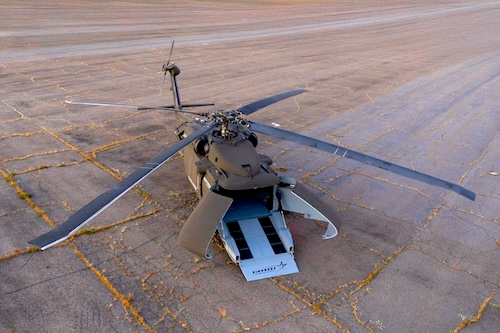
Sikorsky Innovations, the company’s prototyping group, is developing the U-Hawk to be flown singly, in autonomous rotorcraft groups, or in teams with crewed aircraft “We envision a U-Hawk leading and supporting air assaults,” said Sikorsky spokesperson Frans Jurgens. “When pilots are resting, commanders will have flexibility to continue resupply missions on a contested battlefield with U-Hawk aircraft. A soldier will have full command from start-up to shut-down. A soldier can upload mission goals to a U-Hawk aircraft via a tablet. The MATRIX autonomy system automatically generates a flight plan, relying on cameras, sensors, and algorithms to help navigate the fly-by-wire helicopter safely to its destination.”
Also in 2025: Sikorsky demonstrated its MATRIX-controlled, battery-powered Nomad VTOL UAS Rotor Blown Wing aircraft. Equipped with two prop-rotors attached to a 10-foot wingspan, the payload-capable Nomad was able to takeoff, hover, and land vertically, and fly like an airplane. (A Rotor Blown Wing uses the airflow generated by its proprotors to "blow" over the wing, to reduce drag on the wing in hover and cruise modes and when transitioning from vertical to horizontal flight, and vice versa.)
Besides its ability to use hybrid-electric or conventional propulsion, what makes the Nomad design so compelling is its scalability. This VTOL UAS can be the size of a tabletop up to the geometric length of a Black Hawk helicopter, depending on mission and payload requirements. An 18-foot wingspan Nomad variant currently in development will use hybrid-electric propulsion.
In other 2025 news, Sikorsky Innovations and GE Aerospace are finalizing designs to build a hybrid-electric power systems testbed with a 600kW electric motor,” Jurgens told Rotor Pro. “The testbed is a first step to evaluate hover performance of the follow-on HEX demonstrator — a 9,000-pound max. gross weight tilt-wing UAS aircraft with 1.2MW-class turbogenerator and associated power electronics. First flight of the HEX testbed is expected in 2026.”
In March 2025, Sikorsky announced availability of the highly anticipated S-92 Phase IV main gearbox. It features an auxiliary lubrication system that automatically engages in the event of primary oil pressure loss. This eliminates the need for immediate landing, allowing operators to safely reach their destination. The gearbox solution has been validated through more than 800 hours of rigorous testing, and FAA certification is anticipated in 2026.
EHang Unveils VT35 Pilotless eVTOL
EHang Holdings Limited unveiled its new VT35 Pilotless Electric VTOL on 13 October 2025 in Hefei, China. Derived from the company’s VT30 prototype, the two-seater, autonomous flight VT35 is intended for medium-to-long-range applications including intercity, cross-sea, and cross-mountain transportation.
The VT35 has a tandem-wing outfitted with eight distributed lift propellers for vertical takeoff and landing. It also has a tail-mounted pusher propeller for forward flight. According to EHang, the VT35 is compatible with existing EH216-S vertiports and can use a wide range of urban takeoff and landing sites, such as parks, rooftops and parking lots. It has a fully loaded range of about 125 miles and a maximum takeoff weight of 2,094 pounds.
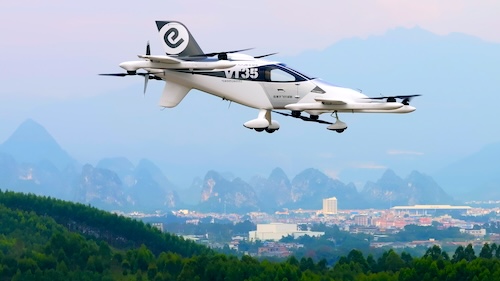
The Civil Aviation Administration of China (CAAC) accepted EHang's type certificate (TC) application for the VT35 eVTOL aircraft in March 2025. According to the company, the VT35 is currently undergoing airworthiness certification, with internal testing and experimental flights underway.
“Coinciding with the second anniversary of the EH216-S’s Type Certification, VT35’s launch marks the evolution of EHang’s long-range product line and a major milestone towards our advanced air mobility vision,” said EHang CEO Wang Zhao during the VT35 unveiling ceremony. “Together with our partners, we will accelerate the commercialization of pilotless eVTOL aircraft across diverse application scenarios, fostering a new, integrated urban–intercity low-altitude transportation ecosystem.”
Ascent AeroSystems Scores Many Firsts in 2025
Ascent AeroSystems’ coaxial propulsion unmanned aerial systems (UAS) stand apart from traditional quadcopters or other multirotor drones. Unlike those designs, Ascent’s family of high-performance, dual-use UAS feature a unique vertical cylindrical shape with two sets of centrally mounted counter-rotating blades. Its flagship SPIRIT and SPARTAN platforms have the ability to carry payloads on both the top and bottom of the aircraft. The company has reimagined UAS by putting function first in a way that enhances the operational capabilities across crewed and uncrewed VTOL aircraft.
“2025 was a great year for Ascent,” said company President Paul Fermo. “We had a number of product introductions, released new payload integrations, and received certifications for both platform and company-level cybersecurity and supply chain reliability.”
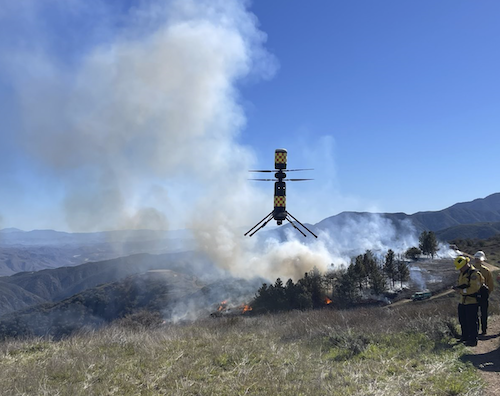
To be precise, Ascent unveiled HELIUS—its smallest coaxial UAS to date—in 2025; it’s the company’s first UAS that’s less than 250 grams. Purpose-designed for public safety operations, the HELIUS ultra-low light camera is equipped for use in surveillance missions, and small enough to be carried on an officer’s equipment belt. Fermo also noted, “Our SPIRIT UAS rejoined the Department of Defense’s Blue UAS Cleared List as a ready-to-deploy ISR platform and as a foundational platform component. It is the only UAS platform to be included on both DIU Cleared lists.”
Ascent also introduced SPARTAN in 2025. It is an evolution of the heavyweight NX30 UAS platform “with advancements that position it extremely well for beyond-visual-line-of-sight operations,” Fermo said.
To optimize the multi-mission capabilities of SPIRIT and SPARTAN, Ascent extended its range of sensors and accessories to include multispectral and photogrammetry options for agricultural operations, additional EO/IR sensors for advanced ISR, surveillance, and search and rescue. It also introduced advanced GCS options.
Finally, Ascent became the first U.S.-based small UAS OEM to achieve CMMC Level 2 compliance, a pre-requisite for doing business with the DoD that was enacted in November 2025. “With the push for building a strong and resilient U.S. drone industrial base and directives to accelerate UAS deployment across all services and all levels, this is a significant differentiator for our company,” Fermo concluded.
Dufour Aerospace Works on Aero-200
Building on Switzerland’s legacy of high-efficiency aircraft design, Dufour Aerospace continued its steady march toward certification of the tilt-wing VTOL Aero-200 cargo drone. The Aero-200 has four propeller engines that handle both vertical and horizontal flight. It has an initial payload capacity of about 44 pounds (20 kg), a cruise speed of 77 mph, and a range of up to 124 miles.
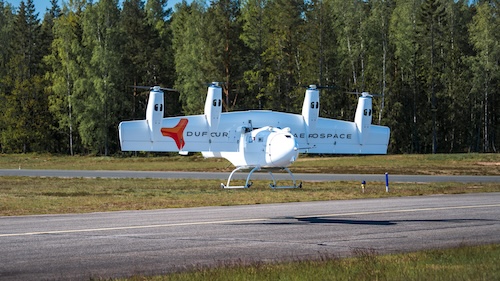
“We are working hard to certify the Aero-200 and bring it to market,” said Thomas Pfammatter, the company’s co-founder and head of strategy. “Dufour Aerospace will increase the efficiency of the VTOL industry by providing first unmanned and later manned tilt-wing aircraft.”
Robinson Reveals R88 and R66 NxG
This past year was exciting for Robinson Helicopter Company. First, the company revealed its new R88 10-seater single-engine helicopter at Verticon (formerly Heli-Expo) in March 2025. “We also introduced [at Verticon] the R66 NxG with a refreshed and updated glass cockpit and interior design,” said Robinson Helicopter President and CEO David Smith. “The R66 NxG features our recently FAA-approved Advanced Flight Control System by Garmin, making us the first OEM to include a standard autopilot system in a light single-engine helicopter.”
The R88 is Robinson Helicopter’s first all-new model in nearly 15 years. It carries two pilots and eight passengers, and is powered by a single Safran Arriel 2W 1,000-shaft horsepower engine. “We have dedicated significant resources to building the iron bird, ground test articles, and the first flight aircraft,” Smith told Rotor Pro. “The R88 marks a vital sign of health for the rotorcraft industry. Our industry is at its best when we push product development forward with new designs and safety enhancements. Robinson has the largest installed civil helicopter fleet in the world, so our opportunity to give our customers even more products to address a wider array of missions is exciting.”
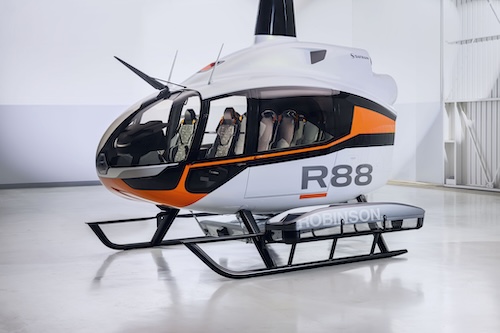
In addition to announcing the R88 and R66 NxG in 2025, Robinson Helicopter made major changes in its factory operations. This included a comprehensive factory and inventory management toolset to significantly improve its fulfillment of parts and manufacturing speed for the years ahead. This efficiency is directly improving the company’s lead times for all key spare parts, overhaul kits, and popular field modifications, such as the new Symmetric Horizontal Stabilizer retrofit kit.
“We are also making key investments in our unmanned systems division, Ascent AeroSystems, as they field the first production run of our Helius small UAS,” said Smith. “We will continue to expand and operationalize our manned-unmanned teaming and large UAS businesses that complement the Ascent product lines.”
Rotor Technologies Progress on UAVs
Rotor Technologies is pushing ahead with two new uncrewed aerial vehicles (UAVs), both of which are based on the Robinson R44 helicopter platform. The first is the Airtruck, which is intended to be a utility UAV with 1,000+ pounds of payload capacity. The second is the Sprayhawk, which is an agricultural UAV with a 110-gallon capacity.
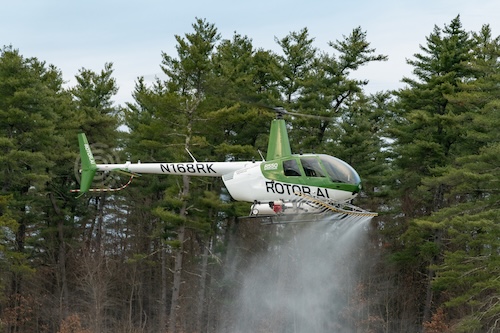
“We are completing the development of the Airtruck and Sprayhawk together with Robinson Helicopter Company and moving towards production,” said Nicholas J. Coates, Rotor Technologies’ vice president of partnerships. “We have secured regulatory approvals in Brazil and Argentina, with U.S. 44807 approval underway.” According to the company, Airtruck and Sprayhawk have a maximum takeoff weight of 2,500 pounds each, which makes them the largest civilian drones available for purchase in the world.
“This UAV enhances pilot and ground crew safety and efficiency by reducing risk in high-risk missions, such as precision agriculture, firefighting, utilities/construction, and offshore work,” Coates told Rotor Pro. “The Airtrick and Sprayhawk bring a new level of safety to dull, dirty and dangerous missions. They also open up new markets to VTOL, reduce costs and workload for operators, and help address pilot shortages by shifting roles toward mission manager positions. Autonomy and unmanned systems extend the relevance of helicopters in a changing aviation landscape.”
READ NOV/DEC ISSUE OF ROTOR PRO
READ MORE ROTOR PRO: https://justhelicopters.com/Magazine
WATCH ROTOR PRO YOUTUBE CHANNEL: https://buff.ly/3Md0T3y
You can also find us on
Instagram - https://www.instagram.com/rotorpro1
Facebook - https://www.facebook.com/rotorpro1
Twitter - https://twitter.com/justhelicopters
LinkedIn - https://www.linkedin.com/company/rotorpro1