|
Dec
22
2025
|
|
Posted 297 days ago ago by Admin
|
|
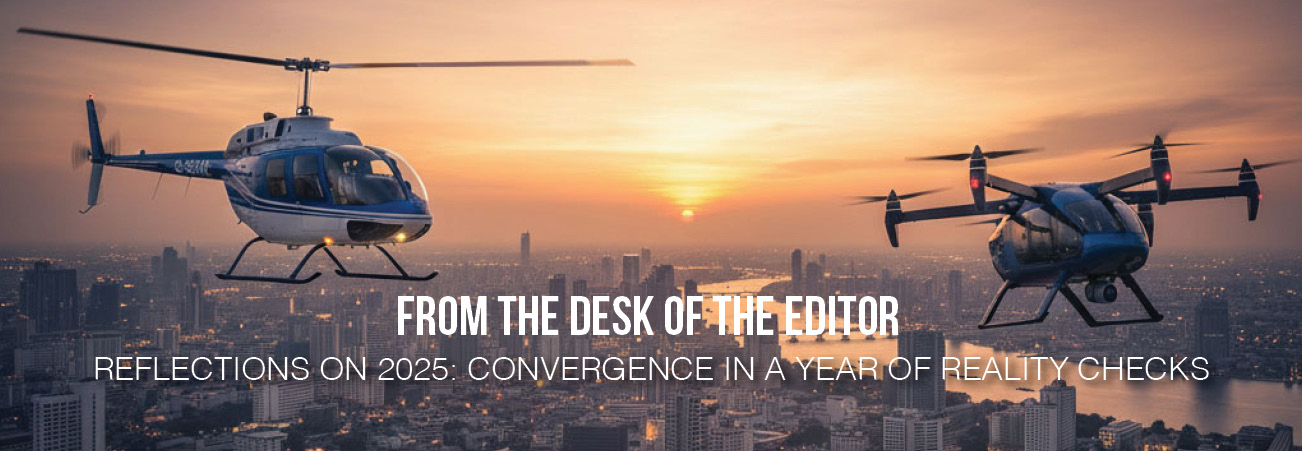
Reflections on 2025: Convergence in a Year of Reality Checks
The year 2025 marked a pivotal moment in vertical flight that was characterized by the traditional helicopter sector experiencing booming demand against severe supply constraints, while the nascent electric vertical takeoff and landing (eVTOL) sector pushed aggressively toward commercialization while navigating crucial home-stretch regulatory hurdles. The two segments are not yet competitors, but are instead complementary forces driving the entire vertical-mobility ecosystem forward.
Traditional Rotorcraft: Demand Outpaces Supply
For traditional helicopters, the market is defined by unmatched demand for critical missions. Global geopolitical tensions are driving significant increases in defense and para-public spending, particularly for military-transport, surveillance, and next-generation attack helicopters. Furthermore, the persistent threat of natural disasters coupled with a revival in the offshore energy sector is keeping the order books full for specialized heavy- and medium-lift aircraft.
The major constraint, however, is an ongoing supply-demand imbalance. OEMs continue to face an uphill battle against persistent supply chain bottlenecks, long lead times for specialized parts, and an industry-wide shortage of skilled maintenance technicians. This scarcity has caused the pre-owned helicopter market to surge with high prices and high liquidity for reliable aircraft as operators around the globe look for immediate solutions to replace their aging fleets.
The eVTOL Sector: Certification is King
The eVTOL industry, poised to revolutionize urban mobility, was focused squarely on regulatory milestones in 2025. Companies are in the advanced stages for both Federal Aviation Administration (FAA) and European Union Aviation Safety Agency (EASA) certification. While the path remains rigorous and capital-intensive, successful progress by key players—such as Joby Aviation's operational flights in multiple countries and the unveiling of new designs by others—is building market confidence.
Investment is increasingly targeted, moving from speculative venture capital to strategic corporate and government partnerships. Dual-use defense contracts and collaboration with aerospace veterans validates the technology, provides essential funding, and offers a near-term revenue stream while the primary urban air mobility (UAM) market matures.
Convergence and the Future of Vertical Flight
The most significant factor uniting helicopters and eVTOL is the push for sustainability and infrastructure. The need to reduce emissions is driving traditional helicopter players toward Sustainable Aviation Fuel (SAF). Of course, eVTOLs are inherently electric. The physical integration of both types of aircraft hinges on the development of Vertiports and advanced air traffic management (ATM) systems, which must safely accommodate both traditional rotorcraft and the high-frequency operations of eVTOLs.
In essence, 2025 was a year of operational realism. Helicopters are essential, but constrained; eVTOLs are promising, but must prove their safety and operational viability at scale. The successful marriage of these two markets–one mature and one coming of age–will be defined by the clarity of regulations and the timely rollout of supporting ground infrastructure.
READ NOV/DEC ISSUE OF ROTOR PRO
READ MORE ROTOR PRO: https://justhelicopters.com/Magazine
WATCH ROTOR PRO YOUTUBE CHANNEL: https://buff.ly/3Md0T3y
You can also find us on
Instagram - https://www.instagram.com/rotorpro1
Facebook - https://www.facebook.com/rotorpro1
Twitter - https://twitter.com/justhelicopters
LinkedIn - https://www.linkedin.com/company/rotorpro1