|
Dec
08
2025
|
|
Posted 318 days ago ago by Admin
|
|
VIEW VIDEO
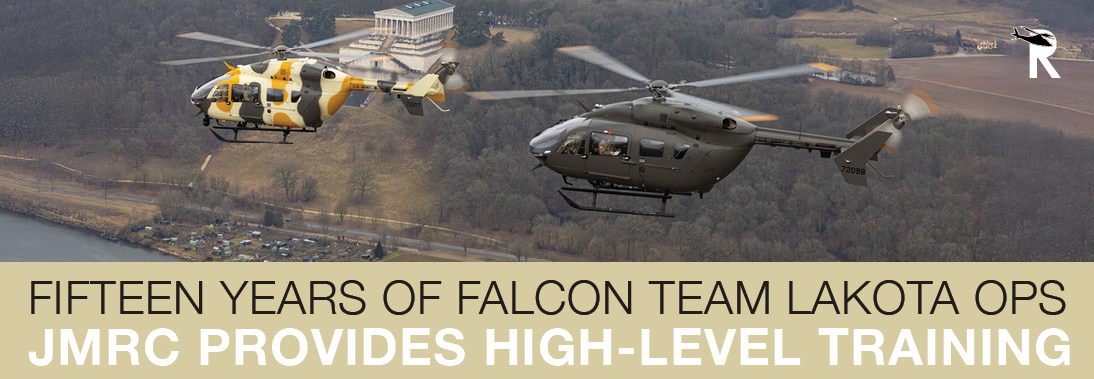
The Hohenfels Training Area is home to the Joint Multinational Readiness Center (JMRC). The Center has several Observer Coach Training teams, including the Falcon Team. This unit is equipped with eight UH-72A Lakotas and is led by Colonel Beau G. Rollie. The senior aviation trainer informed Rotor Pro about the diversity of assignments for his skilled unit.
The JMRC is the sole U.S. Army forward stationed Combat Training Center (CTC) and has an important objective: training leaders, staff and units to dominate in conducting global multidomain operations.
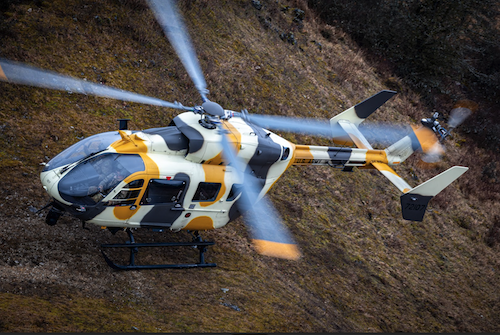
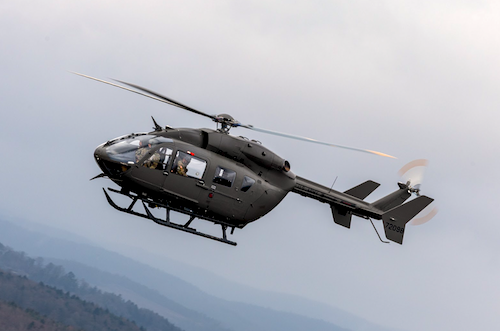
The JMRC has 12 observer, coach and trainer (OCT) teams. Each OCT team has a specialized task during large-scale exercises, also called rotations. The Falcon Team conducts five to 10 large-scale rotations annually. To perform their mission, the team operates eight UH-72A Lakotas. Four of the light utility helicopters (LUHs) are painted in the regular green color scheme. The other four are in a yellow-brown camouflage pattern that names them ‘Bruised Bananas’.
Mimicking mission
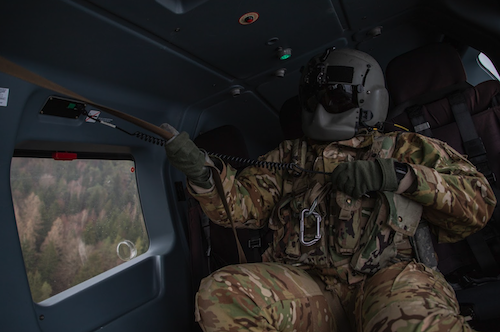
Rollie has been the commander of this unit for over 18 months. He said, “The most flown mission for us is White Chase Mission. Essentially, we fly as umpires. We bring a referee onboard any participating helicopter that flies in in our training exercise. If it is a Black Hawk or a Chinook, a referee rides in that aircraft with them. When Apaches or Eurocopter Tigers conduct their training, we chase along with one of our green Lakotas.
“When I am on the White Chase mission, I am watching a team that operates helicopters as they move forward in battle. I overhear their internal conversations on targets they want to shoot or when they call for artillery support or report that they are making back to the higher headquarters. Prior to the mission, the OCTs are coaching them through their preparation. When we go out and fly, we watch the mission unfold. After returning to the CTC, we debrief the crews and give them feedback on how their mission went.”
The four camouflaged aircraft are used for flying the opposing force (OPFOR) or the “Red Air” mission. For this mission, the LUHs are equipped with the L-3 Wescam MX-15i EO/IR sensor system and the Multiple Integrated Laser Engagement System (MILES) / Tactical Engagement Systems (TESS) that make training even more realistic for troops. With the MILES/TESS gear, targets can be attacked without using ammunition. The LUH itself can also be ‘shot’ by visiting units during the training.
Rollie said, “Even during the Red Air missions, we continue to perform our OCT role. For me, the best coaches are the enemy. I can instruct someone on the correct approach or procedure If not correct, they perish during the laser-tag game. With regards to flying, replicating Red Air missions is the most interesting and fun mission for me. Flying around in the middle of the night to shoot at the good guys. As a former Apache pilot, these are the most dynamic missions for me to fly.
“Even though in the Red Air missions we stage the Lakota as an enemy helicopter, I fly it like an Apache. We do not necessarily mirror Russian tactics, but the weapons we replicate are based on those from the Eastern Bloc inventory. Within our organization, we call these Red Air missions ‘Sokol’ – the Russian word for “Falcon.”
The Falcon team also flies Blue Air scenarios with the green-colored LUHs, operating as friendly units. Finally, Green Air scenarios are flown. Rollie said, “During the Green Air mission, we are typically in a position to observe – say two Apaches – as they're fighting. At an altitude of 3,000 feet, I can keep an eye on both of them. Due to the nap-of-the-earth those, Apaches will actually not be in radio comms with everyone as they operate very low. Whereas, I am up high and can talk to them, while I am watching their mission unfold.”
New kid in town
In April 2010, the eight UH-72A LUH Lakotas replaced a fleet of 10 ageing UH-1 Iroquois. According to the Lakota Operational Test and Evaluation Report: “The LUH costs less to operate and support than a Black Hawk. Compared to its predecessor, the Lakota’s deployment readiness is higher, more spare parts are available and fewer maintenance hours are required.”
Rollie said, “In terms of operational capabilities, the Huey had its advantages, such as carrying capacity. On a good day, the UH-1 could carry eight or nine soldiers. With the Lakota, I am challenged with carrying more than four fully loaded soldiers without sacrificing fuel. Once I carry less fuel on board, I can carry more soldiers. However, this does have a direct impact on my range and station time. Replicating air assault training is thus made more difficult.” This is a striking claim, given the fact the 2007 Lakota Operational Test and Evaluation Report stated: ‘The Lakota provides 40% more payload and mission duration than the UH-1H aircraft it replaces.’
Nevertheless, the replacement of the Huey for the Lakota was necessary. Rollie said, “Eventually, the fleet reached a crossover point where the Huey got so old that they needed to be renewed. That was when the Lakota came into the picture.” The Airbus Helicopters' H145 final assembly line – the civilian version of the Lakota – is located in Donauwörth, less than a hundred miles from Hohenfels Army Air Field. Yet, the Lakota aircraft are built at the Airbus Helicopters facility in Columbus, Mississippi.
According to the Falcon team commander, there is an indirect link between the German and U.S. production lines. “Most parts are manufactured in and around Donauwörth, but they still have to go to the United States to enter the U.S. Army supply system. Once those parts have been booked into the U.S. Army supply system, they come to us.”
Small fleet availability
According to the 2010 Light Utility Helicopter Selected Acquisition, the JMRC would receive 10 UH-72As. However, the Lakota became the primary trainer for the Army. Rollie said, “Sometimes new pilots aren't nice to the aircraft they train on. This created shortages of airframes at the locations where we train. When the shortages where we train manifested, they took aircraft from places that have less need.”
According to the CO, this does not adversely affect the performance of the JMRC's mission: “Eight is a fine number for the mission we have, and we are likely to maintain this number of airframes in the future. If we had more exercises where the need is for us to travel abroad, then I would be challenged. However, I rarely run an exercise where I take my referees and fly to France or Germany to watch their Army.”
The Lakota is built to operate in non-combat environments for logistics and support missions and is a very suitable, cost-efficient platform with a high operational availability rate. The colonel clarifies, “For the army, we require an 85% fully mission-ready rating, and normally we are well above that. Our fleet flies between 3,000 and 4,000 flight hours a year. Each pilot must do 70 hours per year. Most of our pilots are probably doing around 100 hours a year. That is low, compared to some of the other airframe standards.”
Small but significant
Even though the Hohenfels Training Area covers more than 62 square miles, it is relatively small by American standards. However, the Bavarian location is unique to the U.S. Army and provides great training value. Rollie comments, “The United States has three major Combat Training Centers. One in Germany, one in Louisiana and one in the California desert. This one is the smallest, the one in Louisiana is a little bit bigger but the CTC in California is absolutely massive. The value of having three CTCs is that we have three very different training areas. The foliage here in Germany, combined with the rolling hills is very different than either of the other two. Here in Hohenfels, a tank company can be moving under the trees, and a helicopter can fly almost right over them and sometimes miss them.
“The other real value of the JMRC to me is almost every exercise has some NATO partner as a participant of the exercise. So, in war we would fight as allies and here we actually train to fight as allies, which has some very unique challenges.”
Future Prospects
Despite current global and political tensions, Rollie is positive on the Falcon team’s future. He said, “I think the JMRC will remain in place as it is. The JMRC, 7th Army Training Command, EUCOM, and the U.S. Army remain committed to defending with NATO allies and partners.”
Although the first Army unit started to operate the new UH-72B in September 2021, the Falcon team’s fleet will not be replaced anytime soon. “We are probably only about halfway through the lifespan of our airframes. There are no plans to replace them with other aircraft. There is also no decision yet on any upgrades to our current aircraft,” the CO clarifies.
Rollie said, “The only thing I would change with the LUH, are the avionics packages. There have been improvements, mainly related to upgrading the GPS Garmin 430 to the Garmin 650, and there have been some changes in the radios. We could use newer, better radios. Current avionics work well with our NATO partners because we can plug in with most NATO radios but we have some problems plugging in with the more advanced American units.
“Finally, I would like to shift more to include joint operations. We are called the Joint Multinational Readiness Center. The only air force partners here are mostly focused on Joint Terminal Attack Controller (JTAC) and Tactical Air Control Party (TACP). I would try to make the Falcon Team more air-focused and bring some more air force trainers here. In a perfect world, I would probably have a few fancy Cessnas out there that could fly even higher. It is some of the joint interoperability pieces that I think we somewhat miss here.”
VIEW VIDEO
READ SEP/OCT ISSUE OF ROTOR PRO
READ MORE ROTOR PRO: https://justhelicopters.com/Magazine
WATCH ROTOR PRO YOUTUBE CHANNEL: https://buff.ly/3Md0T3y
You can also find us on
Instagram - https://www.instagram.com/rotorpro1
Facebook - https://www.facebook.com/rotorpro1
Twitter - https://twitter.com/justhelicopters
LinkedIn - https://www.linkedin.com/company/rotorpro1