|
Dec
01
2025
|
|
Posted 325 days ago ago by Admin
|
|
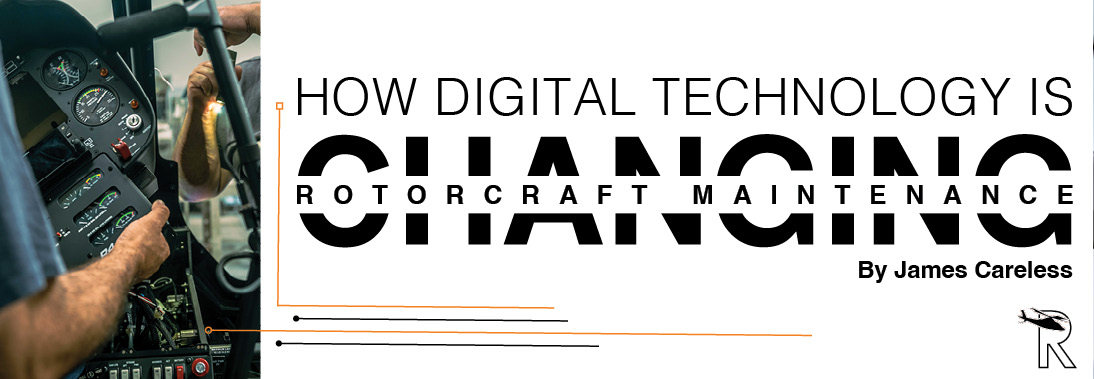
The Digital Revolution is impacting rotorcraft maintenance. In addition to their wrenches and screwdrivers, rotorcraft maintainers are now using digital tools such as artificial intelligence (AI) and augmented reality (AR) to get the job done. “We’re embracing disruptive innovation in our processes, technology and tools to drive speed, agility and data-driven insights for our customers,” said Steve Schmidt, Sikorsky’s VP of Engineering & Technology.
The New Digital Toolbox
No matter which rotorcraft manufacturer you talk to, they’re all developing digital tools to help maintainers do their jobs more accurately and efficiently. For instance, Robinson Helicopter is developing immersive AR overlays for the R66 and R88, allowing technicians to practice in a virtual environment without the risk of damaging an aircraft.
“This hardware-agnostic approach enables Robinson Helicopter maintenance instructors and technical support teams to guide mechanics globally through repair procedures, reducing errors and improving safety,” said David Smith, president and CEO of Robinson Helicopter Company. “Additionally, the new R88 platform will feature an advanced health and usage monitoring system (HUMS) with early detection capabilities. This system will relay real-time information to Robinson Helicopter and its engine partners during flight. By using AI to analyze this data, we can identify patterns, optimize operations, and take a proactive approach to maintenance.”
Sikorsky is also using AI to improve the maintenance and performance of its rotorcraft. “For example, we're using AI-powered predictive maintenance software to analyze data from our virtual sensors and estimate the remaining useful life of a drive shaft,” Schmidt said. “This allows us to plan maintenance more effectively.”
Furthermore, Sikorsky is employing natural language processing (NLP) to extract actionable knowledge from human-written maintenance activities. This makes it possible to process and utilize large amounts of existing data that is previously difficult to interpret.
“As well, in addition to digital twins [virtual models of physical aircraft systems that are constantly updated by sensor data] and predictive maintenance, we're also using AI-powered diagnostic software to analyze data from our aircraft and identify potential issues,” said Schmidt. “This software uses machine learning algorithms to analyze patterns in the data and identify anomalies, which enables us to detect potential problems before they occur.”
Leonardo is advancing several initiatives in the digital toolbox arena, with a strong focus on harnessing AI, advanced analytics, and immersive training technologies to enhance rotorcraft support. “At the center of this transformation is our Diagnostic Services Tower (DST), a state-of-the-art facility that processes data from more than 4,500 helicopters worldwide,” said Andrea Campagna, Leonardo Helicopters U.S. director of Customer Support and Services for the Americas. “More than 1,300 aircraft are now equipped with advanced sensors, which transmit real-time operational data into our digital ecosystem.”
Initially based in Sesto Calende, Italy, Leonardo’s DST was moved to an expanded facility in Philadelphia this year. “It continuously monitors flight and operational data, powered by our DaVinci-1 high-performance computer,” Campagna told Rotor Pro magazine. “Beyond predictive maintenance, the DST also supports training and simulation environments. By integrating real-world data into virtual reality (VR) modules, we provide pilots and technicians with highly realistic training that prepares them for both.”
The Value of Digitization
It takes a lot of time and money to digitize rotorcraft maintenance. Fortunately, the experts believe that digitizing these processes is well worth the effort. “These digital tools will reduce aircraft downtime and improve efficiency,” said Smith. “By providing a clean, mobile-friendly digital workflow and instant access to critical information, they will enhance technician efficiency and reduce training time. The use of real-time, AI-driven analytics also enables a proactive supply chain, helping Robinson Helicopters predict and deliver parts before they are needed, an efficient process thanks to our vertically integrated factory in Torrance, California, where 85% of our parts are manufactured.”
Over at Sikorsky, “the digital tools we're using in rotorcraft maintenance bring several advantages, including improved predictive maintenance, reduced maintenance costs, and increased aircraft availability,” Schmidt said. “By leveraging these AI-powered tools and platforms, we're able to improve the safety, efficiency, and performance of our rotorcraft.”
The rotorcraft industry’s adoption of digital tools is doing more than just making mechanics more efficient. “AI-driven analytics transform maintenance from being reactive to predictive analyzing inputs to detect early warning signs of component wear or system issues,” said Campagna. “This predictive capability is a practical form of a digital twin, where aircraft real-world conditions are mirrored digitally, enabling proactive interventions. Instead of waiting for components to fail, the system identifies potential issues early, allowing maintenance teams to schedule interventions in advance. This reduces unscheduled downtime, optimizes fleet availability, and ensures operational readiness.”
The benefits from digitally backed predictive maintenance are very real. “Clients benefit directly through higher dispatch reliability, reduced operating costs, and improved safety margins,” she said. “Predictive maintenance also optimizes lifecycle management by preventing unnecessary part replacements and extending component service life. The combined effect delivers greater operational efficiency, cost savings, and assured mission readiness.”
Bridging the Knowledge Gap
There is no doubt that Baby Boomers are the human knowledge base of the rotorcraft maintenance industry. The problem is that they are retiring, leaving younger, understandably less-knowledgeable technicians to fill the void. “The experienced technicians who have spent decades working on these machines are retiring, which if not addressed will create a knowledge gap that no amount of automation can fill,” said Maria Aguirre, head of MRO for Airbus Helicopters in North America.
This is where the Digital Revolution can help bridge the gap. “By digitizing the legacy knowledge of retiring mechanics, such as converting paper manuals, notes, and tribal knowledge into a digital format, we can ensure this critical information is not lost,” Smith said. “This helps us pass along decades of mechanical intuition and skills, setting the next generation up for success.”
Even with the digitization of legacy data, the need for a direct non-digital transfer of knowledge from one generation to another remains. This is why Airbus Helicopters is reassigning some of its veteran technicians from doing hands-on repairs to training younger, newer employees. “This approach allows us to capture all that critical knowledge — the things you can only learn from years on the job — and pass it down in a structured, systematic way,” said Aguirre. “This also frees up our other experienced staff to keep the day-to-day operations running smoothly.”
Airbus is sharing some of this expertise with its customers. To make this happen, “we have a team of senior technicians dedicated to training our customers' own mechanics,” she added. “This enables them to perform minor repairs on-site, which not only makes their operations more efficient but also reduces the number of small repair jobs that come to us, allowing our team to focus on more complex, high-level work.”
The Future of Rotorcraft Maintenance
So far in this article, we have described the immense impact of digital tools on rotorcraft maintenance. So, what will this area of expertise look like in the future? With the introduction of so much digital technology, will humans have a place in the rotorcraft maintenance shops of tomorrow?
On this first point, the experts we interviewed expect the future of rotorcraft maintenance to be much different from the present. “The nature of rotorcraft maintenance is expected to change significantly in the coming years, with a growing emphasis on predictive maintenance, automation, and AI-powered diagnostics,” said Schmidt. “Take predictive maintenance: AI models trained on fleet usage and maintenance data can help identify cause-and-effect relationships between usage patterns and maintenance needs. This can lead to increased asset availability, reduced mission aborts, and lower life-cycle costs.”
Schmidt also foresees the emergence of digitally provisioned ‘conversational diagnostics’ and ‘image interpretation and decision support.’ In the first area, he says,”The use of generative pre-trained transformer (GPT) tools, such as ChatGPT, can facilitate rapid diagnostic activities through interactive conversations between machines and humans. This can enable the generation of customized diagnostics and maintenance instructions on-the-fly.” As for image interpretation and decision support, Schmidt says, “The integration of image acquisition capabilities and advanced image processing can enable rapid autonomous inspections and improve aircraft availability. This can reduce the need for manual inspections and improve maintenance efficiency.”
Leonardo’s Campagna agrees, “The nature of maintenance will continue to evolve, with AI, digital twins and predictive analytics continuing to play a larger role in planning and decision-making.” However, she doesn’t think this evolution will demean the value of human technicians on the shop floor. “Helicopters are highly complex machines operating in demanding environments, and real-life, hands-on expertise will always be essential,” she said. “Looking ahead, the future of helicopter maintenance will not be about replacing people. The focus will be on providing them with innovative, faster, and more effective tools to empower them.”
This view is shared by Sikorsky’s Schmidt. “As for the question of whether a time will come when there is no longer a need for hands-on work, it's likely that AI and automation will augment human maintenance workers, but not entirely replace them,” he said. “At Lockheed Martin we are trying to look at how AI can be used to make us better at our jobs and more efficient. It will not take away the ability for us to work, rather it will change the way we work for the better.”
Robinson Helicopter’s Smith similarly sees an ongoing role for human technicians. “Hands-on work will always be essential to perform rotorcraft maintenance,” he told Rotor Pro. “While digital tools are transforming how maintenance is performed, they are meant to assist, not replace, physical interaction with aircraft. The human touch, physical inspections, and routine maintenance tasks remain critical for ensuring safety, reliability, and regulatory compliance.”
More than anything, human curiosity and intuition will ensure our place in the rotorcraft maintenance hangars of tomorrow. “Robots are designed and programmed to solve a specific problem, but lack the holistic view and curiosity to say, ‘Wait a minute; that doesn’t look right’ if they see an anomaly in the system or the component at hand,” said Aguirre. “In the helicopter industry, lives are at stake every time a rotorcraft takes flight. Our people have a deep passion for their work and a profound sense of responsibility. That's something I believe you can't outsource to a robot or an AI. The human element of care, judgment, and dedication is what makes our maintenance and our aircraft truly safe.”
READ SEP/OCT ISSUE OF ROTOR PRO
READ MORE ROTOR PRO: https://justhelicopters.com/Magazine
WATCH ROTOR PRO YOUTUBE CHANNEL: https://buff.ly/3Md0T3y
You can also find us on
Instagram - https://www.instagram.com/rotorpro1
Facebook - https://www.facebook.com/rotorpro1
Twitter - https://twitter.com/justhelicopters
LinkedIn - https://www.linkedin.com/company/rotorpro1