Built for the Missions That Matter: Becker Avionics at 70

Roland Becker (right) and Max Egon Becker (left)
In aviation, reputation is rarely built on marketing. It’s built in the cockpit—over thousands of hours, in heat, weather, and vibration, when conducting missions that save lives in an EMS aircraft, fighting fires, performing law enforcement functions, or hauling the boss to his next appointment—equipment either works or it doesn’t.
For nearly seven decades, Becker Avionics has built its reputation the quiet way: by making systems that do their job. No drama. No surprises. Just reliability.
That philosophy can be traced back to Baden-Baden, Germany, in 1956, when Max Egon Becker decided to take a step beyond his successful automotive radios and into aviation.
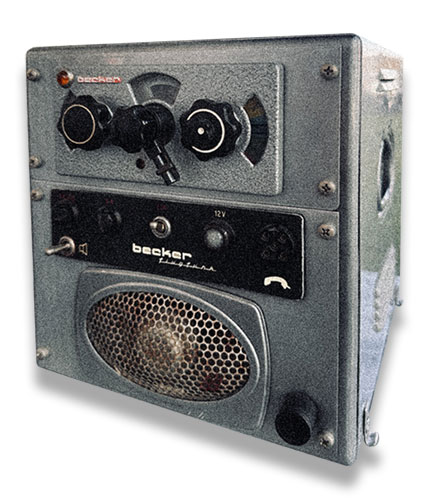
AR24 VHF Radio (1957)
1955 was the beginning of a cautious but determined resurgence of German aviation.
Becker Flugfunk was one of the early participants in that revival.
The company’s first products were VHF radios—simple by today’s standards, even by the standards of the time. The AR24 was introduced in the late 1950s and leaned heavily on pre-war technology. There were no leaps of innovation yet, just careful execution.
But in aviation, execution is everything.
One of Becker’s first meaningful opportunities came through Dornier. The Do 27, Germany’s first mass-produced post-war aircraft, needed dependable communication equipment. Becker Flugfunk supplied it.
Growing with the Airplane
As general aviation expanded through the 1960s, so did expectations for avionics. Systems needed to be smaller, lighter, and more reliable, not just functional.
Becker evolved alongside those demands.
The transition from vacuum tubes to transistors marked a turning point. Becker Flugfunk’s AR12 VHF Radio reduced power consumption and improved durability. The AR10 brought avionics into more standardized instrument formats, aligning with cockpit integration trends.
Then, in the early 1970s, Becker introduced the AR3201 VHF radio. Compact, efficient, and modern for its time, it represented more than a product upgrade. It reflected a shift in mindset: avionics were no longer standalone devices; they were part of a broader system.
In the late 1970s, the introduction of the 2000 series systems, including VHF radios, VOR/ILS navigation systems, ADF, and audio panels, brought small, rugged, and dependable units. These qualities translated directly into operational value. It wasn’t long before OEMs, including MBB (a predecessor to Airbus Helicopters), began selecting Becker equipment for factory installation.
For helicopter operators, in particular, the appeal was immediate. Weight mattered. Space mattered. Vibration resistance mattered even more.
A Pilot’s Perspective at the Top
While the company was finding its technical footing, a second generation was preparing to lead it.
Roland Becker’s path into aviation didn’t begin in a boardroom—it began in the cockpit. By the time he was 17, he became the youngest certified pilot in Switzerland, where he was attending school. By his early twenties, he had earned a commercial pilot license and multi-engine qualifications.
He understood aircraft not as products, but as a pilot.
When he joined the company in the 1970s and later became sole owner in 1993, that perspective began to shape Becker Avionics in subtle but lasting ways.
Roland Becker’s vision for the company was to never push to build the most complex system. Instead, the emphasis remained on what pilots and operators needed to complete their mission. This was facilitated by a concerted effort to listen carefully to the pilots and crewmen who carried out the mission. Not the OEMs' management or engineers, well-intended as they might be.
That mindset continues to define the company’s products today.
Looking Beyond Borders Early
One of Becker’s more strategic decisions came from recognizing a limitation: Germany alone was not a large enough market to sustain long-term growth.
So, the company looked outward—earlier than many of its peers.
Manufacturing operations were established in Taiwan around 1970, leveraging that electronics industry's efficiency. By the mid-1970s, Becker Avionics had entered the United States, gaining access to the world’s largest general aviation market. France followed, then Brazil, and later Poland. Today, Becker Avionics is active in the worldwide aviation market.
This wasn’t expansion for its own sake. It was deliberate positioning:
By the time globalization became a defining trend in aerospace, Becker was already operating within it.
Adapting Without Losing Focus
The arrival of GPS in the 1980s changed aviation permanently. Navigation systems became more precise, more capable, and more complex.
Then came the digital revolution around the turn of the century, bringing software-driven avionics, integrated systems, and new expectations for connectivity.
For many companies, these shifts required reinvention.
Becker Avionics adapted—but without abandoning its core identity.
Rather than competing directly with large-scale integrated flight deck providers, the company refined its niche:
-
Compact systems
-
Integrated communication solutions
-
Equipment that fits into constrained platforms
-
It wasn’t about doing everything. It was about doing the right things well.
Where Becker Avionics Fits Today
In today’s avionics landscape, Becker Avionics occupies a space that is easy to overlook but difficult to replace.
Its systems are widely used in:
-
Helicopters
-
General aviation aircraft
-
Special mission platforms (SAR, EMS, firefighting, law enforcement, ISR, even space flight)
These are environments where:
Recent products, such as the DVCS6100+ Compact digital communication system, the first digital intercom system to be awarded an ETSO and an FAA TSO. reflects how the company continues to evolve to meet modern cockpit requirements while staying true to its strengths.
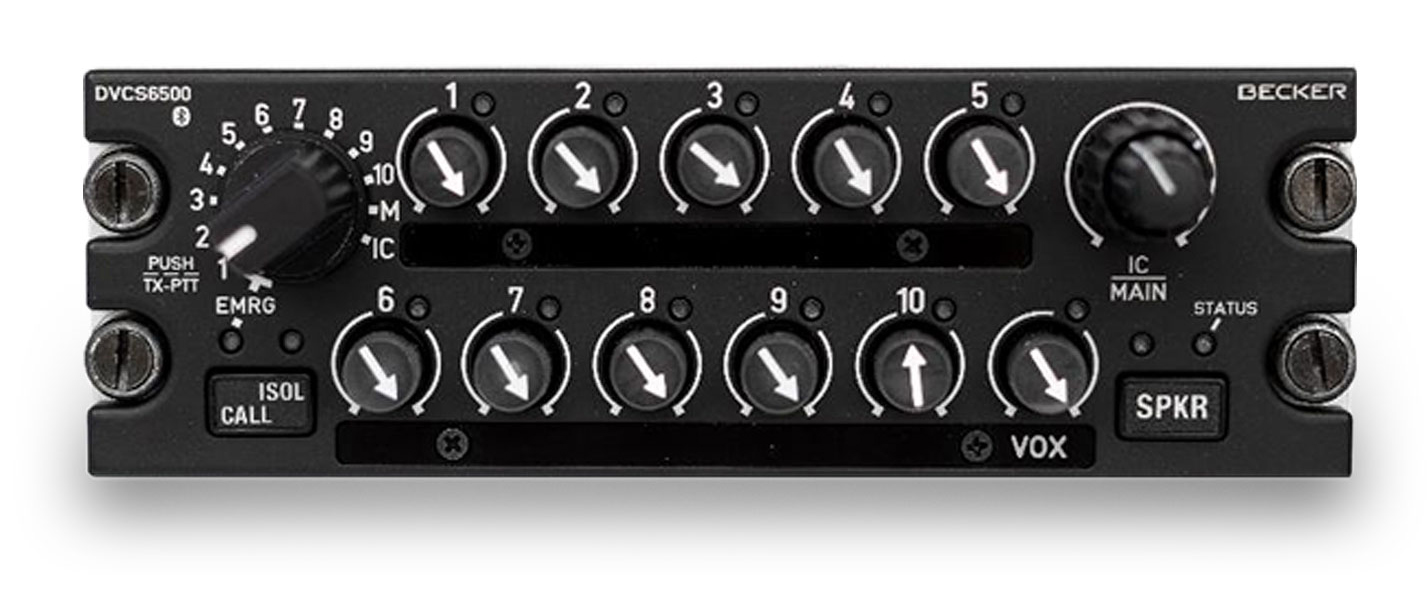
DVCS6100+ Compact
The DVCS6100 has a 10,000-plus-hour mean time between failures (MTBF) employed in the United States Army’s LUH helicopter. Becker’s follow-on Digital Intercom, the AMU 6500, incorporates all the clarity, mission-centric capabilities, and robustness of the DVCS, while adding state-of-the-art 3D audio and Bluetooth.
The Value of Quiet Consistency
Aviation tends to celebrate big advances, new aircraft, new propulsion systems, and new flight technologies.
But much of aviation’s safety and efficiency depends on something less visible: equipment that works exactly as expected, every time.
That’s where Becker Avionics has built its legacy.
From early VHF radios to modern digital systems, the company has followed a consistent path:
Design Philosophy: Why Becker Avionics Still Matters
In a market increasingly dominated by large integrated avionics suites, Becker’s continued relevance comes down to a few consistent principles:
-
Compactness : critical for helicopters and legacy airframes with limited panel space.
-
Reliability : systems designed for high uptime in demanding environments.
-
Simplicity : reduced training burden for pilots and maintainers.
-
Modularity : ease of retrofit and compatibility with mixed avionics architectures.
These attributes are particularly valuable for operators managing:
It’s not a strategy that generates headlines.
But it is one that earns trust.
Looking Ahead
As aviation continues to evolve—toward more automation, more integration, and more digital complexity, the need for dependable subsystems isn’t going away.
If anything, it’s increasing.
Aircraft are becoming more capable, but also more dependent on the integrity of their components. Communication systems remain mission-critical across every segment of aviation.
Becker Avionics is unlikely to redefine the cockpit.
But it will continue to support it—quietly, reliably, and with the same philosophy that began in Baden-Baden, Germany, nearly 70 years ago.
In aviation, that kind of consistency is more than a legacy. It’s an asset.
READ MORE ROTOR PRO: https://justhelicopters.com/Magazine
WATCH ROTOR PRO YOUTUBE CHANNEL: https://buff.ly/3Md0T3y
You can also find us on
Instagram - https://www.instagram.com/rotorpro1
Facebook - https://www.facebook.com/rotorpro1
Twitter - https://twitter.com/justhelicopters
LinkedIn - https://www.linkedin.com/company/rotorpro1